Question
  1. Given below are the steps for extraction of copper from its ore. Write the reaction involved.
    1. Roasting of copper (1) sulphide.
    2. Reduction of copper (1) oxide with copper (1) sulphide.
    3. Electrolytic refining.
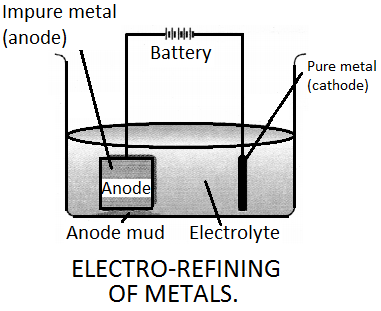
  2. Draw a neat and well labelled diagram for electrolytic refining of copper.
Answer

  1. Given below are the steps.
  1. Roasting:

$2\text{Cu}_2\text{S(s) + 3O}_2\text{(g)}\xrightarrow{\text{heat}}2\text{Cu}_2\text{O(s) + 2SO}_2\text{(g)}$

  1. Reduction:

$2\text{Cu}_2\text{O(s) + Cu}_2\text{S(s)}\xrightarrow{\text{heat}}6\text{Cu}\text{(s) + SO}_2\text{(g)}$

This reaction in which one of the reactants (Cu2S) carries the reduction of the product (Cu2O) is known as auto-reduction.

  1. Reactions taking place in electrorefensing are:

At cathode (reduction): Cu2+(aq) + 2e- → Cu(s)

At anode (oxidation): Cu(s) → Cu2+(aq) + 2e-

  1. For the diagram of electro-refining,

Need a full question paper?

Generate a complete, print-ready paper with questions like this in minutes — across 16+ boards, with answer keys.

Start Generating Free

Similar questions

Balance the following chemical equations.
  1. HNO3 +Ca(OH)2 → Ca(NO3)2 + H2O
  2. NaOH + H2SO4 → Na2SO4 + H2O
  3. NaCl + AgNO3 → AgCl + NaNO3
  4. BaCl2 + H2SO4 → BaSO4 + HCl
A strip of metal X is dipped in a blue coloured salt solution YSO4. After some time, a layer of metal Y from the salt solution is formed on the surface of metal strip X. Metal X is used in galvanisation whereas metal Y is used in making electric wires. Metal X and metal Y together form an alloy Z.
  1. What could metal X be?
  2. What could metal Y be?
  3. Name the metal salt YSO4.
  4. What type of chemical reaction takes place when metal X reacts with salt solution YSO4? Write the equation of the chemical reaction involved.
  5. Name the alloy Z.
  1. Define the term ‘isomers’.
  2. Draw two possible isomers of the compound with molecular formula $\text{C}_3\text{H}_6\text{O}$ and write their names.
  3. Give the electron dot structure of the above two compounds.
State and explain the various methods for preventing or retarding rancidity of food.
Two organic compounds A and B have the same molecular formula C6H12. Write the names and structural formulae:
  1. If A is a cyclic compound.
  2. If B is an open chain compound.
  3. Which compound contains single bonds as well as a double bond?
  4. Which compound contains only single bonds?
State five uses of metals and five of non-metals.
What are hydrocarbons? Write the name and general formula of,

  1. Saturated hydrocarbons.
  2. Unsaturated hydrocarbons.

Draw the structure of one hydrocarbon of each type. How can an unsaturated hydrocarbon be made saturated?

A part of the early classification of elements has been given below:
$\text{H}\ \ \ \ \ \ \ \text{Li} \ \ \ \ \ \ \ \text{Be} \ \ \ \ \ \ \ \ \ \text{B}\ \ \ \ \ \ \ \text{C}\ \ \ \ \ \ \ \text{N}\ \ \ \ \ \ \ \text{O}\\\text{F}\ \ \ \ \ \ \ \text{Na}\ \ \ \ \ \ \text{Mg}\ \ \ \ \ \ \ \text{Al}\ \ \ \ \ \ \text{Si}\ \ \ \ \ \ \ \text{P}\ \ \ \ \ \ \ \ \text{S}$
  1. Which law of classification of element is illustrated by the above arrangement of elements?
  2. Name the scientist who proposed such a classification of elements.
  3. Why is such a classification of elements compared with a characteristics of musical scale?
  4. State one limitation of this classification of elements.
What are micelles? Why does it form when soap is added to water? Will a micelle be formed in other solvents such as ethanol also? State briefly how the formation of micelles help to clean the clothes having oily spots.