Sample QuestionsMetals and Non-Metals questions
One sample from each question group in this chapter. Select any group above to see the full set with answer keys.
Assertion: Rusting of Iron is endothermic in nature.
Reason: As the reaction is slow, the release of heat is barely evident.
- A
Both A and R are true, and R is the correct explanation of A.
- B
Both A and R are true, and R is not the correct explanation of A
- C
A is true but R is false.
- ✓
A is false but R is true.
Answer: D.
View full solution →On adding dilute sulphuric acid to a test tube containing a metal ' $X$ ', a colourless gas is produced when a burning match stick is brought near it. Which of the following correctly represents metal ' $X$ '?
Answer: A.
View full solution →Solutions of copper sulphate, iron sulphate and zinc sulphate are prepared and marked $\ce{I, II}$ and $\ce{III}$ respectively. Few pieces of aluminium are added to each solutions. After some time a change will be observed in
- A
$\ce{I}$ and $\ce{II}$
- B
$\ce{II}$ and $\ce{III}$
- C
$\ce{III}$ and $\ce{I}$
- ✓
Answer: D.
View full solution →The aqueous solutions of copper sulphate and zinc sulphate appear:
- A
Blue and green respectively.
- B
Green and colourless respectively.
- C
Blue and brown respectively.
- ✓
Blue and colourless respectively.
Answer: D.
View full solution →Acetic acid reacts with solid sodium hydrogen carbonate :
- A
- ✓
Vigorously with effervescence.
- C
Slowly without effervescence.
- D
Vigorously without gas formation.
Answer: B.
View full solution →Food cans are coated with tin and not with zinc because.
- A
Zinc is costlier than tin.
- B
Zinc has a higher melting point than tin.
- C
Zinc is more reactive than tin.
- D
Zinc is less reactive than tin.
View full solution →An element reacts with oxygen to give a compound with a high melting point. This compound is also soluble in water. The element is likely to be
Which of the following methods is suitable for preventing an iron frying pan from rusting?
- A
- B
- C
Applying a coating of zinc
- D
View full solution →Which of the following pairs will give displacement reactions?
- A
NaCl solution and copper metal.
- B
MgCl2 solution and aluminium metal.
- C
FeSO4 solution and silver metal.
- D
AgNO3 solution and copper metal.
View full solution →On adding dilute sulphuric acid to a test tube containing a metal ' $X$ ', a colourless gas is produced when a burning match stick is brought near it. Which of the following correctly represents metal ' $X$ '?
Answer: A.
View full solution →In the following questions, a statement of Assertion is given by the corresponding statement of Reason. Of the statements, mark the correct answer as.
Assertion : Hydrogen is not a metal but it has been assigned a place in the reactivity series of metals.
Reason : Hydrogen has a tendency to lose electron and forms a positive ion $H^+$.
- ✓
If both Assertion and Reason are true and Reason is the correct explanation of Assertion.
- B
If both Assertion and Reason are true, but Reason is not the correct explanation of Assertion.
- C
If Assertion is true, but Reason is false.
- D
If Assertion is false, but Reason is true.
Answer: A.
View full solution →For two statements are given $-$ one labelled Assertion $(A)$ and the other labelled Reason $(R)$. Select the correct answer to these questions from the codes $\ce{(a), (b), (c)}$ and $(d)$ as given below :
Assertion : On reacting with water, calcium starts floating over water.
Reason : Calcium reacts with cold water at room temperature.
- A
Both $A$ and $R$ are true, and $R$ is correct explanation of the assertion.
- ✓
Both $A$ and $R$ are true, but $R$ is not the correct explanation of the assertion.
- C
$A$ is true, but $R$ is false.
- D
$A$ is false, but $R$ is true.
Answer: B.
View full solution →For two statements are given $-$ one labelled Assertion $(A)$ and the other labelled Reason $(R).$ Select the correct answer to these questions from the codes $\ce{(a), (b), (c)}$ and $(d)$ as given below :
Assertion : The oxides of sulfur and phosphorus are acidic in nature.
Reason : Metal oxides are basic in nature.
- A
Both $A$ and $R$ are true, and $R$ is correct explanation of the assertion.
- ✓
Both $A$ and $R$ are true, but $R$ is not the correct explanation of the assertion.
- C
$A$ is true, but $R$ is false.
- D
$A$ is false, but $R$ is true.
Answer: B.
View full solution →For two statements are given $-$ one labelled Assertion $(A)$ and the other labelled Reason $(R).$ Select the correct answer to these questions from the codes $\ce{(a), (b), (c)}$ and $(d)$ as given below :
Assertion : Electrovalency of Na is $+\ 1.$
Reason : The number of electrons which an atom either loses or gains in the formation of an ionic bond is known as its valency.
- ✓
Both $A$ and $R$ are true, and $R$ is correct explanation of the assertion.
- B
Both $A$ and $R$ are true, but $R$ is not the correct explanation of the assertion.
- C
$A$ is true, but $R$ is false.
- D
$A$ is false, but $R$ is true.
Answer: A.
View full solution →For two statements are given $-$ one labelled Assertion $(A)$ and the other labelled Reason $(R).$ Select the correct answer to these questions from the codes $\ce{(a), (b), (c)}$ and $(d)$ as given below :
Assertion : Silver and gold do not react with oxygen even at high temperatures.
Reason : Silver and gold are less active metals.
- ✓
Both $A$ and $R$ are true, and $R$ is correct explanation of the assertion.
- B
Both $A$ and $R$ are true, but $R$ is not the correct explanation of the assertion.
- C
$A$ is true, but $R$ is false.
- D
$A$ is false, but $R$ is true.
Answer: A.
View full solution →In the following questions, a statement of Assertion is given by the corresponding statement of Reason. Of the statements, mark the correct answer as.
- If both Assertion and Reason are true and Reason is the correct explanation of Assertion.
- If both Assertion and Reason are true, but Reason is not the correct explanation of Assertion.
- If Assertion is true, but Reason is false.
- If Assertion is false, but Reason is true.
- Both Assertion and Reason are false.
Assertion: When lead vessel is kept in a solution of ZnSO
4, lead will remain unaffected.
Reason: Lead is more electropositive than zinc.
In the following questions, a statement of Assertion is given by the corresponding statement of Reason. Of the statements, mark the correct answer as.
- If both Assertion and Reason are true and Reason is the correct explanation of Assertion.
- If both Assertion and Reason are true, but Reason is not the correct explanation of Assertion.
- If Assertion is true, but Reason is false.
- If Assertion is false, but Reason is true.
- Both Assertion and Reason are false.
Assertion: Hydrogen is not a metal but it has been assigned a place in the reactivity series of metals.
Reason: Hydrogen has a tendency to lose electron and forms a positive ion H
+.
For two statements are given-one labelled Assertion (A) and the other labelled Reason (R). Select the correct answer to these questions from the codes (a), (b), (c) and (d) as given below:
- Both A and R are true, and R is correct explanation of the assertion.
- Both A and R are true, but R is not the correct explanation of the assertion.
- A is true, but R is false.
- A is false, but R is true.
Assertion: The reaction of calcium with water is less violent in comparison to that of sodium.
Reason: The heat evolved is not sufficient for the hydrogen to catch fire.
For two statements are given-one labelled Assertion (A) and the other labelled Reason (R). Select the correct answer to these questions from the codes (a), (b), (c) and (d) as given below:
- Both A and R are true, and R is correct explanation of the assertion.
- Both A and R are true, but R is not the correct explanation of the assertion.
- A is true, but R is false.
- A is false, but R is true.
Assertion: The property of beating a metal into sheets is called ductility.
Reason: Gold and silver are most malleable metals.
For two statements are given-one labelled Assertion (A) and the other labelled Reason (R). Select the correct answer to these questions from the codes (a), (b), (c) and (d) as given below:
- Both A and R are true, and R is correct explanation of the assertion.
- Both A and R are true, but R is not the correct explanation of the assertion.
- A is true, but R is false.
- A is false, but R is true.
Assertion: The oxides of sulfur and phosphorus are acidic in nature.
Reason: Metal oxides are basic in nature.
The non-metal present in steel is _______.
Ordinary aluminium strips are not attacked by water because of the presence of a layer of _________ on the surface of aluminium.
The alloy in which one of the metals is mercury is called an _______.
Magnesium liberates ________ gas on reacting with hot boiling water.
Two atoms of the same element combine to form a molecule. The bond between them is known as _________ bond.
Two chlorine atoms combine to form a molecule. The bond between them is known as ________.
Two atoms of the same element combine to form a molecule. The bond between them is known as _________ bond.
Tiffin boxes are electroplated with ________ but car bumpers are electroplated with ________ to protect them from rusting.
The white powder formed when magnesium ribbon burns in oxygen is of __________.
The rocky material found with ores is called _______.
All the non-metals which are above hydrogen in the activity series, displaces hydrogen from dilute acids. [True/ False]
Non-metals can exist in all three physical states, i.e. solid, liquid and gases. [True/ False]
State whether the following statement is true or false:
The aqueous solution of an ionic compound conducts electricity because there are plenty of free electrons in the solution.
The electric wires made up of copper and aluminium. [True/ False]
All ores contain minerals. [True/ False]
The electric wires made up of copper and aluminium. [True/ False]
State whether the following statement is true or false:
The aqueous solution of an ionic compound conducts electricity because there are plenty of free electrons in the solution.
State whether the following statement is true or false :
Non-metals react with dilute acids to produce a gas which burns with a ‘pop’ sound.
Non-metals can exist in all three physical states, i.e. solid, liquid and gases. [True/ False]
All the non-metals which are above hydrogen in the activity series, displaces hydrogen from dilute acids. [True/ False]
What happens when a small piece of sodium is dropped into ethanol?
What changes in the colour of iron nails and copper sulphate solution do you observe after keeping the iron nails dipped in copper sulphate solution for about 30 minutes?
From amongst the metals sodium, calcium, aluminium, copper and magnesium, name the metal:
- Which reacts with water only on boiling.
- Another which does not react even with steam.
Which property of copper and aluminium makes them suitable:
For making electric wires?
What iron compound is present in haematite ore? Also write its chemical formula.
Give reasons: Platinum, gold and silver are used to make jewellery.
What happens when a small piece of sodium is dropped into ethanol?
What changes in the colour of iron nails and copper sulphate solution do you observe after keeping the iron nails dipped in copper sulphate solution for about 30 minutes?
From amongst the metals sodium, calcium, aluminium, copper and magnesium, name the metal:
- Which reacts with water only on boiling.
- Another which does not react even with steam.
Write the uses of following non-metals:
- Nitrogen
- Carbon
Draw a labelled diagram in proper sequence to show budding in hydra.
A student is observing the temporary mount of a leaf peel under a microscope. Draw labelled diagram of the structure of stomata as seen under the microscope.
In three test tubes A, B, and C, three different liquids namely, distilled water, underground water and distilled water in which a pinch of calcium sulphate is dissolved, respectively are taken. Equal amount of soap solution is added to each test tube and the contents are shaken. In which test tube will the length of the foam (lather) be longest? Justify your answer.
Draw the electron-dot structure of a hydrogen chloride molecule:
- Which inert gas does the H atom in HCl resemble in electron arrangement?
- Which inert gas does the Cl atom in HCl resemble in electron arrangement?
The atomic number of an element X is 12.
- What must an atom of X do to attain the nearest inert gas electron configuration?
- Which inert gas is nearest to X?
In the electrolytic refining of a metal M, what would you take as the anode, the cathode and the electrolyte?
Name two metals which will displace hydrogen from dilute acids, and two metals which will not.
What are amphoteric oxides? Give two examples of amphoteric oxides.
Give reasons why copper is used to make hot water tanks and not steel (an alloy of iron).
A man went door to door posing as a goldsmith. He promised to bring back the glitter of old and dull gold ornaments. An unsuspecting lady gave a set of gold bangles to him which he dipped in a particular solution. The bangles sparkled like new but their weight was reduced drastically. The lady was upset but after a futile argument the man beat a hasty retreat. Can you play the detective to find out the nature of the solution he had used?
A reddish-brown metal ' $X$ ', when heated in air, gives a black compound ' $Y$ ', which when heated in presence of $H _2$ gas gives ' $X$ ' back. ' $X$ ' is refined by the process of electrolysis; this refined form of ' $X$ ' is used in electrical wiring.
Identify ' $X$ ' and ' $Y$ '. Draw a well-labeled diagram to represent the process of refining ' $X$ '.
View full solution →An element ' $M$ ' with electronic configuration (2,8,3) combines separately with $Cl , SO ^2$ anions. Write the chemical formulae of the compounds formed. Predict with the suitable reason the nature of the bond formed by element ' $M$ ' in general. How will the electrical conductivity of the compounds formed vary with respect to 'M'?
View full solution →The given reaction shows one of the processes to extract the metals like Iron and Manganese.
$
MnO _2( s )+ Al ( s ) \rightarrow Mn ( l )+ Al _2 O _3( s )+\text { Heat }
$
a) Give reason why the above reaction is known as a thermite reaction.
b) Identify the substance oxidised and reduced in the above reaction.
c) Give a reason why Aluminium is preferably used in thermite reactions.
View full solution →
- What are amphoteric oxides? Choose the amphoteric oxides from amongst the following oxides:
$\text{Na}_{2}\text{O, ZnO, Al}_{2}\text{O}_{3}, \text{CO}_{2}, \text{H}_{2}\text{O}$
- Why is it that non-metals do not displace hydrogen from dilute acids?
The atomic number of an element is 12.
- Write its electronic configuration and determine its valency.
- Is it more reactive or less reactive than Ca (atomic number 20)? Justify your answer giving reason.
- Is it a metal or a non-metal?
- Write the formula of its oxide.
Differentiate between metal and non-metal on the basis of their chemical properties.
You must have seen tarnished copper vessels being cleaned with lemon or tamarind juice. Explain why these sour substances are effective in cleaning the vessels.
The given reaction shows one of the processes to extract the metals like Iron and Manganese.
$
MnO _2( s )+ Al ( s ) \rightarrow Mn ( l )+ Al _2 O _3( s )+\text { Heat }
$
a) Give reason why the above reaction is known as a thermite reaction.
b) Identify the substance oxidised and reduced in the above reaction.
c) Give a reason why Aluminium is preferably used in thermite reactions.
View full solution →A reddish-brown metal ' $X$ ', when heated in air, gives a black compound ' $Y$ ', which when heated in presence of $H _2$ gas gives ' $X$ ' back. ' $X$ ' is refined by the process of electrolysis; this refined form of ' $X$ ' is used in electrical wiring.
Identify ' $X$ ' and ' $Y$ '. Draw a well-labeled diagram to represent the process of refining ' $X$ '.
View full solution →An element ' $M$ ' with electronic configuration (2,8,3) combines separately with $Cl , SO ^2$ anions. Write the chemical formulae of the compounds formed. Predict with the suitable reason the nature of the bond formed by element ' $M$ ' in general. How will the electrical conductivity of the compounds formed vary with respect to 'M'?
View full solution →What happens when an iron strip is put into separate beakers containing aqueous solutions of copper sulphate and zinc sulphate? Where is iron placed in the activity series with respect to copper and zinc? Describe the steps involved in the extraction of zinc from its sulphide and carbonate ores. Support your answer with balanced chemical equation for the chemical reactions involved in the process.
- Give an example of a metal which:
- Is a liquid at room temperature.
- Is kept immersed in kerosene for storing.
- Is both malleable and ductile.
- Is the best conductor of heat.
- Name the process of obtaining a pure metal from an impure metal through electrolysis. Suppose you have to refine copper using this process, then explain mentioning inwith the help of a labelled diagram the process of purification, brief the materials used as (i) anode, (ii) cathode and (iii) electrolyte.
- Explain how the following metals are obtained from their compounds by the reduction process:
- Metal M which is in the middle of the reactivity series.
- Metal N which is high up in the reactivity series.
Give one example of each type.
- Distinguish between ‘roasting’ and ‘calcination’. Which of these two is used for sulphide ores and why?
- Write a chemical equation to illustrate the use of aluminium for joining cracked railway lines.
- Name the anode, the cathode and the electrolyte used in the electrolytic refining of impure copper.
What is meant by refining of a metals? Name the most widely used method of refining impure metals produced by various reduction processes. Describe with the help of a labelled diagram how this method may be used for refining of copper.
Read the following and answer any three questions from (i) to (iv).Ionic compound is a chemical compound in which ions are held together by ionic bonds. An ionic bond is the type of chemical bond in which two oppositely charged ions are held through electrostatic forces. We know that, metal atoms have loosely bound valence electrons in their valence shell and non-metal atoms need electrons in their valence shell to attain noble gas configuration. The metal atom loses the valence electrons while non-metal atom accepts these electrons. By losing electrons, metal atoms change to cations and by accepting electrons, non-metals form anions. Ionic compounds are generally solid and exist in the form of crystal. They have high melting and boiling points.
- Write two element which can change to a cation?
- Write two element which can change to an anion?
- Which Ionic compounds are soluble and how?
OR - What are Ionic compounds? Give two examples.
The reactivity series is a list of metals arranged in the order of their decreasing activities. The metal at the top of the reactivity series is the most reactive and metal at the bottom is the least reactive. The more reactive metal displaces less reactive metal from its salt solution.| K | Potassium | More reactive |
| Na | Sodium | |
| Ca | Calcium |
| Mg | Magnesium |
| Al | Aluminium |
| Zn | Zinc | More reactive |
| Fe | Iron | |
| Pb | Lead |
| [H] | [Hydrogen] |
| Cu | Copper |
| Hg | Mercury |
| Ag | Silver |
| Au | Gold | Least reactive |
(i) Name the metals which react with steam but not with hot water.
(ii) What happen when calcium react with nitric acid and which method is used to extract metal present at the top of the reactivity series?
or
(ii) Which of the following metals exist in their native states in nature?
I. $Cu$
II. $Au$
III. $Zn$
IV. Ag View full solution →The earth's crust is the major source of metals-seawater contains some soluble salts such as sodium chloride, magnesium chloride, etc. The elements or compounds, which occur naturally in the earth's crust are known as minerals. At some places, minerals contain a very high percentage of a particular metal and the metal can be profitably extracted from it. These minerals are called ores.
(i) Name the chief ore of mercury and zinc.
(ii) Write equations for the extraction of copper from its sulphide ore.
or
(ii) Define the process used to convert carbonate ores into metal oxide.
The arrangement of metals in a vertical column in the decreasing order of their re-activities is called the reactivity series or activity series of metals. The most reactive metal is at the top position of the reactivity series. The least reactive metal is at the bottom of the reactivity series.
Hydrogen, though a non-metal, has been included in the activity series of metals only for comparison. Apart from it, the hydrogen atom also has tendency to lose its valence electron and form cation like the behaviour shown by metals. Thus,
\[H \longrightarrow H ^{+}+ e ^{-}\]
(i) An element ' $X$ ' after reacting with acids liberate hydrogen gas and can displace lead and tin from their salt solution. Write down the Name of $X$ metal.
(ii) Which metal can be displaced by copper from its salt solution?
or
(ii) Write down the name of most reactive metal and which metal does not liberate hydrogen gas after reacting with acid?
View full solution →Some reaction of metal with some compounds are given in the table:| Metal | Iron (II) Sulphate | Copper (II) Sulphate | Zinc Sulphate | Silver Nitrate |
| A | No reaction | Displacement | ……………… | ……………… |
| B | Displacement | ……………… | No reaction | ……………… |
| C | No reaction | No reaction | No reaction | Displacement |
| D | No reaction | No reaction | No reaction | No reaction |
(i) Name the most and least active metal.
(ii) Arrange the metals $A, B, C$ and $D$ in order of increasing reactivity.
or
(ii) Container of which metal can be used to store both zinc sulphate solution and silver nitrate solution? View full solution →Read the following and answer any three questions from (i) to (iv).Ionic compound is a chemical compound in which ions are held together by ionic bonds. An ionic bond is the type of chemical bond in which two oppositely charged ions are held through electrostatic forces. We know that, metal atoms have loosely bound valence electrons in their valence shell and non-metal atoms need electrons in their valence shell to attain noble gas configuration. The metal atom loses the valence electrons while non-metal atom accepts these electrons. By losing electrons, metal atoms change to cations and by accepting electrons, non-metals form anions. Ionic compounds are generally solid and exist in the form of crystal. They have high melting and boiling points.
- Write two element which can change to a cation?
- Write two element which can change to an anion?
- Which Ionic compounds are soluble and how?
OR
- What are Ionic compounds? Give two examples.
Corrosion is the phenomenon of deterioration of surface of metal in presence of air and moisture. It is a natural process and in the presence of a moist atmosphere, chemically active metals get corroded. This is oxidation reaction. Rusting is the process where iron corrodes due to exposure to the atmosphere. The main circumstance of corrosion occurs with iron because it is a structural material in construction, bridges, buildings, rail transport, ships, etc. Aluminium is also an important structural metal, but even aluminium undergoes oxidation reactions. However, aluminium doesn't corrode or oxidize as rapidly as its reactivity suggests. An alloy of aluminium or any other metal like magnesium can make aluminium stronger and harder.
Copper $( Cu )$ corrodes and forms a basic green carbonate and lead corrodes to form a white lead oxide or carbonate.
(i) What is rusting?
(ii) Which two metals do not corrode easily?
(iii) List two properties of alloys.
or
(iv) What is the effect of corrosion on electrical conductivity?
View full solution →When a metal is attacked by substances around it such as moisture, acids, etc., it is said to corrode, and this process is called corrosion. The black coating on silver, green coating on copper and reddish-brown powder on iron surface are some examples of corrosion.
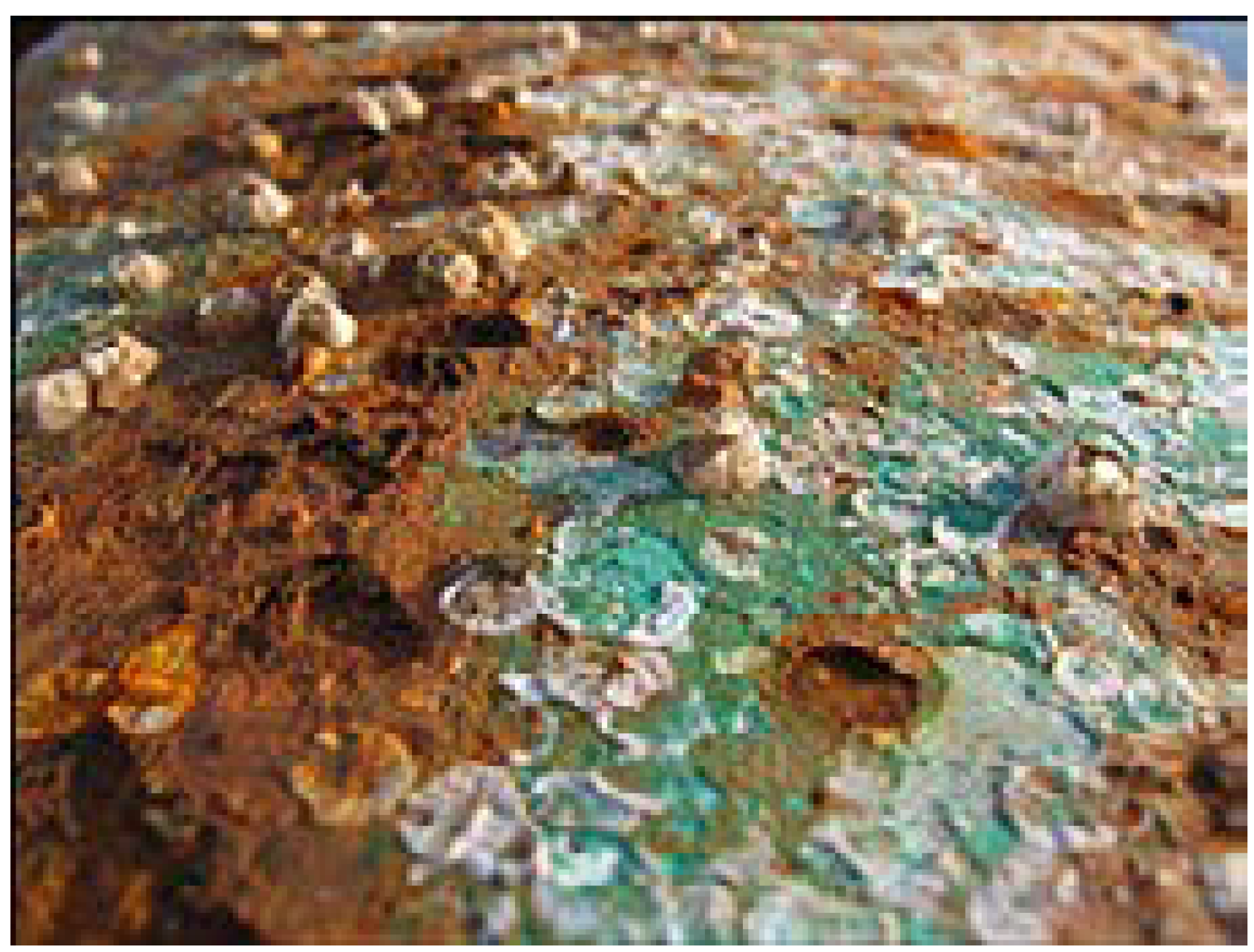
(i) What is the name given to the corrosion of iron?
(ii) What is the formula of green colour coating on copper?
(iii) Name two methods to prevent corrosion of iron.
or
(iv) Is corrosion a redox reaction?
Electronic configuration of some of the elements are given :| Type of element | Element | Atomic number | Number of electrons in shell |
| Metals | Sodium (Na)Magnesium (Mg)Aluminium (Al) | 111213 | 2828283 |
| Non-metals | Oxygen (O)Sulphur (S)Chlorine (Cl) | 81617 | 26286287 |
(i) State one physical property to distinguish between metals and non-metals.
(ii) What is the nature of the bond formed when magnesium reacts with chlorine? Write the formula of the compound.
or
(ii) What is common between oxygen and sulphur? Draw the electron dot structure of $O _2$ molecule.
View full solution →The arrangement of metals in a vertical column in the decreasing order of their re-activities is called the reactivity series or activity series of metals. The most reactive metal is at the top position of the reactivity series. The least reactive metal is at the bottom of the reactivity series.
Hydrogen, though a non-metal, has been included in the activity series of metals only for comparison. Apart from it, the hydrogen atom also has tendency to lose its valence electron and form cation like the behaviour shown by metals. Thus,
$H \longrightarrow H ^{+}+ e ^{-}$
(i) An element ' $X$ ' after reacting with acids liberate hydrogen gas and can displace lead and tin from their salt solution. Write down the Name of $X$ metal.
(ii) Which metal can be displaced by copper from its salt solution?
or
(ii) Write down the name of most reactive metal and which metal does not liberate hydrogen gas after reacting with acid?
View full solution →You are given a hammer, a battery, a bulb, wires and a switch.
- How could you use them to distinguish between samples of metals and non-metals?
- Assess the usefulness of these tests in distinguishing between metals and non-metals.
What happens when an iron strip is put into separate beakers containing aqueous solutions of copper sulphate and zinc sulphate? Where is iron placed in the activity series with respect to copper and zinc? Describe the steps involved in the extraction of zinc from its sulphide and carbonate ores. Support your answer with balanced chemical equation for the chemical reactions involved in the process.
- Give an example of a metal which:
- Is a liquid at room temperature.
- Is kept immersed in kerosene for storing.
- Is both malleable and ductile.
- Is the best conductor of heat.
- Name the process of obtaining a pure metal from an impure metal through electrolysis. Suppose you have to refine copper using this process, then explain mentioning inwith the help of a labelled diagram the process of purification, brief the materials used as (i) anode, (ii) cathode and (iii) electrolyte.
- Explain how the following metals are obtained from their compounds by the reduction process:
- Metal M which is in the middle of the reactivity series.
- Metal N which is high up in the reactivity series.
Give one example of each type.
- Distinguish between ‘roasting’ and ‘calcination’. Which of these two is used for sulphide ores and why?
- Write a chemical equation to illustrate the use of aluminium for joining cracked railway lines.
- Name the anode, the cathode and the electrolyte used in the electrolytic refining of impure copper.