MCQ
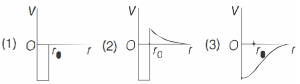
Given below are three schematic graphs of potential energy $V(r)$ versus distance $r$ for three atomic particles : electron $\left(e^{-}\right)$, proton $\left(p^{+}\right)$and neutron $(n)$, in the presence of a nucleus at the origin $O$. The radius of the nucleus is $r_0$. The scale on the $V$-axis may not be the same for all figures. The correct pairing of each graph with the corresponding atomic particle is
  • $(1, n),\left(2, p^{+}\right),\left(3, e^{-}\right)$
  • B
    $\left(1, p^{+}\right),\left(2, e^{-}\right),(3, n)$
  • C
    $\left(1, e^{-}\right),\left(2, p^{+}\right),(3, n)$
  • D
    $\left(1, p^{+}\right),(2, n),\left(3, e^{-}\right)$
Answer

Correct option: A.
$(1, n),\left(2, p^{+}\right),\left(3, e^{-}\right)$
a
(a)

For an electron and nucleus pair, Potential energy $=\frac{K(-e)(+Z e)}{r}$

$=\frac{-K Z e^2}{r}$

So, potential energy of electron is negative and it tends to zero as separation $r$ increases.

Hence, correct variation of potential energy with $r$ is as shown in graph $(3)$. For a neutron, force outside nucleus is zero.

Hence, potential energy of neutron is zero as $r > r_0$.

So, correct variation of potential energy with $r$ for a neutron is as shown in graph $(1)$.

For a proton, as $r > r_0$, force is repulsive. Hence, potential energy is positive.

So, correct variation of potential energy with $r$ is as shown in graph $(2)$.

Need a full question paper?

Generate a complete, print-ready paper with questions like this in minutes — across 16+ boards, with answer keys.

Start Generating Free

Similar questions

Which one of the following statements is true
An object is placed at a distance of $12\,cm$ in front of a plane mirror. The virtual and erect image is formed by the mirror. Now the mirror is moved by $4\,cm$ towards the stationary object. The distance by which the position of image would be shifted, will be:
A current of $1\, mA$ is flowing through a copper wire. How many electrons will pass a given point in one second
Correct Bernoulli's equation is (symbols have their usual meaning) :
The work functions for sodium and copper are $2eV$ and $4eV$. Which of them is suitable for a photocell with $4000 Å$ light
Parallel rays of light of intensity $I =912 \ Wm ^{-2}$ are incident on a spherical balck body kept in surroundings of temperature $300 \ K$. Take Stefan-Boltzmann constant $\sigma=5.7 \times 10^{-8} Wm ^{-2} K ^{-4}$ and assume that the energy exchange with the surroundings is only through radiation. Th final steady state temperature of the black body is close to:
In the figure shown, $A$ & $B$ are free to move. All the surfaces are smooth. then $(0 < \theta < 90^o)$
Which of the following graph represents the variation of resistivity ( $\rho$ ) with temperature $(T)$ for copper $?$
Gauss’s law is true only if force due to a charge varies as
A single slit of width $0.1\, mm$ is illuminated by a parallel beam of light of wavelength $6000\,\mathop A\limits^o $ and diffraction bands are observed on a screen $0.5\, m$ from the slit. The distance of the third dark band from the central bright band is........$mm$