MCQ
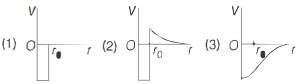
Given below are three schematic graphs of potential energy $V(r)$ versus distance $r$ for three atomic particles : electron $\left(e^{-}\right)$, proton $\left(p^{+}\right)$and neutron $(n)$, in the presence of a nucleus at the origin $O$. The radius of the nucleus is $r_0$. The scale on the $V$-axis may not be the same for all figures. The correct pairing of each graph with the corresponding atomic particle is
  • $(1, n),\left(2, p^{+}\right),\left(3, e^{-}\right)$
  • B
    $\left(1, p^{+}\right),\left(2, e^{-}\right),(3, n)$
  • C
    $\left(1, e^{-}\right),\left(2, p^{+}\right),(3, n)$
  • D
    $\left(1, p^{+}\right),(2, n),\left(3, e^{-}\right)$
Answer

Correct option: A.
$(1, n),\left(2, p^{+}\right),\left(3, e^{-}\right)$
a
(a)

For an electron and nucleus pair, Potential energy $=\frac{K(-e)(+Z e)}{r}$

$=\frac{-K Z e^2}{r}$

So, potential energy of electron is negative and it tends to zero as separation $r$ increases.

Hence, correct variation of potential energy with $r$ is as shown in graph $(3)$. For a neutron, force outside nucleus is zero.

Hence, potential energy of neutron is zero as $r > r_0$.

So, correct variation of potential energy with $r$ for a neutron is as shown in graph $(1)$.

For a proton, as $r > r_0$, force is repulsive. Hence, potential energy is positive.

So, correct variation of potential energy with $r$ is as shown in graph $(2)$.

Need a full question paper?

Generate a complete, print-ready paper with questions like this in minutes — across 16+ boards, with answer keys.

Start Generating Free

Similar questions

The electric field inside a conductor.
Work function of lithium and copper are respectively $2.3\ eV$ and $4.0\ eV$. Which one of the metal will be useful for the photoelectric cell working with visible light ? $(h = 6.6 × 10^{-34} J-s, c = 3 ×10^8 m/s)$
At a place, the horizontal and vertical intensities of earth's magnetic field is $0.30$ Gauss and $0.173$  Gauss respectively. The angle of dip at this place is.....$^o$
 A convex lens $'A'$ of focal length $20\, \mathrm{~cm}$ and a concave lens $'B'$ of focal length $5\, \mathrm{~cm}$ are kept along the same axis with a distance $'\mathrm{d}'$ between them. If a parallel beam of light falling on $'A'$ leaves $'B'$ as a parallel beam, then the distance $'d'$ in $cm$ will be :
Assertion : The stars twinkle while the planets do not.

Reason : The stars are much bigger in size than the planets.

In the Millikan's experiment, the distance between two horizontal plates is 2.5 cm and the potential difference applied is 250 V. The electric field between the plates will be
The binding energy of nucleons in a nucleus can be affected by the pairwise Coulomb repulsion. Assume that all nucleons are uniformly distributed inside the nucleus. Let the binding energy of a proton be $E_b^p$ and the binding energy of a neutron be $E_b^n$ in the nucleus.

Which of the following statement($s$) is(are) correct?

$(A)$ $E_b^p-E_b^n$ is proportional to $Z(Z-1)$ where $Z$ is the atomic number of the nucleus.

$(B)$ $E_b^p-E_b^n$ is proportional to $A^{-\frac{1}{3}}$ where $A$ is the mass number of the nucleus.

$(C)$ $E_b^p-E_b^n$ is positive.

$(D)$ $E_b^p$ increases if the nucleus undergoes a beta decay emitting a positron.

A singly ionized magnesium atom $(A=24)$ ion is accelerated to kinetic energy $5\,keV$ and is projected perpendicularly into a magnetic field $B$ of the magnitude $0.5\,T$. The radius of path formed will be___________ $cm$
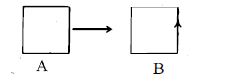
There are two square loops $A$ and $B$ . When $A$ moves towards $B$ , a current starts flowing in $B$ as shown in figure and current in $B$ stops when $A$ stops moving. From that we can infer that (Assume loop $B$ is at rest)
Five lumen/watt is the luminous efficiency of a lamp and its luminous intensity is 35 candela. The power of the lamp is