MCQ
Given below are two statements : one is labelled as
Assertion A and the other is labelled as Reason R.
Assertion A: Number of photons increases with increase in frequency of light.
Reason R: Maximum kinetic energy of emitted electrons increases with the frequency of incident radiation.
In the light of the above statements, choose the most appropriate answer from the options given below :
  • A
    Both A and R are correct and R is NOT the correct explanation of A.
  • B
    A is correct but R is not correct.
  • C
    Both A and R are correct and R is the correct explanation of A.
  • D
    A is not correct but R is correct.

Answer

Intensity of light $I =\frac{ nh v}{A}$
Here n is no. of photons per unit time.
$n =\frac{ IA }{ hy }$ so on increasing frequency v, n decreases taking intensity constant. 
$k _{\max }= h \nu-\phi$ So on increasing , kinetic energy increases. 

Need a full question paper?

Generate a complete, print-ready paper with questions like this in minutes — across 16+ boards, with answer keys.

Start Generating Free

Similar questions

An $EM$ wave propagating in $x$-direction has a wavelength of $8\,mm$. The electric field vibrating $y$ direction has maximum magnitude of $60\,Vm ^{-1}$. Choose the correct equations for electric and magnetic fields if the $EM$ wave is propagating in vacuum
The radius of a soap bubble whose potential is $16\,V$ is doubled. The new potential of the bubble will be.....$V$
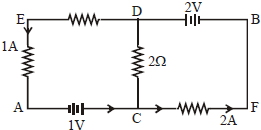
In the circuit, given in the figure currents in different branches and value of one resistor are shown. Then potential at point $B$ with respect to the point $A$ is$.......V$
A nucleus has a half-life of $30\; min$. At $3 \;PM$ its decay rate was measured as $120000 \,cps$. the decay rate ........... $\,cps$ at $5 \,PM$ ?
When a load of $10 \,kg$ is suspended on a metallic wire, its length increase by $2 \,mm$. The force constant of the wire is $........ N / m$
The position of a particle moving on $x$-axis is given by $x(t)=A \sin t+B \cos ^2 t+ Ct ^2+D$, where $t$ is time. The dimension of $\frac{A B C}{D}$ is-
A particle of charge per unit mass $\alpha$ is released from origin with a velocity $\bar{v}=v_0 \vec{i}$ in a uniform magnetic field $\bar{B}=-B_0 \hat{k}$. If the particle passes through $(0, y, 0)$ then $y$ is equal to
A metal wire of uniform mass density having length $L$ and mass $M$ is bent to form a semicircular arc and a particle of mass $m$ is placed at the centre of the arc. The gravitational force on the particle by the wire is:
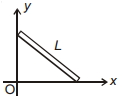
A rod of length $L$ leans against a smooth vertical wall while its other end is on a smooth floor. The end that leans against the wall moves uniformly vertically downward. Select the correct alternative
A small particle moves to position $5 \hat{i}-2 \hat{j}+\hat{k}$ from its initial position $2 \hat{i}+3 \hat{j}-4 \hat{k}$ under the action of force $5 \hat{i}+2 \hat{j}+7 \hat{k} N$. The value of work done will be $............J$.