MCQ
Given below are two statements. One is labelled as Assertion (A) and the other is labelled as Reason (R). Assertion (A) : The binding energy per nucleon is found to be practically independent of the atomic number A , for nuclei with mass numbers between 30 and 170. Reason (R): Nuclear force is long range. In the light of the above statements, choose the correct answer from the options given below :
  • A
    (A) is false but (R) is true
  • (A) is true but (R) is false
  • C
    Both (A) and (R) are true and (R) is the correct explanation of (A)
  • D
    Both (A) and (R) are true but (R) is NOT the correct explanation of (A)
Answer

Correct option: B.
(A) is true but (R) is false
B

Need a full question paper?

Generate a complete, print-ready paper with questions like this in minutes — across 16+ boards, with answer keys.

Start Generating Free

Similar questions

The weight of man in a lift moving with same acceleration upwards is $608\,N$ , while the weight of the same man in the life moving down wards with the same acceleration is $368\,N$ . His normal weight is ............ $N$
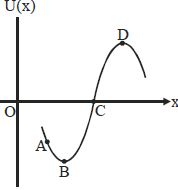
Potential energy of a particle varies with distance $x$ as shown in the graph Select the wrong statement
A circular ring carries a uniformly distributed positive charge. The electric field $(E) $ and potential $ (V) $ varies with distance $(r)$ from the centre of the ring along its axis as
A light emitting diode $(LED)$ is fabricated using GaAs semiconducting material whose band gap is $1.42 \mathrm{eV}$. The wavelength of light emitted from the $LED$ is:
A magnet of magnetic moment $50 \hat{ I } A - m ^2$ placed along $X$-axis, where magnetic field is $B=(0.5 \hat{i}+3.0 \hat{j}) T$. The torque acting on magnet is
A tuning fork and a sonometer wire were sounded together and produce $4$ beats per second. When the length of sonometer wire is $95 cm$ or $100 cm,$ the frequency of the tuning fork is ..... $Hz$
A beam of electromagnetic radiation of intensity $6.4 \times 10^{-5}\; \mathrm{W} / \mathrm{cm}^{2}$ is comprised of wavelength, $\lambda=310 \;\mathrm{nm} .$ It falls normally on a metal (work function $\varphi=2 \;\mathrm{eV}$ ) of surface area of $1\; \mathrm{cm}^{2} .$ If one in $10^{3}$ photons ejects an electron, total number of electrons ejected in $1 \;s$ is $10^{\mathrm{x}}$.then $\mathrm{x}$ is

$\left(\mathrm{hc}=1240\; \mathrm{eV} \mathrm{nm}, 1\; \mathrm{eV}=1.6 \times 10^{-19} \;\mathrm{J}\right)$

The equations of two waves acting in perpendicular directions are given as $x=a \cos (\omega t+\delta)$ and $y=a \cos (\omega t+\alpha)$, where $\delta=\alpha+\frac{\pi}{2}$, the resultant wave represents
A boy standing at the top of a tower of $20\, m$ height drops a stone . Assuming $g = 10 \,ms^{-2,}$ the velocity with which it hits the ground is.........$ms^{-1}$
Match List$-I$ with List$-II$

      List $-I$       List $-II$
$(A)$ Moment of inertia of solid sphere of radius $(R)$ about any tangent  $(I)$  $\frac{5}{3} MR ^{2}$
$(B)$ Moment of inertia of hollow sphere of radius $(R)$ about any tangent $(II)$ $\frac{7}{5} MR ^{2}$
$(C)$ Moment of inertia of circular ring of radius $(R)$ about its diameter. $(III)$ $\frac{1}{4} MR ^{2}$
$(D)$ Moment of inertia of circular disc of radius $(R)$ about any diameter. $(IV)$ $\frac{1}{2} MR ^{2}$

Question: Choose the correct answer from the options given below