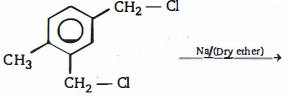
MCQ
Given below are two statements: one is labelled as Assertion A and the other is labelled as Reason R:
Assertion (A): A reaction cannot have zero activation energy.
Reason (R): The minimum extra amount of energy absorbed by reactant molecules so that their energy becomes equal to threshold value, is called activation energy.
In the light of the above statements, choose the correct answer from the options given below:
  • A
    A is false but R is true.
  • B
    Both A and R are true and R is the correct explanation of A.
  • Both A and R are true and R is NOT the correct explanation of A.
  • D
    A is true but R is false.

Answer

Correct option: C.
Both A and R are true and R is NOT the correct explanation of A.
(C)
A reaction can have zero activation energy, for example, $CH _3+ CH _3 \rightarrow CH _3- CH _3$ has zero activation energy.

Need a full question paper?

Generate a complete, print-ready paper with questions like this in minutes — across 16+ boards, with answer keys.

Start Generating Free

Similar questions

The enthalpy changes for the following processes are listed below :
$Cl_2(g) \to 2Cl(g), 242.3\, kJ\, mol^{-1}$
$I_2(g) \to 2I(g), 151.0\, kJ\, mol^{-1}$
$ICl(g) \to I(g) + Cl(g), 211.3 kJ\, mol^{-1}$
$I_2(s) \to  I_2(g), 62.76\, kJ\, mol^{-1}$
Given that the standard states for iodine and chlorine are $I_2(s)$ and $Cl_2(g)$, the standard enthalpy of formation for $ICl(g)$ is .............. $\mathrm{kJ\,mol}^{-1}$
Which of the following products can be obtained from above reaction ?
A $5\%$ solution of canesugar (mol. wt. $ =342$) is isotonic with $1\%$ solution of a substance $X$. The molecular weight of $X$ is
Match the thermodynamic processes given under Column $I$ with the expression given under Column $II$:
Column $I$ Column $II$
$(A)$ Freezing of water at $273 K$ and $1 \ atm$ $(P)$ $q =0$
$(B)$ Expansion of $1 \ mol$ of an ideal gas into a vacuum under isolated conditions $(Q)$ $w=0$
$(C)$ Mixing of equal volumes of two ideal gases at constant temperature and pressure in an isolated container $(R)$ $\Delta S _{\text {sy5 }} < 0$
$(D)$ Reversible heating of $H _2( g )$ at $1 \ atm$ from $300 \ K$ to $600 \ K$, followed by reversible cooling to $300 \ K$ at $1 \ atm$ $(S)$ $\Delta U =0$
  $(T)$ $\Delta G =0$
Transitional elements are named transition elements because their characters are
Which statements is/are incorrect
$Mg$ and $Li$ are similar in their properties due to
Carbon-Carbon bond length in benzene is.....$\mathop A\limits^o $
$4d, 5 \mathrm{p}, 5 \mathrm{f}$ and $6 \mathrm{p}$ orbitals are arranged in the order of decreasing energy. The correct option is
Products obtained in above Wurtz reaction is