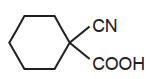
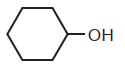
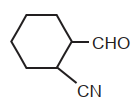
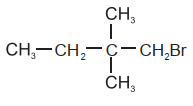
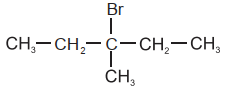
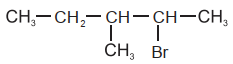
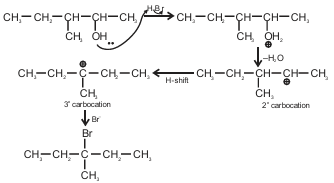
MCQ 14 Marks
Which of the following is not a characteristics of a covalent compound?
- A
- ✓
- C
Insoluble in polar solvent
- D
Small difference in electronegativity between the combining atoms.
Answer(B)
Covalent compounds have definite geometry.
View full question & answer→MCQ 24 Marks
Which of the following solution(s) have pH between 6 and 7?
1. $2 \times 10^{-6} MNaOH$
2. $2 \times 10^{-6} M HCl$
3. $10^{-8} M HCl$
4. $10^{-13} M NaOH$
Answer(B)
pH of $10^{-8} M HCl$ is not 8 but it is less than 7 because in this case contribution of $H ^{+}$from water is not neglected.
$\begin{array}{l}\text { Total } H^{+}=10^{-8}(\text { from acid })+10^{-7} \text { (from water) } \\
=10^{-8}(1+10) \\
=11 \times 10^{-8} M \\
pH=-\log \left[H^{+}\right]=-\log \left[11 \times 10^{-8}\right] \\
=-\left[\log 11+\log 10^{-8}\right] \\
=-[1.0414-8] \\
=6.9586=6.96\end{array}$
View full question & answer→MCQ 34 Marks
Given below are two statements:
Statements-I: The halogen molecule of maximum bond length is $I _2$.
Statements-II: The most reactive halogen is $I _2$.
In the light of the above statements, choose the most appropriate answer from the options given below:
- ✓
Statement l is correct but Statement II is incorrect
- B
Statement I is incorrect but Statement II is correct.
- C
Both Statement I and Statement II are correct.
- D
Both Statement I and Statement II are incorrect.
AnswerCorrect option: A. Statement l is correct but Statement II is incorrect
(A)
The halogen molecule of maximum bond length is $I _2$.
Bond length $\propto$ Atomic radius
Thus, bond length order of halogen is:
$F_2The most reactive halogen is $F_2$
View full question & answer→MCQ 44 Marks
In the reaction, $Cl _2+ CH _4 \xrightarrow{ hv } CH _3 Cl + HCl$ presence of a small amount of oxygen.
- A
increases the rate of reaction for a brief period of time.
- ✓
decreases the rate of reaction for a brief period of time.
- C
does not affect the rate of reaction
- D
completely stops the reaction
AnswerCorrect option: B. decreases the rate of reaction for a brief period of time.
(B)
Halogenation of alkanes follows free radicals mechanism and presence of a small amount of oxygen can slow down the reaction for a period of time depending upon the amount of oxygen. Oxygen reacts with methyl free radical to form less reactive free radicals and acts as an inhibitor.
View full question & answer→MCQ 54 Marks
The rate for formation of $NO$ in the following reaction is $3.6 \times 10^{-3} mol L ^{-1} s^{-1}$. Find the rate of disappearance of $O _2$.
$4 NH_3(g)+5 O_2(g) \rightarrow 4 NO(g)+6 H_2 O(g)$
- ✓
$4.5 \times 10^{-3} mol L ^{-1} s^{-1}$
- B
$3.6 \times 10^{-3} mol L ^{-1} s^{-1}$
- C
$1.8 \times 10^{-3} mol L ^{-1} s^{-1}$
- D
$7.2 \times 10^{-3} mol L ^{-1} s^{-1}$
AnswerCorrect option: A. $4.5 \times 10^{-3} mol L ^{-1} s^{-1}$
(A)
For the given reaction;
$4 NH_3(g)+5 O_2(g) \rightarrow 4 NO(g)+6 H_2 O(g)$
Differential rate law is:
Rate $=$
$\begin{array}{l}-\frac{d\left[NH_3\right]}{d t} \times \frac{1}{4}=-\frac{d\left[O_2\right]}{d t} \times \frac{1}{5}=+\frac{d[NO]}{d t} \times \frac{1}{4} \\
=+\frac{d\left[H_2 O\right]}{dt} \times \frac{1}{6}\end{array}$
Hence, rate in terms of $O _2$ and NO ;
$\text { Rate }=-\frac{d\left[O_2\right]}{dt} \times \frac{1}{5}=+\frac{d[NO]}{dt} \times \frac{1}{4}$
Therefore, rate of disappearance of $O _2$,
$\begin{array}{l}-\frac{d\left[O_2\right]}{dt}=+\frac{d[NO]}{dt} \times \frac{1}{4} \times \frac{5}{1} \\
=3.6 \times 10^{-3} \times \frac{5}{4} \\
=4.5 \times 10^{-3} mol L^{-1} s^{-1}\end{array}$
View full question & answer→MCQ 64 Marks
Consider the following reactions:
Phenol $\xrightarrow{\text { Zn dust }} X \xrightarrow[A_{\text {nhy }} NCl _3]{ CH _3 Cl } Y$
The product $Y$ is:
Answer(A)
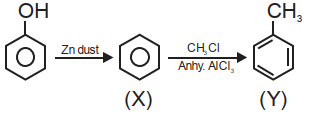
View full question & answer→MCQ 74 Marks
0.9 g urea when dissolved in 45 g water caused elevation of $0.17^{\circ} C$ in boiling point. The value of molal elevation constant of water is:
- A
$0.22 K kg mol ^{-1}$
- B
$0.93 K kg mol ^{-1}$
- ✓
$0.51 K kg mol ^{-1}$
- D
$0.73 K kg mol ^{-1}$
AnswerCorrect option: C. $0.51 K kg mol ^{-1}$
(C)
$\begin{aligned} \Delta T _{ b } & = K _{ b } \times \frac{ w _1 \times 1000}{ w _2 \times M _1} \\ K_{ b } & =\frac{\Delta T _{ b } \times w _2 \times M _1}{ w _1 \times 1000} \\ & =\frac{0.17 \times 45 \times 60}{0.9 \times 1000} \\ & =0.51 Kkg mole ^{-1}\end{aligned}$
View full question & answer→MCQ 84 Marks
Identify the products [P] obtained in the following sequence of reactions,

- ✓
$CH _2= CH _2$
- B
$CH _3- CH _3$
- C
$CH _3- CHO$
- D
$C _4 H _{10}$
AnswerCorrect option: A. $CH _2= CH _2$
(A)
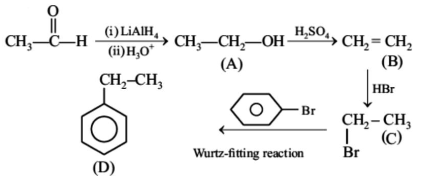
$LiAlH _4$ used for reduction of carbonyl group into alcohol and $H _2 SO _4$ used for dehydration of alcohol View full question & answer→Question 94 Marks
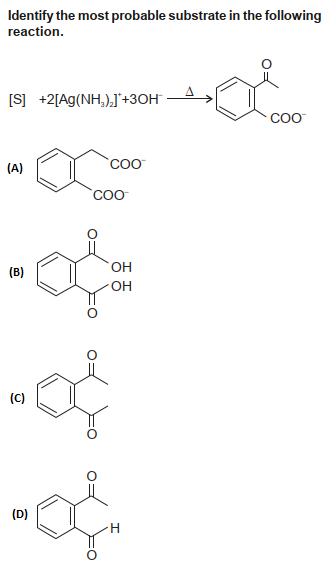
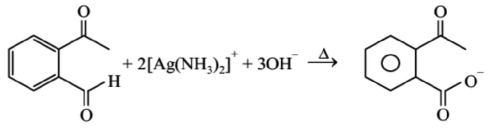
Answer(D)
Tollen's reagent oxidises aldehydes into carboxylate ion whereas ketone is not oxidised by tollen's reagent.
View full question & answer→Question 104 Marks
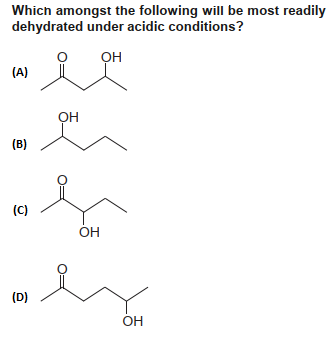
Answer(A)
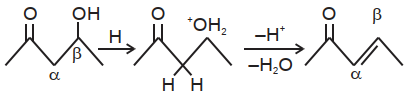
$\beta$-hydroxy ketone readily undergo dehydration to form $\alpha, \beta$ unsaturated ketones. View full question & answer→Question 114 Marks
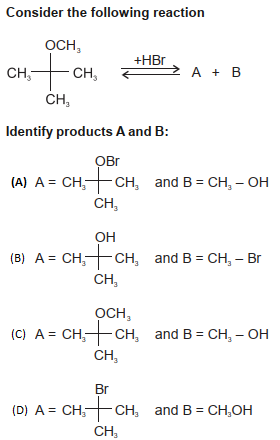
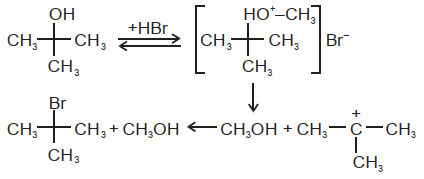
Answer(D)
Reaction follows $S _{ N } 1$ pathway:
View full question & answer→MCQ 124 Marks
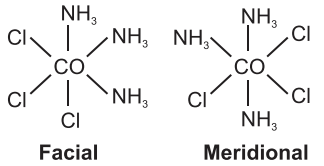
How many geometrical isomers are possible in given complex respectively:
$\left[CO\left(NH_3\right)_3 Cl_3\right] \&\left[Cr\left(C_2 O_4\right)_3\right]^{3-}$
Answer(A)
$\left[ Cr \left( C _2 O _4\right)_3\right]^{3-}$ has a bidendate ligand, So no geometrical isomers.
$\left[ CO \left( NH _3\right)_3 Cl _3\right]$ has facial \& Meridional isomers.
View full question & answer→MCQ 134 Marks
Which of the following statements are incorrect?
A. All the transition metals except scandium form MO oxides which are ionic.
B. The lowest oxidation number corresponding to the group number in transition metal oxides is attained in $Sc _2 O _3$ to $MnO _7$
C. Acidic character increases from $V _2 O _3$ to $V _2 O _4$ to $V _2 O _5$.
D. $V _2 O _5$ dissolves in acids to give $VO _4{ }^{3-}$ salts
E. $CrO$ is amphoteric but $Cr _2 O _3$ is basic:
Choose the correct answer from the options given below:
Answer(B)
The highest oxidation number corresponding to the group number in transition metal oxides is attained in $Sc _2 O _3$ to $Mn _2 O _7$.
$CrO$ is basic but $Cr _2 O _3$ is amphoteric.
View full question & answer→MCQ 144 Marks
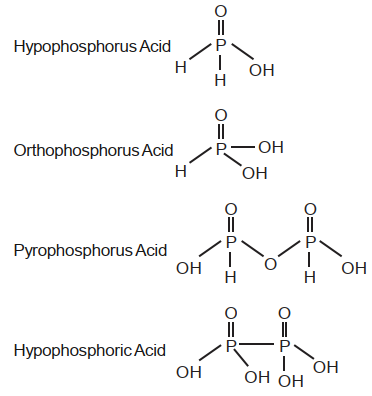
Match List-l with List-ll:
List-l
(Oxoacids of Phosphorus) | List-ll
(Bonds of Phosphorus) |
| (A) Hypophosphorus Acid | (I) Two P-OH
One P-H
One P = 0 |
| (B) Orthophosphorus Acid | (II) Four P-OH
Two P = 0
One P-P |
| (C) Pyrophosphorus Acid | (III) One P-OH
Two P-H
One P = 0 |
| (D) Hypophosphoric Acid | (IV) Two P-OH
Two P-H
Two P = 0 |
Choose the correct answer from the options given below:
Answer(B)
View full question & answer→MCQ 154 Marks
Consider the following compounds/species:
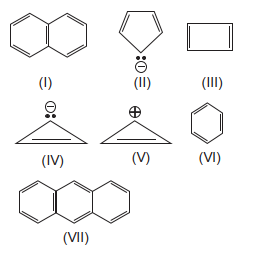
The number of compounds/species which obey Huckel's rule is ____________ :
Answer(A)
According to Huckel rule, A compound/molecule is said to be aromatic if it have cyclic conjugate and $[4 n+2] \pi$ electron system.
$\begin{array}{l}\Rightarrow \text { Molecule must be } sp^2 \text { hybridised } \\
\Rightarrow \text { Molecule must be planar. }\end{array}$
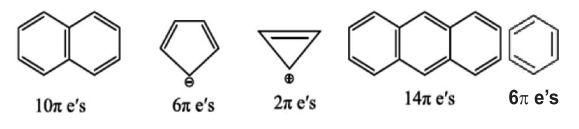
All these are aromatic species according to Huckel rule. View full question & answer→MCQ 164 Marks
On balancing the given redox reaction,
$aFe ^{2+}+ bCr _2 O _7^{2-}+ cH ^{+} \rightarrow dFe ^{3+}+ eCr ^{3+}+ fH _2 O$
the coefficients a,b,c,d,e & f are found to be, respectively:
Answer(B)
oxidation Half Reaction
$Fe ^{2+} \rightarrow Fe ^{3+}+ le ^{-}$$\quad$...(i)
Reduction Half Reaction
$Cr _2 O _7^{2-}+14 H ^{+} \rightarrow 2 Cr ^{3+}+7 H _2 O$$\quad$...(ii)
Oxygen is balanced by adding water and hydrogen is balanced by adding $H ^{+}$ and the charge is balanced by electrons.
Add [(i) x 3] + (ii) equations
$6 Fe ^{2+}+ Cr _2 O _7^{2-}+14 H ^{+} \rightarrow 6 Fe ^{3+}+2 Cr ^{3+}+7 H _2 O$
View full question & answer→MCQ 174 Marks
The equilibrium concentrations of the species in the reaction $A+B \rightleftharpoons C+D$ are $4,3,12$ and $6$ mol $L ^{-1}$ respectively at $300 K . \Delta G ^0$ for the reaction is approximately.
$(R=2 cal / mol K(\log 6 \approx 0.778))$
- A
- B
$-1002 cal$
- C
$-992 cal$
- ✓
$-1075 cal$
AnswerCorrect option: D. $-1075 cal$
(D)
$\begin{array}{l} K _{ eq }=\frac{[ C ][ D ]}{[ A ][ B ]} \\ K _{ eq }=(12 \times 6)(4 \times 3)=6 \\ \Delta G ^0=-2.303 RT \log K _{ eq }=-2.303(2)(300)(\log 6) \\ =-1075 cal \text { approx. } \quad(\because R =2 cal / mol k )\end{array}$
View full question & answer→MCQ 184 Marks
Which amongst the following options is the correct relation for change in Gibbs energy for the system at constant temperature?
- A
$\Delta$ Gsys $=\Delta H$ sys $+T \Delta$ Ssys
- B
$\Delta G s y s=\Delta$ Ssys $-T \Delta H$ sys
- ✓
$\Delta$ Gsys $=\Delta$ Hsys $-T \Delta$ Ssys
- D
$\Delta H$ sys $=T \Delta G s y s+\Delta$ Ssys
AnswerCorrect option: C. $\Delta$ Gsys $=\Delta$ Hsys $-T \Delta$ Ssys
(C)
$\Delta$ Gsys $=\Delta$ Hsys $-T \Delta$ Ssys
View full question & answer→MCQ 194 Marks
Given below are two statements:
Statement I: A unit formed by the attachment of a base to 3' position of sugar is known as nucleoside.
Statement II: When nucleoside is linked to phosphorous acid at 5'-position of sugar moiety, we get nucleotide.
In the light of the above statements, choose the correct answer from the options given below:
- A
Statement I is false but Statement II is true.
- B
Both statement I and Statement II is true.
- ✓
Both Statement I and Statement II are false
- D
Statement I is true but Statement II is false
AnswerCorrect option: C. Both Statement I and Statement II are false
(C)
A unit formed by the attachement of a base to 1' position of sugar is known as nucleoside.
When nucleoside is linked to phosphoric acid at 5'-position of sugar moiety, we get nuceotide.
View full question & answer→MCQ 204 Marks

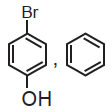
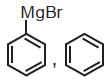
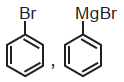
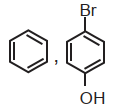
Identify [A] & [B] Respectively.
Answer(C)
Bromobenzene is formed in first step (Sandmeyer reaction), which further gives phenyl magnesium bromide.
Phenyl magnesium bromide further gives benzene with water:
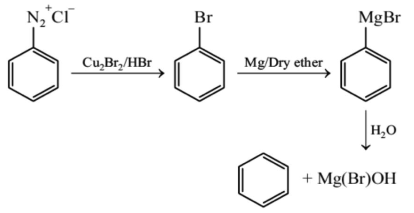
View full question & answer→MCQ 214 Marks
$CH_3 NC \xrightarrow[\text { (ii) } H_2 O^{-}]{\text {(i) } LiH_3} \text { Product. }$
Product is ____________
- ✓
$CH _3 NHCH _3$
- B
$CH _3 CH _2 NH _2$
- C
$CH _3 NH _2$
- D
AnswerCorrect option: A. $CH _3 NHCH _3$
(A)
$CH_3 NC \xrightarrow[\text { (i) } H_3 O_6]{\text { (i) } LiH_6} CH_3 NHCH_3$
Methyl isocyanide gives a secondary amine, $CH _3 NHCH _3$ upon reduction.
View full question & answer→MCQ 224 Marks
Complete the following reaction:

[A] is ____________
Answer(A)
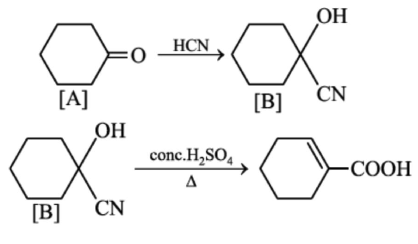
View full question & answer→MCQ 234 Marks
AnswerCorrect option: B. $Zn - Hg + HCl$
(B)
ketones are reduced into hydrocarbons using Zn-Hg/HCI (Clemmension reduction).
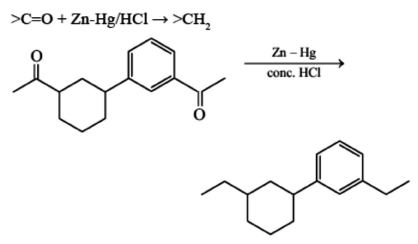
View full question & answer→MCQ 244 Marks
The given compound:
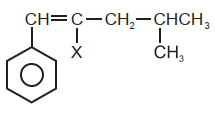
is an example of ____________ .
Answer(B)
Vinylic Halides contain a carbon atom with a double Bond to another carbon and a Halogen atom attached to it.
View full question & answer→MCQ 254 Marks
Consider the following reaction and identify the product

MCQ 264 Marks
Potassium trioxalatoalumniate (III) is a:
Answer(B)
Homoleptic complexes have all ligands identical. Potassium trioxalatoaluminate (III) is $K _3\left[ Al \left( C _2 O _4\right)_3\right]$ which has only oxalate ion as ligand
View full question & answer→MCQ 274 Marks
Which salt is more stable in aqueous solution, $Cu ^{2+}$ salt or $Cu ^{+}$salt?
AnswerCorrect option: B. $Cu ^{2+}$
(B)
The greater stability of $Cu ^{2+}( aq )$ rather than $Cu ^{+}$ (aq) is due to the much more negative $\Delta_{\text {hyd }} H$ of $Cu ^{2+}( aq )$ than $Cu ^{+}$, which more than compensates for the second ionisation enthalpy of Cu .
View full question & answer→MCQ 284 Marks
Amongst the given options, which of the following molecules/ion acts as a Lewis base?
- A
$H ^{+}$
- ✓
$NH _3$
- C
$H _3 O ^{+}$
- D
$BF _3$
AnswerCorrect option: B. $NH _3$
(B)
$NH _3$ can donate lone pair so it behaves as Lewis Base.
View full question & answer→MCQ 294 Marks
Given below are two statements: one is labelled as Assertion A and the other is labelled as Reason R:
Assertion (A): A reaction cannot have zero activation energy.
Reason (R): The minimum extra amount of energy absorbed by reactant molecules so that their energy becomes equal to threshold value, is called activation energy.
In the light of the above statements, choose the correct answer from the options given below:
- A
A is false but R is true.
- B
Both A and R are true and R is the correct explanation of A.
- ✓
Both A and R are true and R is NOT the correct explanation of A.
- D
A is true but R is false.
AnswerCorrect option: C. Both A and R are true and R is NOT the correct explanation of A.
(C)
A reaction can have zero activation energy, for example, $CH _3+ CH _3 \rightarrow CH _3- CH _3$ has zero activation energy.
View full question & answer→MCQ 304 Marks
For a certain reaction, the rate $=k[A]^2[B]$. When the initial concentration of A is doubled and initial concentration of B is tripled, the initial rate would:
- A
increase by a factor of three.
- B
decrease by a factor of nine.
- C
increase by a factor of six.
- ✓
increase by a factor of twelve.
AnswerCorrect option: D. increase by a factor of twelve.
(D)
Let the new rate be, R'.
$\begin{array}{l}
A^{\prime}=[2 A], B^{\prime}=[3 B] \\
R^{\prime}=K\left[A^{\prime}\right]^2\left[B^{\prime}\right] \\
=K[2 A]^2[3 B] \\
=12 K[A]^2[B] \\
=12 \times R
\end{array}
$
Hence, rate would become twelve times.
View full question & answer→MCQ 314 Marks
Given below are two statements: one is labelled as Assertion A and the other is labelled as Reason R:
Assertion (A): In equation $\Delta_{ r } G =- nFE E_{\text {cell }}$, value of $\Delta_{ r } G$ depends on $n$.
Reason (R): Both $E _{\text {cell }}$ and $\Delta_{ r } G$ are extensive properties.
In the light of the above statements, choose the correct answer from the options given below:
- A
A is false but R is true.
- B
Both A and R are true and R is the correct explanation of A
- C
Both A and R are true but R is NOT the correct explanation of A
- ✓
Answer(D)
Free energy is extensive property, and $E _{ Cell }^{\circ}$ is an intensive property $\Delta_{ r } G$ is depends on the ' $n$ ' which is number of electron transferred in the reaction
$\Delta_{r} G=-nFE{ }^{\circ}$
View full question & answer→MCQ 324 Marks
The conductivity of centimolar solution of $KCl$ at $25^{\circ} C$ is $0.0630 ohm ^{-1} cm^{-1}$ and the resistance of the cell containing the solution at $25^{\circ} C$ is 30 ohm. The value of cell constant is:
- A
$3.26 cm^{-1}$
- B
$1.34 cm^{-1}$
- C
$3.82 cm^{-1}$
- ✓
$1.89 cm^{-1}$
AnswerCorrect option: D. $1.89 cm^{-1}$
(D)
Conductivity = Conductance x Cell constant
Conductance = (1/resistance)
Cell constant = Conductivity x Resistance
Cell constant = $0.0630 \times 30=1.89 cm^{-1}$
View full question & answer→MCQ 334 Marks
Given below are two statements: one is labelled as Assertion A and the other is labelled as Reason R:
Assertion (A): Helium is used to dilute oxygen in diving apparatus.
Reason (R): Helium has very low solubility in Blood.
In the light of the above statements, choose the correct answser from the options given below:
- A
A is false but R is true.
- ✓
Both A and R are true and R is the correct explanation of A.
- C
Both A and R are true and R is NOT the correct explanation of A
- D
A is true but R is false.
AnswerCorrect option: B. Both A and R are true and R is the correct explanation of A.
(B)
Helium is used as a diluent for oxygen in modern diving apparatus because of its very low solubility in blood.
View full question & answer→MCQ 344 Marks
Weight (g) of five moles of the organic compound, which is obtained by heating sodium ethanoate with sodium hydroxide in presence of calcium oxide is:
Answer(C)
Sodium ethanoate is $CH _3 COONa$ and given process is soda-lime decarboxylation.
$CH_3 COONa+NaOH \xrightarrow{CaO} CH_4+Na_2 CO_3$
Methane is obtained having molar mass 16 . Five moles would be 80 g .
View full question & answer→MCQ 354 Marks
The number of $\sigma$ bonds, and $\pi$ bonds in pyridine, respectively are:
Answer(D)
The structures of pyridine is:
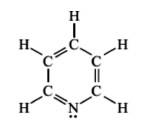
Hence, it has 11 sigma, $3 \pi$ bonds. View full question & answer→MCQ 364 Marks
In Lassaigne's extract of an organic compound, both nitrogen and sulphur are present, on reaction with $Fe ^{3+}$, it forms $[ Fe ( SCN )]^{2+}$, of which colour:
Answer(A)
In case, nitrogen and sulphur both are present in an organic compound, sodium thiocyanate is formed.
$Na+C+N+S \rightarrow NaSCN$
Which further reacts as:
$Fe^{3+}+SCN^{-} \rightarrow[Fe(SCN)]^{2+} \text { (Blood red color) }$
View full question & answer→MCQ 374 Marks
Match List-l with List-ll:
| List-l | List-ll |
| A. Coke | I. Used to cut and grind hard materials. |
| B. Diamond | II. Carbon atoms are all $sp _2$ hybridised |
| C. Fullerene | III. Used as a reducing agent |
| D. Graphite | IV. Cage like molecules |
Choose the correct answer from the options given below:
Answer(C)
Coke-reducing agent
Diamond-used to cut & grind Hard materials
Fullerenes-cage like structures
Graphite-$sp ^2$ hybridised carbon.
View full question & answer→MCQ 384 Marks
Taking stability as the factor, which one of the following represents correct relationship?
- A
$AlCl _3< AlCl$
- B
$TlCl 3> TICl$
- C
$TlI _3> TlI$
- ✓
$AlCl < AlCl _3$
AnswerCorrect option: D. $AlCl < AlCl _3$
(D)
Going down the group 13, stability of lower oxidation state increase.
In case of B, Al, Ga and In , higher O.S. +3 remains more stable than lower O.S. +1 .
But in last stable element, thallium (TI), lower O.S. +1 become more stable tahn higher O.S. +3 .
View full question & answer→MCQ 394 Marks
Intermolecular forces are forces of attraction and repulsion between interacting particles that will include:
A. dipole-dipole forces.
B. dipole-induced dipole forces,
C. Metallic bonding
D. Covalent bonding
E. London dispersion forces
Choose the most appropriate answer from the options given below:
Answer(D)
Covalent Bonding and metallic Bonding NOT an intermolecular force while rest all are considered as intermolecular forces.
View full question & answer→MCQ 404 Marks
The correct order of energies of molecular orbitals of $O _2$ molecule is:
- A
$\begin{array}{l} E \left(\pi 2 p_{ x }\right)= E \left(\pi 2 p_{ y }\right)< E \left(\sigma 2 p_z\right)<\left( E \pi^* 2 p_{ x }\right) = E \left(\pi^* 2 p_{ y }\right)\end{array}$
- B
$\begin{array}{l} E \left(\pi 2 p_{ x }\right)= E \left(\pi 2 p _{ y }\right)> E \left(\sigma 2 p_z\right)>\left( E \pi^* 2 p_{ x }\right) = E \left(\pi^* 2 p_y\right)\end{array}$
- C
$\begin{array}{l} E \left(\pi 2 p_{ x }\right)= E \left(\pi 2 p _{ y }\right)< E \left(\sigma 2 p_{ z }\right)>\left( E \pi^* 2 p_{ x }\right) = E \left(\pi^* 2 p_{ y }\right)\end{array}$
- ✓
$\begin{array}{l} E \left(\pi 2 p _{ x }\right)= E \left(\pi 2 p _{ y }\right)> E \left(\sigma 2 p _{ z }\right)<\left( E \pi^* 2 p_{ x }\right) = E \left(\pi^{\star} 2 p_y\right)\end{array}$
AnswerCorrect option: D. $\begin{array}{l} E \left(\pi 2 p _{ x }\right)= E \left(\pi 2 p _{ y }\right)> E \left(\sigma 2 p _{ z }\right)<\left( E \pi^* 2 p_{ x }\right) = E \left(\pi^{\star} 2 p_y\right)\end{array}$
(D)
$\begin{array}{l} E \left(\pi 2 p_x\right)= E \left(\pi 2 p_y\right)> E \left(\sigma 2 p_z\right)<\left( E \pi^* 2 p_x\right) \\ = E \left(\pi^* 2 p_y\right)\end{array}$
View full question & answer→MCQ 414 Marks
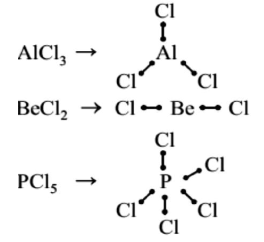
Amongst the following the total number of species having eight electrons around central atom in its outer most shell, is: $NH _3, AlCl _3, BeCl _2, CCl _4, PCl _5$, $CO _2$
Answer(A)
$AlCl _3, BeCl _2$ and $PCl _5$ does not obey octet rule.
$AlCl _3$ and $BeCl _2$ both are electron-deficient species having six electrons in valence shell of central atom whereas $PCl _5$ has ten electrons in valence shell of phosphorous. The structures are:
View full question & answer→MCQ 424 Marks
The element expected to form smallest ion to achieve the nearest nobel gas configuration is:
Answer(A)
Among isoelectronic monoatomic species, size is inversely proportional to atomic number.
Hence among isoelectronic species $Na +, O ^{2-}, N ^{3-}$ , $F ^{-}$(having nearest noble gas configuration); Order of size is $Na ^{+}< F ^{-}< O ^{2-}< N ^{3-}$
$Na ^{+}$ has highest atomic number hence smallest size.
View full question & answer→MCQ 434 Marks
Correct relation of Heisenberg uncertainity principle is:
- ✓
$\Delta v \cdot \Delta x=\frac{h}{4 \pi m}$
- B
$\Delta v \cdot \Delta x=\frac{4 \pi m}{h}$
- C
$\Delta v \cdot \Delta h =\frac{ x }{4 \pi m}$
- D
$\Delta h \cdot \Delta x =\frac{ v }{4 \pi m}$
AnswerCorrect option: A. $\Delta v \cdot \Delta x=\frac{h}{4 \pi m}$
(A)
$\Delta v \cdot \Delta x=\frac{h}{4 \pi m}$
View full question & answer→MCQ 444 Marks
Select the correct statements from the following:
A. Atoms of all elements are composed of three fundamental particles.
B. The mass of the electron is $9.10939 \times 10^{-27} Kg$.
C. All the isotopes of a given element show different chemical properties.
D. Protons and neutrons are collectively known as nucleons.
E. Dalton's atomic theory, regarded the atom as an ultimate particle of matter.
Choose the correct answer from the options given below:
Answer(C)
An Atom has three fundamental particles - electron, proton and neutron.
The mass of the electron is $9.10939 \times 10^{-31} kg$.
Neutrons and protons, both are collectively known as nucleons.
All the isotopes of a given element show same chemical properties.
Dalton's atomic theory, regarded atom as an ultimate particle of matter.
View full question & answer→MCQ 454 Marks
The right option for the mass of $CO _2$ produced by heating 30 g of $40 \%$ pure limestone is (Atomic mass of $Ca =40$ )
$\left[ CaCO _3 \xrightarrow{1200 K} CaO + CO _2\right]$
Answer(D)
$\begin{array}{l}30 g \text { of } 40 \% CaCO_3=30 \times \frac{40}{100}=12 g CaCO_3 \\
CaCO_3 \xrightarrow{12200 K} CaO+CO_2\end{array}$
According to the reaction,
$100 g \text { of } CaCO_3 \rightarrow 44 g \text { of } CO_2$
$12 g CaCO _3 \rightarrow \frac{12 \times 44}{100} g \text { of } CO_2$
$=5.28 g$ of $CO _2$
View full question & answer→