MCQ
Given below are two statements. One is labelled as Assertion $A$ and the other is labelled as Reason $R$.

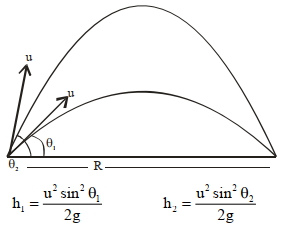
Assertion A :Two identical balls $A$ and $B$ thrown with same velocity '$u$ ' at two different angles with horizontal attained the same range $R$. If $A$ and $B$ reached the maximum height $h_{1}$ and $h_{2}$ respectively, then $R =4 \sqrt{ h _{1} h _{2}}$

Reason R: Product of said heights.

$h _{1} h _{2}=\left(\frac{u^{2} \sin ^{2} \theta}{2 g }\right) \cdot\left(\frac{u^{2} \cos ^{2} \theta}{2 g }\right)$

Choose the $CORRECT$ answer 

  • Both $A$ and $R$ are true and $R$ is the correct explanation of $A$.
  • B
    Both $A$ and $R$ are true but $R$ is NOT the correct explanation of $A$.
  • C
    A is true but $R$ is false
  • D
    A is false but $R$ is true

Answer

Correct option: A.
Both $A$ and $R$ are true and $R$ is the correct explanation of $A$.
a
For same range $\theta_{1}+\theta_{2}=90^{\circ}$

$h _{1} h _{2}=\frac{ u ^{2} \sin ^{2} \theta_{1}}{2 g } \times \frac{ u ^{2} \sin ^{2} \theta_{2}}{2 g }$

$\theta_{2}=90-\theta_{1}$

$h _{1} h _{2}=\frac{ u ^{2} \sin ^{2} \theta_{1}}{2 g } \cdot \frac{ u ^{2} \cos ^{2} \theta_{1}}{2 g }$

$=\left[\frac{ u ^{2} \sin \theta_{1} \cos \theta_{1}}{2 g }\right]^{2}$

$=\left[\frac{ u ^{2} \sin \theta_{1} \cos \theta_{1}}{2 g } \times \frac{2}{2}\right]^{2}=\frac{ R ^{2}}{16}$

$R =4 \sqrt{ h _{1} h _{2}}$

So $R$ is correct explanation of $A$

Need a full question paper?

Generate a complete, print-ready paper with questions like this in minutes — across 16+ boards, with answer keys.

Start Generating Free

Similar questions

The force required to separate two glass plates of 10-2m2 with a film of water 0.05mm thick between them, is (surface tension of water is 70 × 10-3 Nm-1):
Pick the correct statements:
The tension in the spring is ............ $N$
If a car covers $2/5^{th}$ of the total distance with $v_1$ speed and $3/5^{th}$ distance with $v_2 $ then average speed is
Which of the following quantities do not depend on the choice of zero potential or zero potential energy?
  1. Potential at a point.
  2. Potential difference between two points.
  3. Potential energy of a two-charge system.
  4. Change in potential energy of a two-charge system.
How much force is required to produce an increase of $0.2\%$ in the length of a brass wire of diameter $0.6\, mm$ (Young’s modulus for brass = $0.9 \times {10^{11}}N/{m^2}$)
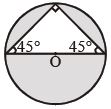
From a circular disc of radius $R$ a triangular portion is cut (see fig.). The distance of  $COM$ of the remaining disc from centre of disc $O$ is:-
An earthen pitcher used in summer cools water in it essentially by evaporation of water from its porous surface. If a pitcher carries $4 \,kg$ of water and the rate of evaporation is $20$ g per hour, temperature of water in it decreases by $\Delta T$ in two hours. The value of $\Delta T$ is close to ........... $^{\circ} C$ (ratio of latent of evaporation to specific heat of water is $540^{\circ} C$
A satellite is to revolve round the earth in a circle of radius $8000\, km$. The speed at which this satellite be projected into an orbit, will be......... $km/s$
The centripetal force acting on a satellite orbiting round the earth and the gravitational force of earth acting on the satellite both equal $F$. The net force on the satellite is