MCQ
Given below are two statements. One is labelled as Assertion $A$ and the other is labelled as Reason $R$.

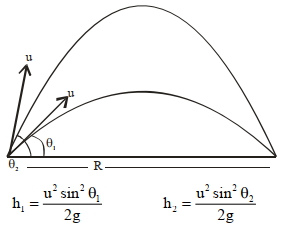
Assertion A :Two identical balls $A$ and $B$ thrown with same velocity '$u$ ' at two different angles with horizontal attained the same range $R$. If $A$ and $B$ reached the maximum height $h_{1}$ and $h_{2}$ respectively, then $R =4 \sqrt{ h _{1} h _{2}}$

Reason R: Product of said heights.

$h _{1} h _{2}=\left(\frac{u^{2} \sin ^{2} \theta}{2 g }\right) \cdot\left(\frac{u^{2} \cos ^{2} \theta}{2 g }\right)$

Choose the $CORRECT$ answer 

  • Both $A$ and $R$ are true and $R$ is the correct explanation of $A$.
  • B
    Both $A$ and $R$ are true but $R$ is NOT the correct explanation of $A$.
  • C
    A is true but $R$ is false
  • D
    A is false but $R$ is true

Answer

Correct option: A.
Both $A$ and $R$ are true and $R$ is the correct explanation of $A$.
a
For same range $\theta_{1}+\theta_{2}=90^{\circ}$

$h _{1} h _{2}=\frac{ u ^{2} \sin ^{2} \theta_{1}}{2 g } \times \frac{ u ^{2} \sin ^{2} \theta_{2}}{2 g }$

$\theta_{2}=90-\theta_{1}$

$h _{1} h _{2}=\frac{ u ^{2} \sin ^{2} \theta_{1}}{2 g } \cdot \frac{ u ^{2} \cos ^{2} \theta_{1}}{2 g }$

$=\left[\frac{ u ^{2} \sin \theta_{1} \cos \theta_{1}}{2 g }\right]^{2}$

$=\left[\frac{ u ^{2} \sin \theta_{1} \cos \theta_{1}}{2 g } \times \frac{2}{2}\right]^{2}=\frac{ R ^{2}}{16}$

$R =4 \sqrt{ h _{1} h _{2}}$

So $R$ is correct explanation of $A$

Need a full question paper?

Generate a complete, print-ready paper with questions like this in minutes — across 16+ boards, with answer keys.

Start Generating Free

Similar questions

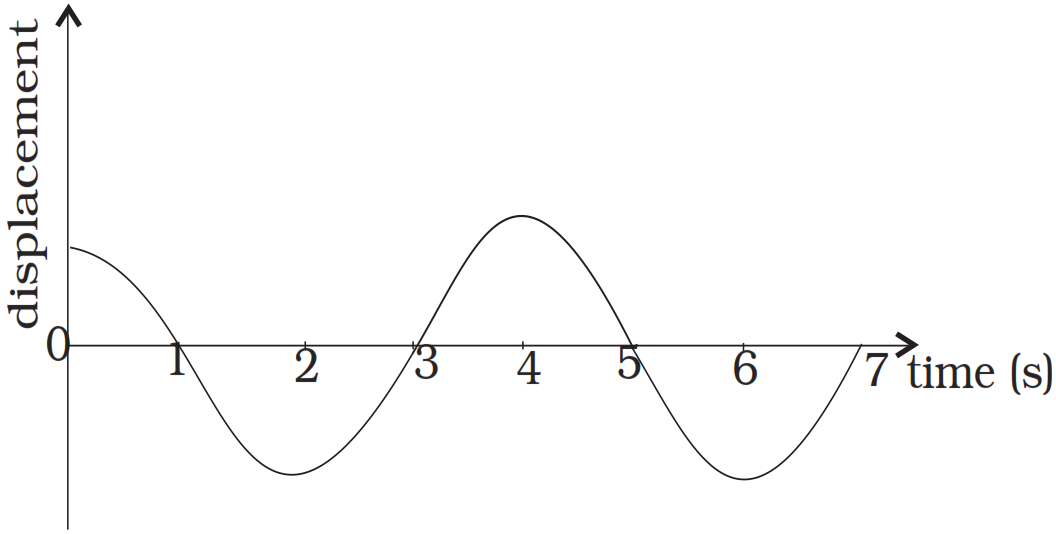
Displacement vs. time curve for a particle executing S.H.M. is shown in Fig. Choose the correct statements:

A device used for investigating the vibration of a fixed string or wire is
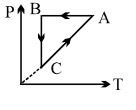
A cyclic process $ABCA$ is shown in $PT$ diagram. When presented on $PV$, it would
The density of a cube is measured by measuring its mass and the length of its sides. If the maximum error in the measurement of mass and length are $3\%$ and $2\%$ respectively, then find the maximum error in the measurement of the density of cube.......... $\%$
A particle moves along a straight line $OX$ . At a time $t$ (in seconds) the distance $x$ (in metres ) of the particle from $O$ is given by $x = 40 + 12t - {t^3}$.How long would the particle travel before coming to rest ?..........$m$
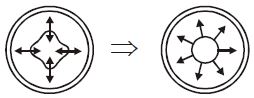
A soap film is formed on a circular frame. A loop of thread is lying on film. If the film inside the loop is broken, then tension in the thread will be : ($R =$ radius of loop, $T =$ surface tension of liquid)
The kinetic energy acquired by a mass $m$ in travelling a certain distance $d$ starting from rest under the action of a constant force is directly proportional to
A scooter of $40\,kg$ mass moving with velocity $4\,m/s$ collides with another scooter of $60\,kg$ mass and moving with velocity $2\,m/s.$ After collision the two scooters stick to each other the loss in kinetic energy .............. $\mathrm{J}$
A semiconducting device is connected in a series circuit with a battery and a resistance. A current is found to pass through the circuit. If the polarity of the battery is reversed, the current drops to almost zero. the device may be:
  1. An intrinsic semiconductor.
  2. A p-type semiconductor.
  3. An n-type semiconductor.
  4. A p-n junction.
A particle is found to be at rest when seen from a frame S1 and moving with constant velocity when seen from another frame S2. Mark out the possible options:
  1. Both the frames are inertial.
  2. Both the frames are non-inertial.
  3. S1 is inertial and S2 is non-inertial.
  4. S1 is non-inertial and S2 is inertial.