MCQ
Given below are two statements. One is labelled as
Assertion (A) and the other is labelled as Reason(R).
Assertion (A) : A electron in a certain region of uniform magnetic field is moving with constant velocity in a straight line path.
Reason (A) : The magnetic field in that region is along the direction of velocity of the electron.
In the light of the above statements, choose the correct answer from the options given below :
  • A
    (A) is false but (R) is true
  • Both (A) and (R) are true and (R) is the correct explanation of (A)
  • C
    Both (A) and (R) are true but (R) is NOT the correct explanation of (A)
  • D
    (A) is true but (R) is false

Answer

Correct option: B.
Both (A) and (R) are true and (R) is the correct explanation of (A)
(B) Both (A) and (R) are true and (R) is the correct explanation of (A)
Sol.
$\begin{array}{l}\overline{ F }= q (\overline{ v } \times \overline{ B }) \\ \overline{ F }=0 \\ \overline{V} \| \overline{ B } \\ \theta=0 \text { or } 180\end{array}$

Need a full question paper?

Generate a complete, print-ready paper with questions like this in minutes — across 16+ boards, with answer keys.

Start Generating Free

Similar questions

Water from a pipe is coming at a rate of $100\, litres$ per minute. If the radius of the pipe is $5\, cm$, the Reynolds number for the flow is of the order of : (density of water $= 1000\, kg/m^3$, coefficient of viscosity of water $= 1\, mPa\, s$)
A diatomic molecule is made of two masses $m_1$ and $m_2$ which are separated by a distance $r$ . If we calculate its rotational energy by applying Bohr's rule of angular momentum quantization, its energy will be given by: ($n$ is an integer)
$20$ $ampere$ current is flowing in a long straight wire. The intensity of magnetic field at a distance $20\, cm$ from the wire will be
Image
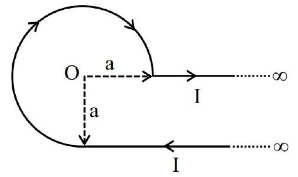
An infinite wire has a circular bend of radius a, and carrying a current I as shown in figure. The magnitude of magnetic field at the origin O of the arc is given by :
A spherical condenser has inner and outer spheres of radii $a$ and $b$ respectively. The space between the two is filled with air. The difference between the capacities of two condensers formed when outer sphere is earthed and when inner sphere is earthed will be
Two sources of sound of same frequency are placed at a distance of $100\,m$ from each  other. An observer moving in between them hears $4$ beats per second. If the distance  between the sound sources is increased to $400\,m$, then number of beats heard by him will be :-
Assertion : Diode lasers are used as optical sources in optical communication.
Reason : Diode lasers consume less energy.
Consider a body of mass $1.0 \mathrm{~kg}$ at rest at the origin at time $\mathrm{t}=0$. A force $\overrightarrow{\mathrm{F}}=(\alpha \mathrm{t} \hat{\mathrm{i}}+\beta \hat{\mathrm{j}})$ is applied on the body, where $\alpha=1.0 \mathrm{Ns}^{-1}$ and $\beta=1.0 \mathrm{~N}$. The torque acting on the body about the origin at time $\mathrm{t}=1.0 \mathrm{~S}$ is $\vec{\tau}$. Which of the following statements is (are) true?

$(A)$ $|\vec{\tau}|=\frac{1}{3} \mathrm{Nm}$

$(B)$ The torque $\vec{\tau}$ is in the direction of the unit vector $+\hat{\mathrm{k}}$

$(C)$ The velocity of the body at $\mathrm{t}=1$ is $\overrightarrow{\mathrm{v}}=\frac{1}{2}(\hat{\mathrm{i}}+2 \hat{\mathrm{j}}) \mathrm{m} \mathrm{s}^{-1}$

$(D)$ The magnitude of displacement of the body at $\mathrm{t}=1 \mathrm{~s}$ is $\frac{1}{6} \mathrm{~m}$

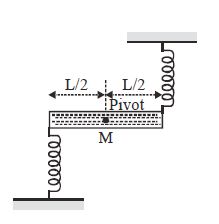
A uniform stick of mass $M$ and length $L$ is pivoted at its centre. Its ends are tied to two springs each of force constant $K$ . In the position shown in figure, the strings are in their natural length. When the stick is displaced through a small angle $\theta $ and released. The stick
A uniform cable of mass $‘M’$ and length $‘L’$ is placed on a horizontal surface such that its ${\left( {\frac{1}{n}} \right)^{th}}$  part is hanging below the edge of the surface. To lift the hanging part of the cable upto the surface, the work done should be