Questions

SECTION - A [PHYSICS MCQ]

Take a timed test

20 questions · auto-graded multiple-choice test.

MCQ 14 Marks
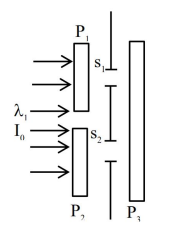
In a Young's double slit experiment, three polarizers are kept as shown in the figure. The transmission axes of $P_1$ and $P_2$ are orthogonal to each other. The polarizer $P_3$ covers both the slits with its transmission axis at $45^{\circ}$ to those of $P$ and $P_2$. An unpolarized light of wavelength $\lambda$ and intensity $I_0$ is incident on $P_1$ and $P_2$. The intensity at a point after $P_3$ where the path difference between the light waves from $s_1$ and $s_2$ is $\frac{\lambda}{3}$, is
Image
  • A
    $\frac{I_6}{2}$
  • B
    $\frac{I_0}{4}$
  • $I_0$
  • D
    $\frac{ I _0}{3}$
Answer
Correct option: C.
$I_0$
(C) $I_0$
Sol.
Image
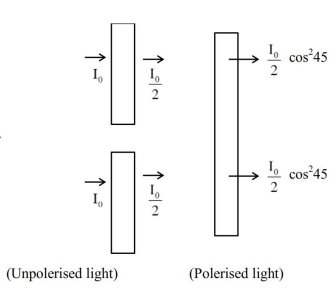
after passing through third poleriser, Intensity of both the waves must be $\frac{I_0}{4}$
now, at a point where path diff is $\frac{\lambda}{3}$, phase difference$
\begin{array}{l}
\Delta \phi=2 K\left(\frac{\Delta x}{\lambda}\right)=\frac{2 \pi}{3} \\
\therefore I_{\text {ros }}=\sqrt{\left(\frac{I_0}{4}\right)^2+\left(\frac{I_0}{4}\right)^2+2\left(\frac{I_0}{4}\right)^2} \cos \frac{2 \pi}{3} \\
=\frac{I_0}{4}
\end{array}
$
View full question & answer
MCQ 24 Marks
Young's double slit interference apparatus is immersed in a liquid of refractive index 1.44. It has slit separation of 1.5 mm . The slits are illuminated by a parallel beam of light whose wavelength in air is 690 nm . The fringe-width on a screen placed behind the plane of slits at a distance of 0.72 m , will be :
  • 0.23 mm
  • B
    0.33 mm
  • C
    0.63 mm
  • D
    0.46 mm
Answer
Correct option: A.
0.23 mm
(A) 0.23 mm
Sol. $\beta=\left(\frac{\lambda_0}{\mu}\right) \times \frac{D}{d}=\frac{690 \times 10^{-9} \times 0.72}{1.44 \times 1.5 \times 10^{-3}}=0.23 mm$
View full question & answer
MCQ 34 Marks
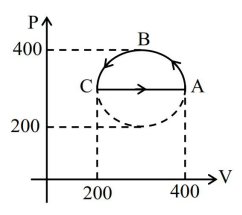
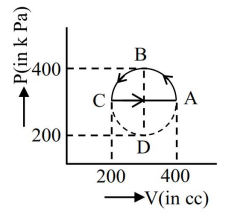
The magnitude of heat exchanged by a system for the given cyclic process ABCA (as shown in figure) is (in SI unit)
Image
  • A
    $10 \pi$
  • $5 \pi$
  • C
    zero
  • D
    $40 \pi$
Answer
Correct option: B.
$5 \pi$
(B) $5 \pi$
Sol.
Image
$\begin{array}{l} W =\frac{1}{2} \pi R ^2 \\ =\frac{1}{2} \times \pi \times\left(\frac{200}{2} \times 10^3\right) \times \frac{200}{2} \times 10^{-6} \\ =\frac{10 \pi}{2}=5 \pi J\end{array}$
View full question & answer
MCQ 44 Marks
Given below are two statements. One is labelled as
Assertion (A) and the other is labelled as Reason(R).
Assertion (A) : A electron in a certain region of uniform magnetic field is moving with constant velocity in a straight line path.
Reason (A) : The magnetic field in that region is along the direction of velocity of the electron.
In the light of the above statements, choose the correct answer from the options given below :
  • A
    (A) is false but (R) is true
  • Both (A) and (R) are true and (R) is the correct explanation of (A)
  • C
    Both (A) and (R) are true but (R) is NOT the correct explanation of (A)
  • D
    (A) is true but (R) is false
Answer
Correct option: B.
Both (A) and (R) are true and (R) is the correct explanation of (A)
(B) Both (A) and (R) are true and (R) is the correct explanation of (A)
Sol.
$\begin{array}{l}\overline{ F }= q (\overline{ v } \times \overline{ B }) \\ \overline{ F }=0 \\ \overline{V} \| \overline{ B } \\ \theta=0 \text { or } 180\end{array}$
View full question & answer
MCQ 54 Marks
The temperature of a body in air falls from $40^{\circ} C$ to $24^{\circ} C$ in 4 minutes. The temperature of the air is $16^{\circ} C$. The temperature of the body in the next 4 minutes will be :
  • A
    $\frac{14}{3}{ }^{\circ} C$
  • B
    $\frac{28}{3}{ }^{\circ} C$
  • $\frac{56}{3}^{\circ} C$
  • D
    $\frac{42}{3}^{\circ} C$
Answer
Correct option: C.
$\frac{56}{3}^{\circ} C$
(C) $\frac{56}{3}^{\circ} C$
$
\begin{array}{l}Sol.\
\frac{T_2-T_1}{t}=K\left[T_{\text {avg }}-T_s\right] \\
T_1=24^{\circ} C ; T_2=40^{\circ} C, t=4, T_{s}=16^{\circ} C \\
\frac{40-24}{4}=K[32-16] \\
K=\frac{4}{16}=\frac{1}{4} \\
\text { Now } \frac{24-T}{4}=K\left[\frac{T+24}{2}-16\right] \\
24-T=\frac{T-16}{2}+16 \\
\frac{3 T}{2}=28 \\
T=\frac{56}{3} C
\end{array}
$
View full question & answer
MCQ 64 Marks
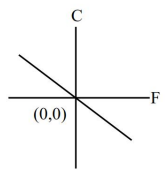
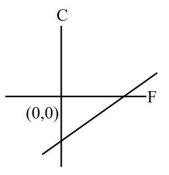
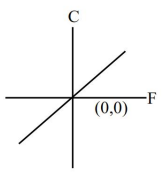
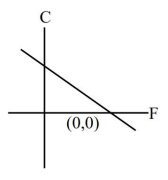
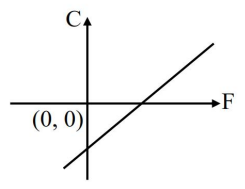
Which of the following figure represents the relation between Celsius and Fahrenheit temperatures?
  • A

    Image

  • Image
  • C

    Image
  • D

    Image
Answer
Correct option: B.

Image
(B)
Image
Sol. $\frac{C}{5}=\frac{ F -32}{9} \Rightarrow C =\frac{5 F}{9}-\frac{160}{9}$
Image
View full question & answer
MCQ 74 Marks
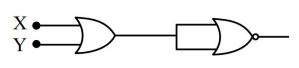
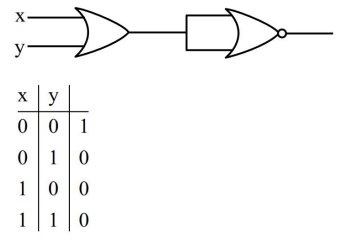
The output of the circuit is low (zero) for
Image
(A) $X =0, Y =0$
(B) $X=0, Y=1$
(C) $X =1, Y =0$
(D) $X =1, Y =1$
Choose the correct answer from the options given below:
  • A
    (A), (C) and (D) only
  • B
    (A), (B) and (C) only
  • (B), (C) and (D) only
  • D
    (A), (B) and (D) only
Answer
Correct option: C.
(B), (C) and (D) only
(C) (B), (C) and (D) only
Sol.
Image
View full question & answer
MCQ 84 Marks
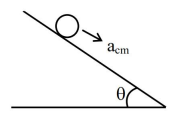
A solid sphere and a hollow sphere of the same mass and of same radius are rolled on an inclined plane. Let the time taken to reach the bottom by the solid sphere and the hollow sphere be $t _1$ and $t _2$, respectively, then
  • $t _1< t _2$
  • B
    $t_1=t_2$
  • C
    $t_1=2 t_2$
  • D
    $t_1>t_2$
Answer
Correct option: A.
$t _1< t _2$
(A) $t _1< t _2$
Sol.
Image
$\begin{array}{l} t =\sqrt{\frac{2 \ell}{ a _{ cm }}} \\ a _{ cm }=\frac{ g \sin \theta}{1+\frac{ I _{ cm }}{ MR ^2}} \\ a _1= a _{ cm _1}=\frac{5 g \sin \theta}{7} \ldots . . \text { Solid } \\ a _2= a _{ cm _2}=\frac{3 g \sin \theta}{5} \ldots . . \text { Hollow } \\ a _1> a _2 \\ t _1< t _2\end{array}$
View full question & answer
MCQ 94 Marks
A solid sphere is rolling without slipping on a horizontal plane. The ratio of the linear kinetic energy of the centre of mass of the sphere and rotational kinetic energy is :
  • A
    $\frac{2}{5}$
  • $\frac{5}{2}$
  • C
    $\frac{3}{4}$
  • D
    $\frac{4}{3}$
Answer
Correct option: B.
$\frac{5}{2}$
(B) $\frac{5}{2}$
Sol. $\frac{\text { Lincar KE }}{\text { Rotational K.E }}=\frac{\frac{1}{2} mv _{ cn }^2}{\frac{1}{2} I \omega^2}$
$
\frac{mv_{cm}^2}{\frac{2}{5} mR^2 \omega^2}=\frac{5}{2} \quad(V=\omega R)
$
View full question & answer
MCQ 104 Marks
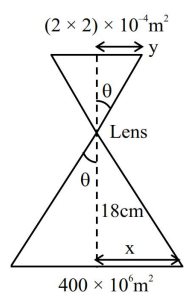
A photograph of a landscape is captured by a drone camera at a height of 18 km . The size of the camera film is $2 cm \times 2 cm$ and the area of the landscape photographed is $400 km^2$. The focal length of the lens in the drone camera is :
  • 1.8 cm
  • B
    2.8 cm
  • C
    2.5 cm
  • D
    0.9 cm
Answer
Correct option: A.
1.8 cm
(A) 1.8 cm
Sol.
Image
$\begin{array}{l} H =18 km \\ \text { Size of camera film }=2 cm \times 2 cm \\ A_{\text {iruge }}=400 km^2 \\ x=20 \times 10^3 m=2 \times 10^4 m \\ y =2 \times 10^{-2} m \\ \frac{x}{y}=10^6=\frac{18 Km }{ f } \\ f =18 \times 10^{-3} m=18 mm \\ f =1.8 cm\end{array}$
View full question & answer
MCQ 114 Marks
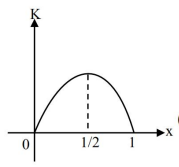
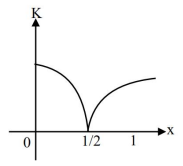
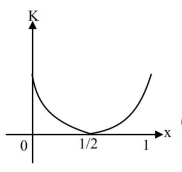
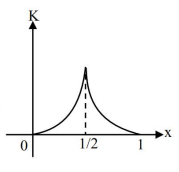
A particle oscillates along the $x$-axis according to the law, $x(t)=x_0 \sin ^2\left(\frac{t}{2}\right)$ where $x_0=1 m$. The kinetic energy ( K ) of the particle as a function of $x$ is correctly represented by the graph.

  • Image
  • B

    Image
  • C

    Image
  • D

    Image
Answer
Correct option: A.

Image
(A) Image
Sol. $\quad x = x _0 \sin ^2 \frac{ t }{2}= x _0\left(\frac{1-\cos t }{2}\right)$
$
x-\frac{x_0}{2}=\frac{-\cos t}{2}
$
where $x_0=1$
$
x-\frac{1}{2}=\frac{-\cos t}{2}
$
Particle is oscillating between $x =0$ to $x =1$
View full question & answer
MCQ 124 Marks
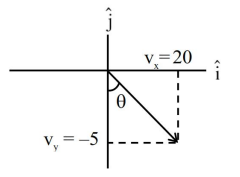
The position vector of a moving body at any instant of time is given as $\overrightarrow{ r }=\left(5 t ^2 \hat{ i }-5 t \hat{ j }\right) m$. The magnitude and direction of velocity at $t=2 s$ is,
  • A
    $5 \sqrt{15} m / s$, making an angle of $\tan ^{-1} 4$ with -ve Y axis
  • B
    $5 \sqrt{15} m / s$, making an angle of $\tan ^{-1} 4$ with +ve X axis
  • $5 \sqrt{17} m / s$, making an angle of $\tan ^{-1} 4$ with -ve Y axis
  • D
    $5 \sqrt{17} m / s$, making an angle of $\tan ^{-1} 4$ with + ve X axis
Answer
Correct option: C.
$5 \sqrt{17} m / s$, making an angle of $\tan ^{-1} 4$ with -ve Y axis
(C) $5 \sqrt{17} m / s$, making an angle of $\tan ^{-1} 4$ with -ve Y axis
Sol.
$\begin{aligned} \overrightarrow{ r } & =5 t^2 \hat{ i }-5 t \hat{ j } \\ \overrightarrow{ v } & =10 t \hat{ i }-5 \hat{ j } \\ \overrightarrow{ v } & =20 \hat{ i }-5 \hat{ j } \quad \text { at } t =2 \sec \end{aligned}$
Image
$\begin{array}{l}\tan \theta=\frac{20}{5}=4 \\ \theta=\tan ^{-1} 4 \\ \text { From-veY-axis }\end{array}$
View full question & answer
MCQ 134 Marks
Image
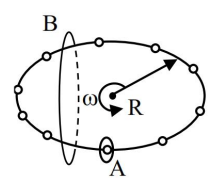
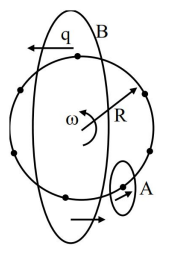
N equally spaced charges each of value q , are placed on a circle of radius R . The circle rotates about its axis with an angular velocity $\omega$ as shown in the figure. A bigger Amperian loop B encloses the whole circle where as a smaller Amperian loop A encloses a small segment. The difference between enclosed currents, $I_A-I_B$, for the given Amperian loops is
  • A
    $\frac{ N ^2}{2 \pi} q \omega$
  • B
    $\frac{2 \pi}{N} q \omega$
  • $\frac{ N }{2 \pi} q \omega$
  • D
    $\frac{N}{\pi} q \omega$
Answer
Correct option: C.
$\frac{ N }{2 \pi} q \omega$
(C) $\frac{ N }{2 \pi} q \omega$
Sol.
Image
$\begin{array}{l}I_A=\frac{N q}{\frac{2 \pi}{\omega}} \\ I_A=\frac{N q \omega}{2 \pi}, I_B=0 \\ I_A-I_B=\frac{N q \omega}{2 \pi}\end{array}$
View full question & answer
MCQ 144 Marks
Given below are two statements. One is labelled as
Assertion (A) and the other is labelled as Reason(R).
Assertion (A) : In an insulated container, a gas is adiabatically shrunk to half of its initial volume. The temperature of the gas decreases.
Reason (R) : Free expansion of an ideal gas is an irreversible and an adiabatic process.
In the light of the above statement, choose the correct answer from the options given below :
  • A
    Both (A) and (R) are true and (R) is the correct explanation of (A)
  • B
    (A) is true but (R) is false
  • (A) is false but ( R ) is true
  • D
    Both (A) and (R) are true but (R) is NOT the correct explanation of (A)
Answer
Correct option: C.
(A) is false but ( R ) is true
(C) (A) is false but ( R ) is true
Sol. (A) $T _1 V_1^{\gamma-1}= T _2 V_2^{\gamma-1}$
Temp increases
R) Free expansion is assumed fast, so Adiabatic
View full question & answer
MCQ 154 Marks
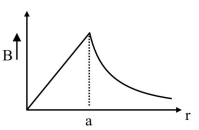
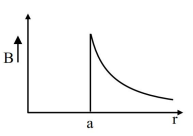
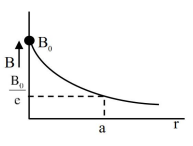
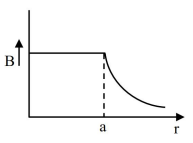
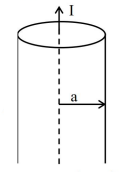
A long straight wire of a circular cross-section with radius ' $a$ ' carries a steady current $I$. The current $I$ is a uniformly distributed across this cross-section. The plot of magnitude of magnetic field $B$ with distance r from the centre of the wire is given by

  • Image
  • B

    Image
  • C

    Image
  • D

    Image
Answer
Correct option: A.

Image
(A) Image
Sol.
Image

$\begin{array}{l} B _{ in }=\frac{\mu_0(\overline{J} \times \overline{ r })}{2} \\ B_{ in } \propto r \\ B _{ az }=\frac{\mu_0 I }{2 \pi r } \\ B _{ net } \propto \frac{1}{ r }\end{array}$
View full question & answer
MCQ 164 Marks
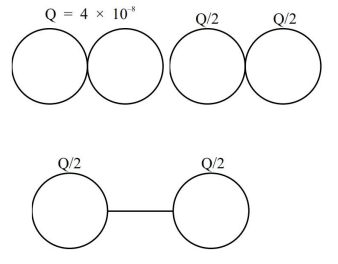
A small uncharged conducting sphere is placed in contact with an identical sphere but having $4 \times 10^{-8}$ C charge and then removed to a distance such that the force of repulsion between them is $9 \times 10^{-3} N$. The distance between them is (Take $\frac{1}{4 \pi \varepsilon_0}$ as $9 \times 10^{\circ}$ in SI units)
  • 2cm
  • B
    3cm
  • C
    4cm
  • D
    1cm
Answer
Correct option: A.
2cm
(A) 2cm
Sol.
Image
$\begin{array}{l} F =\frac{ k \left(\frac{\theta}{2}\right)\left(\frac{\theta}{2}\right)}{ r ^2} \\ 9 \times 10^{-3}=\frac{9 \times 10^9 \times\left(4 \times 10^{-8}\right) \times 4 \times 10^{-8}}{4 \times r ^2} \\ r ^2=\frac{9 \times 10^9 \times 16 \times 10^{-16}}{4 \times 9 \times 10^{-3}}=4 \times 10^{-4} \\ r =2 \times 10^{-2} m \Rightarrow 2 cm\end{array}$
View full question & answer
MCQ 174 Marks
Image
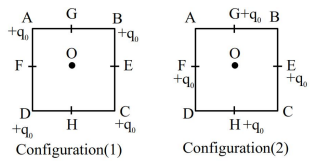
In the first configuration (1) as shown in the figure, four identical charges $\left(q_0\right)$ are kept at the corners $A, B, C$ and $D$ of square of side length ' $a$ '. In the second configuration (2), the same charges are shifted to mid points $G, E, H$ and $F$, of the square, If $K =\frac{1}{4 \pi \varepsilon_0}$, the difference between the potential energies of configuration (2) and (1) is given by :
  • A
    $\frac{ Kq _0^2}{ a }(4 \sqrt{2}-2)$
  • B
    $\frac{ Kq _0^2}{ a }(3-\sqrt{2})$
  • C
    $\frac{ Kq _0^2}{ a }(4-2 \sqrt{2})$
  • $\frac{ Kq _0^2}{ a }(3 \sqrt{2}-2)$
Answer
Correct option: D.
$\frac{ Kq _0^2}{ a }(3 \sqrt{2}-2)$
(D) $\frac{ Kq _0^2}{ a }(3 \sqrt{2}-2)$
$
\begin{array}{l}Sol.\
U_1=\frac{4 Kq_0^2}{a}+\frac{2 Kq_0^2}{\sqrt{2} a}=\frac{Kq_0^2}{a}(4+\sqrt{2}) \\
U_2=\frac{Kq_0^2}{\left(\frac{a}{\sqrt{2}}\right)}(4+\sqrt{2})=\frac{K q_0^2}{a}(4 \sqrt{2}+2) \\
U_2-U_1=\frac{Kq_0^2}{a}(3 \sqrt{2}-2)
\end{array}
$
View full question & answer
MCQ 184 Marks
The energy E and momentum p of a moving body of mass $m$ are related by some equation. Given that e represents the speed of light, identify the correct equation.
  • A
    $E ^2= pc ^2+ m ^2 c ^4$
  • B
    $E ^2= pc ^2+ m ^2 c ^2$
  • C
    $E^2=p^2 c^2+m^2 c^2$
  • $E^2=p^2 c^2+m^2 c^4$
Answer
Correct option: D.
$E^2=p^2 c^2+m^2 c^4$
(D) $E^2=p^2 c^2+m^2 c^4$
$\begin{array}{ll}\text { Sol. } & {[ E ]= M ^1 L^2 T^{-2}} \\ & {[ Pc ]= M ^{\prime} L ^{\prime} T ^{-1} \cdot L^{\prime} T ^{-1}= M ^1 L^2 T^{-2}} \\ & {\left[ mc ^2\right]= M ^1 L^2 T^{-2}} \\ & E ^2= M ^1 L^2 T^{-2} \\ & E ^2= P ^2 c ^2+ m ^2 c ^4\end{array}$
View full question & answer
MCQ 194 Marks
In photoelectric effect, the stopping potential $\left( V _0\right)$ $v / s$ frequency ( v ) curve is plotted.
(h is the Planck's constant and $\phi_0$ is work function of metal)
(A) $V _0 v / s v$ is linear
(B) The slope of $V _0 v / s v$ curve $=\frac{\phi_0}{h}$
(C) h constant is related to the slope of $V _0\ v/s\ v$ line
(D) The value of electric charge of electron is not required to determine $h$ using the $V_0\ v/s\ v$ curve.
(E) The work function can be estimated without knowing the value of $h$.
Choose the correct answer from the options given below :
  • A
    (A), (B) and (C) only
  • B
    (C) and (D) only
  • (A),(C) and (E) only
  • D
    (D) and (E) only
Answer
Correct option: C.
(A),(C) and (E) only
(C) (A),(C) and (E) only
$
\begin{array}{l}Sol.\
hv=\phi+KE_{\max } \\
KE_{\max }=eV_0 \\
V_0=\frac{hv-\phi}{e}
\end{array}
$
(A) $V _0 v / s V$ is linear correct
(B) Slope
$
v_0=\left(\frac{h}{e}\right) v-\frac{\phi}{e} \text { Wrong }
$
Slope $\frac{ h }{ e }$
(C) Correct
(D) Incorrect
(E) Correct
View full question & answer
MCQ 204 Marks
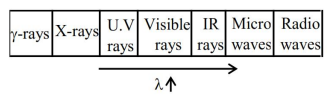
Arrange the following in the ascending order of wavelength ( $\lambda$ ) :
(A) Microwaves $\left(\lambda_1\right)$
(B) Ultraviolet rays $\left(\lambda_2\right)$
(C) Infrared rays $\left(\lambda_3\right)$
(D) X -rays $\left(\lambda_4\right)$
Choose the most appropriate answer from the options given below :-
  • A
    $\lambda_4<\lambda_3<\lambda_2<\lambda_1$
  • B
    $\lambda_3<\lambda_4<\lambda_2<\lambda_1$
  • $\lambda_4<\lambda_2<\lambda_3<\lambda_1$
  • D
    $\lambda_4<\lambda_3<\lambda_1<\lambda_2$
Answer
Correct option: C.
$\lambda_4<\lambda_2<\lambda_3<\lambda_1$
(C) $\lambda_4<\lambda_2<\lambda_3<\lambda_1$
Sol.
Image
View full question & answer