MCQ
Given below are two statements:

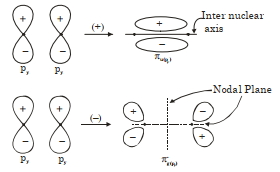
Statement $(I)$ : A $\pi$ bonding $MO$has lower electron density above and below the inter-nuclear asix.

Statement $(II)$ : The $\pi^*$ antibonding $MO$ has a node between the nucles.In the light of the above statements, choose the most appropriate answer from the options given below:

  • A
    Both Statement $I$ and Statement $II$ are false
  • B
    Both Statement $I$ and Statement $II$ are true
  • Statement $I$ is false but Statement $II$ is true
  • D
    Statement $I$ is true but Statement $II$ is false
Answer

Correct option: C.
Statement $I$ is false but Statement $II$ is true
c
A $\pi$ bonding molecular orbital has higher electron density above and below inter nuclear axis

Need a full question paper?

Generate a complete, print-ready paper with questions like this in minutes — across 16+ boards, with answer keys.

Start Generating Free

Similar questions

Which of the following pair of molecules will have permanent dipole moment?
For a chemical reaction $A+B \rightleftharpoons C+D$ $\left(\Delta_{r} H^{0}=80 \,k J\right.$ $mol\,^{-1}$ ) the entropy change $\Delta_{r} S^{0}$ depends on the temperature $T$ (in $K$ ) as $\left(\Delta_{ r } S ^{0}=2 T \left(\, J \,K ^{-1}\, mol ^{-1}\right)\right.$

Minimum temperature at which it will become spontaneous is ..... $K.$(Integer)

Consider the following reaction in which the intermediate carbocation loses $H^+$  to give the final product ? 

Which of the following energy profiles best represents the overall reaction ?

The reaction $CH_{4(g)} + Cl_{2(g)} \to CH_3Cl_{(g)}+ HCl_{(g)}$ has $\Delta H = -25 \,kcal$
$BE(C-Cl) = 84\, kcal, BE \,(H-Cl) = 103\, kcal$
$BE \,(C-H) = X$ and $BE\, (Cl-Cl) = y$
If $\frac{x}{y} = \frac{9}{5}$ then find $y$
Choose the correct order of stability of carbocation using the concept of hyperconjugation.
$\begin{matrix}{\ \ \ \ \ \ \ \ \ \ \ \ \text{CH}_3\\ \ \ \ \ \ \ \ \ \ \ \ \ \ |\\\text{CH}_3-\text{C}^\oplus\\ \ \ \ \ \ \ \ \ \ \ \ \ \ |\\\ \ \ \ \ \ \ \ \ \ \ \ \text{CH}_3} & { \ \ \ \ \ \ \ \ \ \ \ \ \text{CH}_3\\ \ \ \ \ \ \ \ \ \ \ \ \ \ |\\\text{CH}_3-\text{C}^\oplus\\ \ \ \ \ \ \ \ \ \ \ \ \ \ |\\ \ \ \ \ \ \ \ \ \ \ \ \ \text{H} } & {\text{CH}_3\stackrel{{\oplus} }{\hbox{CH}_2}} & \stackrel{{\oplus} }{\hbox{CH}_3} \\ \ \ \ \ \ \ \ \ \text{I} & \ \ \ \ \ \ \ \text{II} & \ \ \text{III} & \text{IV} \end{matrix}$
Which of the following are not redox reactions?
a) $K _4\left[ Fe ( CN )_6\right]+ H _2 SO _4+ H _2 O \rightarrow K _2 SO _4+ CO + FeSO _4+\left( NH _4\right)_2 SO _4$.
b) $CuSO _4+ NH _3 \rightarrow\left[ Cu \left( NH _3\right)_4 SO _4\right.$.
c) $M g+N_2 \rightarrow M g_3 N_2$
d) $I_2+3 Cl _2 \rightarrow 2 ICl _3$
For the reaction of one mole of zinc dust with one mole of sulphuric acid in a bomb calorimeter, $\Delta {\rm{U}}$ and $ w$  correspond to
Which of the following is not used as a Lewis acid
On adding $0.1\, M$ solution each of $[Ag^+], [Ba^{2+}], [Ca^{2+}]$ in a $Na_2SO_4$ solution, species first precipitated is $[K_{sp}\, BaSO_4 = 10^{-11}, K_{sp}\, CaSO_4 = 10^{-6}, K_{sp}\,Ag_2SO_4 = 10^{-5}]$
Which one of the following compound is not a protonic acid
