MCQ
Given below are two statements :-

Statement $I$ : Davisson-Germer experiment establishes the wave nature of electrons.

Statement $II$ : If electrons have wave nature, they can interfere and show diffraction.

In the light of the above statements choose the correct answer from the options given below

  • Both Statement $I$ and Statement $II$ are true
  • B
    Both Statement $I$ and Statement $II$ are false
  • C
    Statement $I$ is true but Statement $II$ is false
  • D
    Statement $I$ is false but Statement $II$ is true
Answer

Correct option: A.
Both Statement $I$ and Statement $II$ are true
a
In Davisson$-$Germer experiment the electrons exhibit diffraction there by proving that electrons have wave nature. Hence both statement are correct.

Both the options are correct by concept

Need a full question paper?

Generate a complete, print-ready paper with questions like this in minutes — across 16+ boards, with answer keys.

Start Generating Free

Similar questions

An engine giving whistle is moving towards a stationary observer with $110\,m/s$ speed. What will be the ratio of the frequency of the whistle heard when the engine is approaching and receding from the observer? (the speed of sound is $330\,m/s$ )
If body having initial velocity zero is moving with uniform acceleration $8\,\,m/{\sec ^2}$ the distance travelled by it in fifth second will be.........$metres$
The surface tension of a liquid at its boiling point
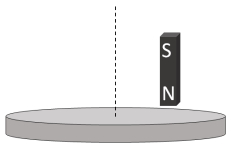
A light disc made of aluminium (a nonmagnetic material) is kept horizontally and is free to rotate about its axis as shown in the figure. A strong magnet is held vertically at a point above the disc away from its axis. On revolving the magnet about the axis of the disc, the disc will (figure is schematic and not drawn to scale)-
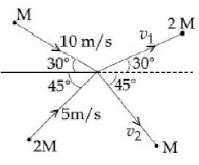
Two particles, of masses $M$ and $2M$, moving as shown, with speeds of $10\, m/s$ and $5\, m/s$, collide elastically at the origin. After the collision, they move along the indicated directions with speeds $v_1$ and $v_2$ respectively. The value of $v_1$ and $v_2$ are nearly
Force acting on a particle moving in a straigth line varies with the velocity of the particle as $F =\frac {K}{v},$ where $K$ is a constant. The work done by this force in time $t$ is
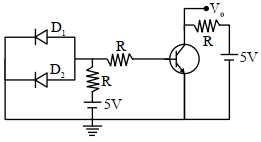
A circuit is arranged as shown in figure. The output voltage ${V}_{0}$ is equal to $\ldots \ldots . {V}$.
A conducting sphere of radius $R = 20$ $cm$ is given a charge $Q = 16\,\mu C$. What is $\overrightarrow E $ at centre
An ideal gas goes from an initial state to final state. During the process, the pressure of gas increases linearly with temperature.
A. The work done by gas during the process is zero.
B. The heat added to gas is different from change in its internal energy.
C. The volume of the gas is increased.
D. The internal energy of the gas is increased.
E. The process is isochoric (constant volume process)
Choose the correct answer from the options given below :-
Electrons with de-Broglie wavelength $\lambda$ fall on the target in an $\mathrm{X}$-ray tube. The cut-off wavelength of the emitted $\mathrm{X}$ rays is