MCQ
Given below are two statements:
Statement I: RNA mutates at a lower rate.
Statement II: Viruses having DNA genome and shorter life span mutate and evolve faster. Choose the correct answer from the options given below:
  • A
    Statement I false but Statement II is true.
  • B
    Both Statement I and Statement II are true.
  • Both Statement I and Statement II are false.
  • D
    Statement I is true but Statement II is false.
Answer

Correct option: C.
Both Statement I and Statement II are false.
(C)
RNA mutates at a faster rate because it is unstable. Therefore, viruses having RNA genome and shorter life span allow them to mutate and evolve at faster rates.

Need a full question paper?

Generate a complete, print-ready paper with questions like this in minutes — across 16+ boards, with answer keys.

Start Generating Free

Similar questions

Which of the following gland grows to the maximum size at puberty and then diminishes gradually?
Which of the following animal is not excrete nitrogen as urea
Which role is played by Lactobacillus in our stomach?
Nicotine is
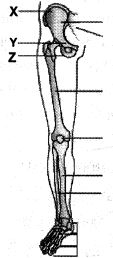
In given figure Fusion of $X, Y$ and $Z$ bone forms
Assertion : Corpus luteum degenerates in the absence of fertilization.

Reason : Progesterone level decreases.

Assertion: Sponges exhibit cellular level of organisation.
Reason: Cells are arranged as loose cell aggregates and some division of labour occur among the cells.
Volume of air remains in the lungs after normal expiration is
Select correct statements regarding to follicular development :
(A) It occurs throughout life in a woman except periods of pregnancies.
(B) Theca formation begins in secondary follicle.
(C) Meiotic I division occurs in Graafian follicle.
(D) Meiotic II division occurs in Graafian follicle.
Which of the following statements are not correct for disorders of circulatory system ?
(i) If repeated checks of blood pressure of an individual is 140/90 (140 over 90) or higher, it shows hypertension.
(ii) High blood pressure leads to heart diseases and also affects vital organs like brain and kidney.
(iii) Coronary artery disease, often referred to as atherosclerosis, affects the vessels that supply blood to the heart muscle.
(iv) Atherosclerosis is caused by deposits of calcium, fat, cholesterol and fibrous tissues, which makes the lumen of arteries narrower.
(v) Angina or angina pectoris is acute chest pain which appears when no enough oxygen is ching the heart muscle.
(vi) Angina can occur in men and women of any age but it is more common among the middle-aged and elderly.
(vii) Heart failure is same as cardiac arrest or a heart attack.