Question
Given below are two statements :

Statement $I$ : The contact angle between a solid and a liquid is a property of the material of the solid and liquid as well.

Statement $II$ : The rise of a liquid in a capillary tube does not depend on the inner radius of the tube.

In the light of the above statements, choose the correct answer from the options given below :

Answer

Statement $I$ is correct as we know contact angle depends on cohesine and adhesive forces.

Statement $II$ is incorrect because height of liquid is given by $h==\frac{2 T \cos \theta_C}{\rho g r}$ where $r$ is radius of

Tube (assuming length of capillary is sufficient) Hence option $(3)$ is correct.

Need a full question paper?

Generate a complete, print-ready paper with questions like this in minutes — across 16+ boards, with answer keys.

Start Generating Free

Similar questions

In a large building, there are $15$ bulbs of $40\ W$, $5$ bulbs of $100\ W, 5$ fans of $80\ W$ and $1$ heater of $1\ kW$. The voltage of electric mains is $220\ V$. The minimum capacity of the main fuse of the building will be ................ $A$
A particle of mass $m$ is thrown horizontally from the top of a tower and another particle of mass $2 \,m$ is thrown vertically upward. The acceleration of centre of mass is .............
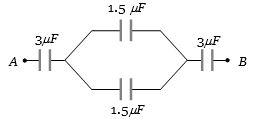
The capacitance between the points $A$ and $B$ in the given circuit will be.......$\mu \,F$
The energy band gap is maximum in
Two sitar strings, $A$  and $B,$  playing the note $'Dha'$  are slightly out of tune and produce beats and frequency  $5\,Hz.$  The tension of the string $B$ is slightly increased and the beat frequency is found to decrease by  $3\,Hz$ . If the frequency of $A$ is $425\,Hz,$  the original frequency of $B$ is  ... $Hz$
If the value of potential in an $ac$, circuit is $10V$, then the peak value of potential is
The force on a particle as the function of displacement x (in $x-$ direction) is given by $F = 10 + 0.5x$ The work done corresponding to displacement of particle from $x = 0$ to $x = 2$ unit is
A wave travelling in positive $x-$direction with $A = 0.2\;m$ has a velocity of $360 \;m/sec.$ if $\lambda = 60\;m,$ then correct expression for the wave is
The balls, having linear momenta $\vec{p}_1=\hat{p} \hat{i}$ and $\vec{p}_2=-p \hat{i}$, undergo a collision in free space. There is no external force acting on the balls. Let $\vec{p}_1^{\prime}$ and $\vec{p}_2^{\prime}$ be their final momenta. The following option$(s)$ is (are) $NOT ALLOWED$ for any non-zero value of $\mathrm{p}, \mathrm{a}_1, \mathrm{a}_2, \mathrm{~b}_1, \mathrm{~b}_2, \mathrm{c}_1$ and $\mathrm{c}_2$.

$(A)$ $ \overrightarrow{\mathrm{p}}_1^{\prime}=\mathrm{a}_1 \hat{\mathrm{i}}+\mathrm{b}_1 \hat{\mathrm{j}}+\mathrm{c}_1 \hat{\mathrm{k}} $

$ \overrightarrow{\mathrm{p}}_2^{\prime}=\mathrm{a}_2 \hat{\mathrm{i}}+\mathrm{b}_2 \hat{\mathrm{j}}$

$(B)$ $ \overrightarrow{\mathrm{p}}_1^{\prime}=\mathrm{c}_1 \hat{\mathrm{k}} $

$ \overrightarrow{\mathrm{p}}_2^{\prime}=\mathrm{c}_2 \hat{\mathrm{k}}$

$(C)$ $ \overrightarrow{\mathrm{p}}_1^{\prime}=\mathrm{a}_1 \hat{\mathrm{i}}+\mathrm{b}_1 \hat{\mathrm{j}}+\mathrm{c}_1 \hat{\mathrm{k}} $

$ \overrightarrow{\mathrm{p}}_2=\mathrm{a}_2 \hat{\mathrm{i}}+\mathrm{b}_2 \hat{\mathrm{j}}-\mathrm{c}_1 \hat{\mathrm{k}}$

$(D)$ $ \vec{p}_1^{\prime}=a_1 \hat{i}+b_1 \hat{j} $

$ \overrightarrow{\mathrm{p}}_2^{\prime}=a_2 \hat{\mathrm{i}}+b_1 \hat{\mathrm{j}}$
Time period of revolution of a nearest satellite around a planet of radius $R$ is T. Period of revolution around another planet, whose radius is $3R$ but having same density is