Experience the future of education. Simply download our apps or reach out to us for more information. Let's shape the future of learning together!No signup needed.*
The gap between the plates of a parallel plate capacitor of area $A$ and distance between plates $d$, is filled with a dielectric whose permittivity varies linearly from ${ \varepsilon _1}$ at one plate to ${ \varepsilon _2}$ at the other. The capacitance of capacitor is
Two positrons $(e^+)$ and two protons $(p)$ are kept on four corners of a square of side $a$ as shown in figure. The mass of proton is much larger than the mass of positron. Let $q$ denotes the charge on the proton as well as the positron then the kinetic energies of one of the positrons and one of the protons respectively after a very long time will be-
A parallel plate air capacitor has a capacitance $C$. When it is half filled with a dielectric of dielectric constant $5$, the percentage increase in the capacitance will be......$\%$
A condenser of $2\,\mu F$ capacitance is charged steadily from $0$ to $5$ $Coulomb$. Which of the following graphs correctly represents the variation of potential difference across its plates with respect to the charge on the condenser
A point dipole $\vec p = - {p_0}\hat x$ is kept at the origin. The potential and electric field due to this dipole on the $y-$ axis at a distance $d$ are, respectively : (Take $V = 0$ at infinity)
The two metallic plates of radius $r$ are placed at a distance $d$ apart and its capacity is $C$. If a plate of radius $r/2$ and thickness $d$ of dielectric constant $6$ is placed between the plates of the condenser, then its capacity will be
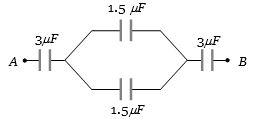
A circuit has a section $AB$ as shown in the figure. If the potential difference between points $A$ and $B$ is $V\, volt$, then potential difference across $C_1$ is
Within a spherical charge distribution of charge density $\rho \left( r \right)$, $N$ equipotential surfaces of potential ${V_0},{V_0} + \Delta V,{V_0} + 2\Delta V,$$.....{V_0} + N\Delta V\left( {\Delta V > 0} \right),$ are drawn and have increasing radii $r_0, r_1, r_2,......r_N$, respectively. If the difference in the radii of the surfaces is constant for all values of $V_0$ and $\Delta V$ then
Consider the situation shown in the figure. The capacitor $A$ has a charge $q$ on it whereas $B$ is uncharged. The charge appearing on the capacitor $B$ a long time after the switch is closed is