Question
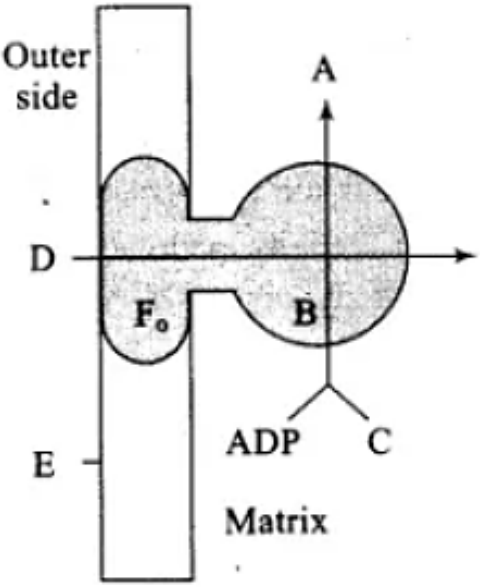
Given below is a diagram showing $ATP$ synthesis during aerobic respiration, replace the symbols $A, B, C, D$ and $E$ by appropriate terms given in the box.
Image
$F1,$ Particle, $Pi, 2H^+$, Inner mitochondrial membrane, $ATP$, $Fo$ particle, $ADP$
Answer

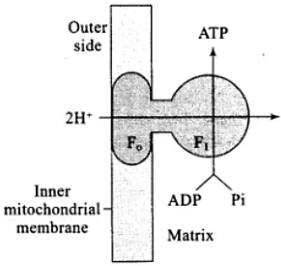
The energy released during the electron transport system is utilized in synthesizing $ \text{$ \text{ATP}$}$ with the help of $ \text{$ \text{ATP}$}$ synthase $($complex $V).$ This complex consists of two major components, $F _1$ and $F _0$ . The $F _1$ headpiece is a peripheral membrane protein complex and contains the site for synthesis of $ \text{$ \text{ATP}$}$ from $ADP$ and inorganic phosphate. $F _1$ is an integral membrane protein complex that forms the channel through which protons across the inner membrane. The passage of protons through the channel is coupled to the
catalytic site of the $F _1$ component for the production of $ \text{ATP}$. For each $ \text{ATP}$ produced, $2 H ^{+}$ passes through $F _0$ from the intermembrane space to the matrix down the electrochemical proton gradient.

Image

Diagrammatic presentation of $ \text{ATP}$ synthesis in mitochondria

Need a full question paper?

Generate a complete, print-ready paper with questions like this in minutes — across 16+ boards, with answer keys.

Start Generating Free