Questions

5 Marks Questions

Take a timed test

6 questions · self-marked practice — reveal the answer and mark yourself.

Question 15 Marks
Describe cilia and flagella of eukaryotic cell. How are flagella of eukaryotes different from those of prokaryotic cell?
Answer
Cilia and flagella are hair like outgrowths of the cell membrane. Cilia are small structures which work like cars, causing the movement of either the cell or the surrounding fluid. Flagella are comparatively longer and responsible for cell movement.
Structure:
- The electron microscopic study of a cilium or the flagellum shows that they are covered with plasma membrane.
- Their core called the axoneme, possesses a number of microtubules running parallel to the long axis. The axoneme has nine pairs of doublets of radially arranged peripheral microtubules, and a pair of centrally located microtubules.
- Such an arrangement of axonemal microtubules is referred to as the 9 + 2 array.
- The central tubules are connected by bridges and are also enclosed by a central sheath, which is connected to one of the tubules of each peripheral couplet by a radial spoke. Thus, there are nine radial spokes The peripheral doublets are also interconnected by
linkers.
- Both the cilium and flagellum emerge from centriole like structure called the basal bodies.
Difference between Flagella of Prokryotes and Eukaryotes
- Flagella of prokryotes are arising from the plasma membrane, while those of eukaryotes are arising from centrioles.
- Flagella of prokaryotes are not membrane bound, while those of eukaryotes are membrane bound.
- Flagella of prokaryotes are simple in structures, while those of eukaryotes are complex in structure.
View full question & answer
Question 25 Marks
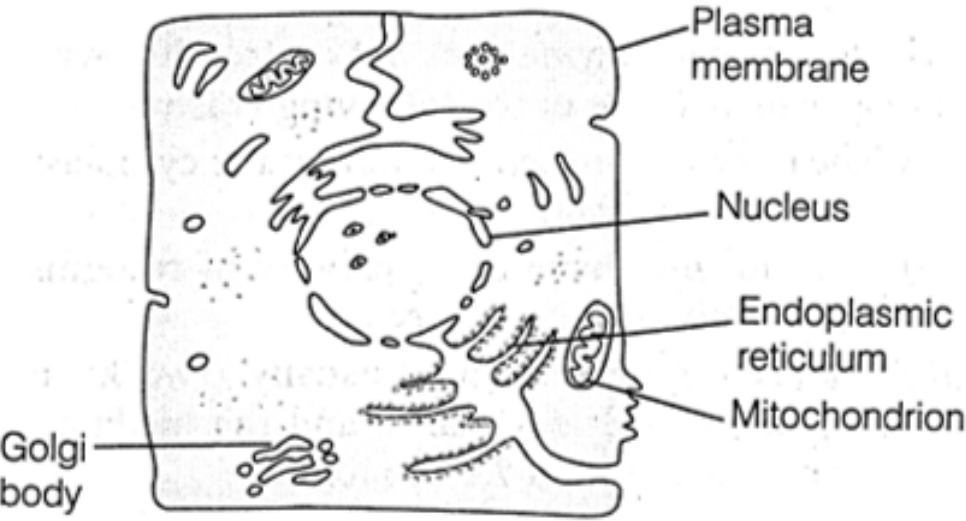
The diagram shows some of the structures present in an animal cell.

Image

Which of these structures is responsible for
i. Manufacture of lipids and steroids
ii. Release of energy
iii. Manufacture of hormones and digestive enzymes
iv. Production of spindle fibres in cell division
v. Endo and exocytosis?
Answer
Structures responsible are
i. Smooth endoplasmic Reticulim (SER) is responsible for the manufacture of lipids and steroids.
ii. Mitochondrion is responsible for the release of energy.
iii. Ribosomes are responsible for the production of hormones and digestive enzymes.
iv. Centrioles are responsible for production of spindle fibres.
v. Plasma membrane is responsible for endo and exocytosis.
View full question & answer
Question 35 Marks
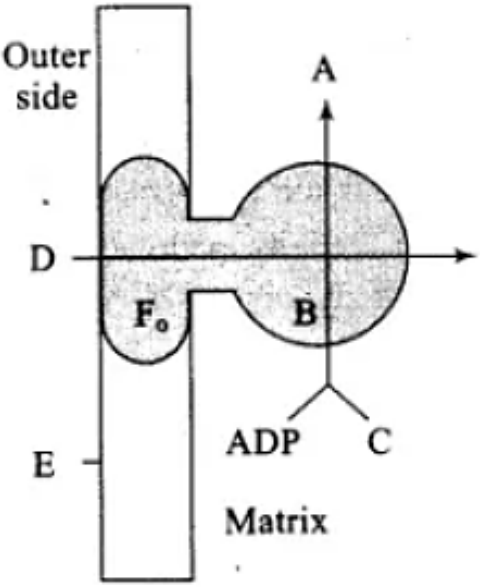
Given below is a diagram showing $ATP$ synthesis during aerobic respiration, replace the symbols $A, B, C, D$ and $E$ by appropriate terms given in the box.

Image
$F1,$ Particle, $Pi, 2H^+$, Inner mitochondrial membrane, $ATP$, $Fo$ particle, $ADP$
Answer
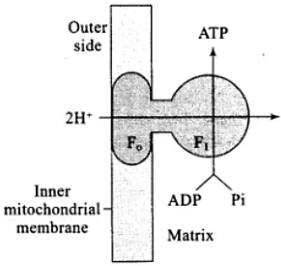
The energy released during the electron transport system is utilized in synthesizing $ \text{$ \text{ATP}$}$ with the help of $ \text{$ \text{ATP}$}$ synthase $($complex $V).$ This complex consists of two major components, $F _1$ and $F _0$ . The $F _1$ headpiece is a peripheral membrane protein complex and contains the site for synthesis of $ \text{$ \text{ATP}$}$ from $ADP$ and inorganic phosphate. $F _1$ is an integral membrane protein complex that forms the channel through which protons across the inner membrane. The passage of protons through the channel is coupled to the
catalytic site of the $F _1$ component for the production of $ \text{ATP}$. For each $ \text{ATP}$ produced, $2 H ^{+}$ passes through $F _0$ from the intermembrane space to the matrix down the electrochemical proton gradient.

Image

Diagrammatic presentation of $ \text{ATP}$ synthesis in mitochondria
View full question & answer
Question 45 Marks
Explain ETS.
Answer
• The metabolic pathway through which the electron passes from one carrier to another, is called the electron transport system {ETS) and it is present in the inner mitochondrial membrane.
• The energy stored in NADH +$H ^{+}$ and $FADH _2$ is used as they move through ETS. This is accomplished when they are oxidized through the electron transport system and the electrons are passed on to $O _2$. resulting in the formation of $H _2 O$.
• Electrons from NADH produced in the mitochondrial matrix during citric acid cycle are oxidised by an NADH dehydrogenase (complex I), and electrons are then transferred to ubiquinone located within the inner membrane. Ubiquinone also receives reducing equivalents via $FADH _2$ (complex II) that is generated during oxidation of succinate in the citric acid cycle.
• The reduced ubiquinone is then oxidised with the transfer of electrons to cytochrome c via cytochrome bc1 complex (complex III).
• Cytochrome c acts as a mobile carrier for transfer of electrons between complex III and IV. Complex IV refers to cytochrome c oxidase complex containing cytochromes a and a³, and two copper centres.
• When the electrons pass from one carrier to another via complex I to IV in the electron transport chain, they are coupled to ATP synthase (complex V) for the production of ATP from ADP and inorganic phosphate. The number of ATP molecules synthesized depends on the nature of the electron donor.
• Oxidation of one molecule of NADH gives rise to 3 molecules of ATP, while that of one molecule of $FADH _2$ produces 2 molecules of ATP. The presence of oxygen is vital, since it drives the whole process by removing hydrogen from the system. Oxygen acts as the final hydrogen acceptor.
• Unlike photophosphorylation where it is the light energy that is utilized for the production of proton gradient required for
phosphorylation, in respiration it is the energy of oxidation-reduction utilized for the same process. It is for this reason that the process is called oxidative phosphorylation.
• The energy released during the electron transport system is utilized in synthesizing ATP with the help of ATP synthase (complex V). This complex consists of two major components, $F _1$ and  $F _0$. The $F _1$ headpiece is a peripheral membrane protein complex and contains the site for synthesis of ATP from ADP and inorganic phosphate. $F _0$ is an integral membrane protein complex that forms the channel through which protons cross the inner membrane. The passage of protons through the channel is coupled to the catalytic site of the F, component for the production of ATP. For each ATP produced, $2 H ^{+}$ passes through $F _0$  from the inter membrane space to the matrix down the electrochemical proton gradient.
View full question & answer
Question 55 Marks
Distinguish anaphase of mitosis from anaphase I of meiosis.
Answer
Anaphase of mitosisAnaphase I of meiosis
The centromere of every   chromosome divides. The centromere does not divide.
Separation of sister   chromatids takes place. Homologous chromosomes are separated.
Only one chromatid of every   chromosome moves to the   pole. The number and types   of chromosomes at each pole   is the same as in the parent   nucleus. Chromosomes are   single-stranded Each homologous pair of chromosomes moves to
the pole with both the chromatids.chromosomes are   double-stranded
The chromatids moving to   one  pole are genetically   identical to those moving
to the opposite pole.
The chromosomes moving to one pole are not
genetically identical to those moving to theopposite   pole.
 
View full question & answer
Question 65 Marks
Describe the following:
i. synapsis
ii. bivalent
iii. chiasmata
Draw a diagram to illustrate your anwer.
Answer
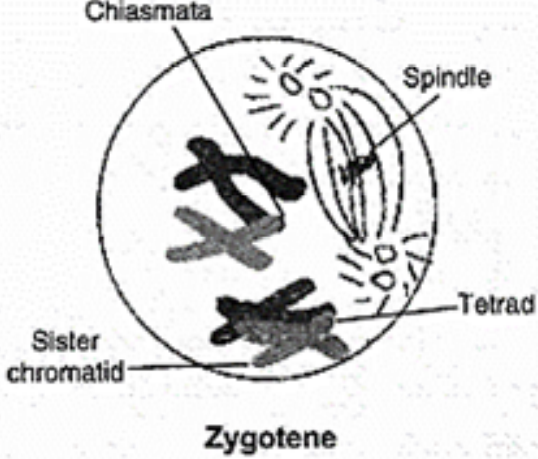
i. During zygotene of prophase I of meiosis homologous chromosomes pair together. This pairing is called synapsis.

Image

ii. Bivalent: The complex formed by homologous chromosomes during zygotene is called a bivalent. They are also known as tetrad
ii. Chiasmata: During diplotene, the paired chromosomes make a X-shaped structure. This is called chiasmata. It is a site where two non-sister chromatids of homologous chromosomes have crossed over.
View full question & answer