Question
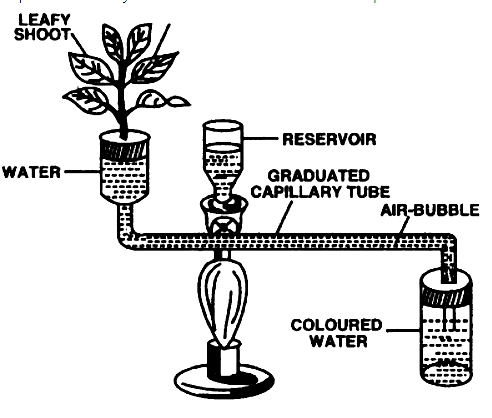
Given below is an apparatus used to study a particular process in plants. Study the same and answer the questions that follow :

(i) Name the apparatus.
(ii) Mention one limitation of this apparatus.
(iii) Which phenomenon is studied with the help of this apparatus?
(iv) What is the function of the part marked ‘reservoir’?
(v) What is the role of the air bubble in the experiment?

Answer

(i) Garreau’s Potometer.
(ii) The capillary tube should be properly dipped into the water.
(iii) Transpiration.
(iv) It is used to adjust the position of air bubble in graduated capillary tube.
(v) The movement of air bubble in graduated tube in a minute gives the rate of transpiration.

Need a full question paper?

Generate a complete, print-ready paper with questions like this in minutes — across 16+ boards, with answer keys.

Start Generating Free

Similar questions

Match the items in column A with those of column B.

Column A

Column B

(a) Auxin

(i) apical dominance

(b) Gibberellin

(ii) cell division

(c) Cytokinin

(iii) fruit ripening

(d) Ethylene

(iv) internodal elongation
Explain the following terms:
(i) Mutation
(ii) Homologous chromosomes
(iii) Alleles
Draw well labeled diagrams of part Artery and Superior vena cava to show the structural.
Differentiate between voluntary and involuntary actions.
Differentiate between the following:Plasmolysis and deplasmolysis
match the conditions in column A with the cause in column B.
A (Condition) B (Cause)
aDwarfism and mental retardation1shortage of glucose in blood
bDiabetes mellitus2Over secretion of growth hormone
cExcess of glucose in blood 3Insulin shock
dGigantism 4Over secretion of thyroxine
eEnlargement of breasts in adult males 5Hypothyroidism
fExophthalmic goitre 6Over secretion of cortical hormones
How does colchicine act as mitotic poison? Is there any advantage of it?
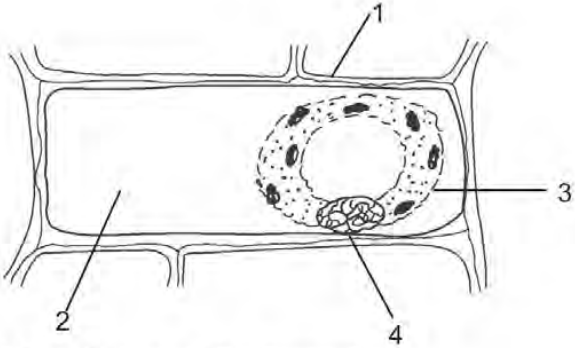
The diagram given below represents a plant cell after being placed in a strong sugar solution:

Image
(i) What is the state of the cell shown in the diagram?
(ii) Name the structure that acts as a selectively permeable membrane.
(iii) How can the above cell be brought back to its original condition? Mention the scientific term for the recovery of the cell.
Give Reasons
Gametes have a haploid (n) number of chromosomes.
The diagram alongside refers to an experiment in which the apparatus was set up with the light source 10 cm away from the plant. After 15 minutes the number of bubbles evolved per minute from the cut stem was recorded. The light source was moved to 20 cm away from the plant, left for 15 minutes and the number of bubbles evolved per minute was again recorded. The experiment was repeated with the light source at distances of 40, 60, 80 and 100 cm away from the plant. Plot a graph for the results obtained and answer the following questions.
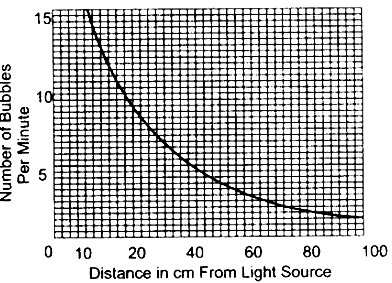
(i) From the graph it seems likely that the rate of bubbling per minute at 50 cm would have been
(a) 2.0 (b) 2.5 (c) 3.0 (d) 3.5
(ii) The gas produced by the plant during the experiment was
(a) air (b) oxygen (c) carbon dioxide (d) nitrogen (e) hydrogen
(iii) The gas collected comes due to the breakdown of
(a) glucose (b) starch (c) water (d) air (e) ATP
(iv) If ice cubes were added to the water, the rate of bubble formation would
(a) Stay the same.
(b) Increase because more water is added.
(c) Decrease because the temperature drops.
(d) Decrease because water freezes.
(e) Cannot tell from the information given.
(v) If some sodium bicarbonate is added to the water the rate of bubble formation
(a) Increases because more respiration occurs.
(b) Increases because more photosynthesis occurs.
(c) Increases because the gas becomes less soluble.
(d) Decreases because carbon dioxide acts as a limiting factor.
(e) Decreases because respiration decreases.