Questions

[3 marks Question Answer]

🎯

Test yourself on this topic

21 questions · timed · auto-graded

Question 13 Marks
Describe an experiment to prove that transpiration occurs more from the undersurface of dorsiventral leaves.
Answer
Two equal pieces of cobalt chloride paper are dried and placed on the upper surface and the other on the lower surface of dorsiventral leaves. They are firmly held in place by pieces of cello tapes or glass slides. After a few minutes, the cobalt chloride paper shows change in colour from blue to pink. The time taken for the cobalt chloride paper on the upper surface of the leaf to turn pink is much longer than for the under surface. Thus, it proves that the rate of transpiration is greater from the undersurface of dorsiventral leaves.
View full question & answer
Question 23 Marks
Describe any three conditions which affect transpiration.
Answer
The three conditions which affect transpiration are the following :
  1. Sunlight: In bright sunlight, the stomata remain fully open and transpiration takes place through the stomatal pores. At night stomata remain closed, so transpiration is reduced.
  2. Wind: If the Wind velocity is high, transpiration becomes rapid because the water vapour is carried away before the air around the leaf becomes saturated.
  3. Available water: If available water in the soil is low, the transpiration is low and the leaves may even begin to wilt.
View full question & answer
Question 33 Marks
Column ‘II’ is a list of items related to ideas in Column ‘I’. Match the term in Column ‘II’ with a suitable idea given in Column ‘I’.
Column I Column II
(i) Transpiration (a) Cacti plants
(ii) Movement of water (b) Stomata
(iii) Guttation (c) Maize plant
(iv) Low rate of transpiration (d)Xylem
(v) The high rate of transpiration (e) Hydathodes
Answer
Column I Column II
(i) Transpiration (b) Stomata
(ii) Movement of water (d) Xylem
(iii) Guttation (e) Hydathodes
(iv) Low rate of transpiration (a) Cacti plants
(v) The high rate of transpiration (c) Maize plant
View full question & answer
Question 43 Marks
Give Reasons for the following:
Guard cells are small in size and are kidney-shaped in outline.
Answer
Because of their small size, guard cells are rapidly influenced by turgor changes. Because of their kidney-shaped outline, they remain joined at their ends. This concave-convex curvature of the two guard cells can be varied easily and this further facilitates the stomatal pore to open and close easily.
View full question & answer
Question 53 Marks
Why do plants absorb more water than what is required by them? Give three uses of this phenomenon.
Answer
Plants absorb more water than what is required. Out of 100%, only 5% of the water is used in metabolic reactions while the remaining 95% is released into the atmosphere as transpiration.
The three uses of this phenomenon are:
(i) It helps in transportation of water and minerals to the various parts of the plant.
(ii) It produces a cooling effect to the plants.
(iii) It evaporates excess water.
View full question & answer
Question 63 Marks
Give Reasons for the following:
Land plants die if their roots remain waterlogged.
Answer
Older portions of the root do not have root hairs. They are covered with a protective layer of dead calls having tiny openings called lenticels. Through these lenticels, gaseous exchange occurs between the soil and inner living cells. If the roots of land plants remain waterlogged, then lenticels will not be able to do the gaseous exchange and as a result of this plants will die.
View full question & answer
Question 73 Marks
Give Reasons for the following:
Transplanting of seedlings to a flowerbed in the evening is better than doing so in the morning.
Answer
During day time the transpiration rate is very high. As a result to excessive transpiration and the seedling will wilt and ultimately die. However, in the evening, the transpiration rate is very slow and the seedling will be able to retain the water absorbed from the soil and as a result of this they will remain transplanted.
View full question & answer
Question 83 Marks
Differentiate Between Transpiration and Perspiration.
Answer
Transpiration Perspiration
(i) It takes place in plants. It takes place in animals.
(ii) Only water vapour is removed. Sweat containing urea, uric add, and salts are removed with water.
(iii) It takes place through the leaves and stem and through the stomata and lenticels. It takes place through the skin. It takes place through the sweat pores of the sweat glands.
View full question & answer
Question 93 Marks
Distinguish between the following :
Stomata and lenticels
Answer
Stomata lenticels
1. Stomata are the minute opening mainly present on leaves. 1. Lenticels are found in the bark of woody stems.
2. Stomata can be open and closed. 2. These are always opened.
3. These are located on the lower surface of dicot leaves and both upper and lower surfaces of monocot leaves. 3. These are located on the stems of woody plants.
4. They lose water vapour and the process is termed stomatal transpiration. 4. They lose water vapour and the process is called lenticular transpiration.
View full question & answer
Question 103 Marks
Differentiate Between Transpiration and Evaporation.
Answer
Transpiration Evaporation
Loss of water in the form of vapour from aerial parts of the plant. Loss of water from the surface of the water bodies in the form of vapour.
It is vital and partly a physical process controlled by both internal and external factors. It is a physical change controlled by the temperature and humidity of the atmosphere.
It is a slow process. It is a fast process.
View full question & answer
Question 113 Marks
Differentiate Between Transpiration and Guttation.
Answer
Transpiration Guttation
(i) It is regulated by guard cells It is due to root pressure.
(ii) It occurs at day time. It occurs at night.
(iii) Water escapes through stomata and lenticels. Water escapes through hydathodes only.
(iv) Water escapes in the form of water vapour. Water escapes from the hydathodes on the margin of the leaves in the form of water droplets.
View full question & answer
Question 123 Marks
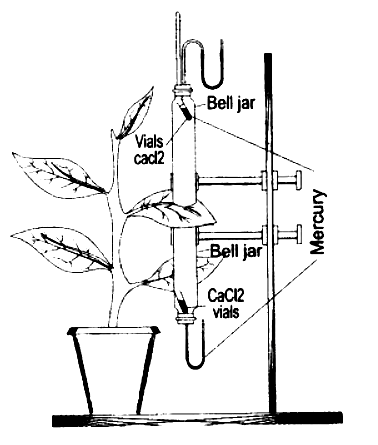
The apparatus shown here is Girreau’s poto-meter designed to demonstrate unequal transpiration from the two surfaces of a dorsiventral leaf. Before keeping the leaf in between the cups, anhydrous calcium chloride ($CaCl_2$) contained in two small vials were weighed and placed in both the cups. The ends of the cups were closed with corks through which two mercury manometers were connected. After a few hours, $CaCl_2$​​​​​​​ vials were taken out and weighed again.

(i) What is the purpose of keeping $CaCl_2$ vials inside the cup?
(ii) After a few hours, the $CaCl_2$ vials were taken out and weighed again. Will you expect any difference in weight? If so, give reasons.
(iii) What was the purpose of using a mano-meter?
(iv) What do you mean by transpiration?
Answer
(i) The $CaCl_2$ vials are kept inside the cup to absorb water.
(ii) After few hours, the weight of the $CaCl_2$​​​​​​​ vials will increase because they will absorb the water which is transpired by the leaf of the plant.
(iii) Manometers are used to indicate the unequal transpiration from two surfaces of a dorsiveritral leaf by showing difference in rise in their mercury levels.
(iv) Transpiration is the loss of water in the form of water vapour from the aerial parts of the living plants.
View full question & answer
Question 133 Marks
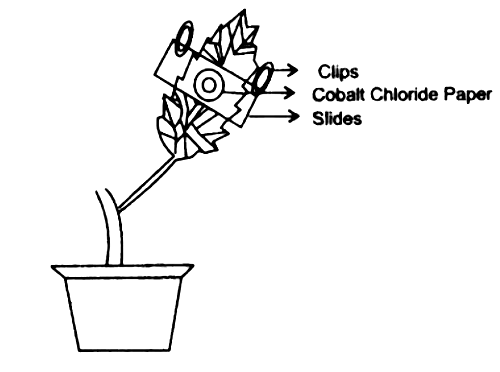
Given below is the diagram of an experimental set up to study the process of transpiration in plants. Study the same and then answer the questions that follow:

(i) What is the colour of dry cobalt chloride paper?
(ii) Is the experimental leaf a monocot or a dicot? Give a reason to support your answer.
(iii) Why axe glass slides placed over the dry cobalt chloride papers?
(iv) After about half an hour what change, if any, would you expect to find in the cobalt chloride paper placed on the dorsal and ventral sides of the leaf? Give a reason to support your answer.
(v) Define the term ‘transpiration’.
Answer
(i) The colour of dry cobalt chloride paper is blue.
(ii) Dicot leaf. It has reticulate venation.
(iii) To prevent water vapour of the air from interfering the experiment. .
(iv) The cobalt chloride paper placed on the lower surface of the leaf will show more pink dots as there are more stomata. The upper surface has less stomata than the lower surface.
(v) Loss of water as water vapour from the aerial parts of the plant.
View full question & answer
Question 143 Marks
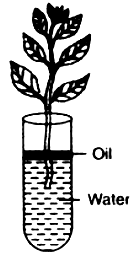
Study the diagram given below and answer the questions that follow:

(i) Name the process being studied in the above experiment.
(ii) Explain the process mentioned in (i) above.
(iii) Why is oil placed over water?
Answer
(i) Transpiration
(ii) It is the process by which plants lose water as vapours through the aerial parts.
(iii) To prevent evaporation of water from the test tube.
(iv)

  1. In bright sunlight, the level of water decreases quickly.
  2. In humid conditions level of water does not decrease for a long time.
  3. On a windy day, the level of water decreases very quickly.

(v)

  1. The number of stomata may be reduced.
  2. leaves may become narrow.
  3. A thick layer of cuticle on the leaf surface helps to decrease transpiration
View full question & answer
Question 153 Marks
Study the diagram given alongside and answer the questions that follow:

(i) Explain the physiological process of being study.
(ii) What will be the observations in the two test-tubes after about 2-3 days?
(iii) Give a reason for your answer in (ii) above.
(iv) Why is the surface of water covered with oil?
(v) State the purpose of setting up test tube B.
Answer
(i) Transpiration: Loss of water as water vapour from aerial parts of the plant.
(ii) After 2-3 days the level of waterfalls in test-tube A while it remains constant in test tube B.
(iii) The fall in the level of water in test-tube A due to the absorption of water by the roots.
(iv) The oil has been put in each test-tube to prevent the loss of water by evaporation.
(v) The purpose of setting up test-tube B is to show that in the absence of a plant, there is no change in the level of water.
View full question & answer
Question 163 Marks
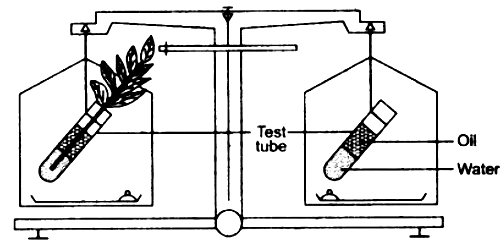
The figure given below represents an experimental set up with a weighing machine to demonstrate a particular process in plants. The experimental set up was placed in bright sunlight. Study the diagram and answer the following questions:

(i) Name the process intended for the study.
(ii) Define the above-mentioned process.
(iii) When the weight of the test tube (A & B) is taken before and after the experiment, what is observed ? Give reasons to justify your observation in A & B.
(iv) What is the purpose of keeping the test tube B in the experimental setup?
Answer
(i) Transpiration.
(ii) It is the release of water vapours from the aerial parts of the plant.
(iii) Weight of test tube A will decrease after the experiment because water will be lost from it through the leaves by transpiration. Weight of test tube B will remain the same after the experiment because water will not be lost by transpiration as there is no plant in and nor by evaporation as oil is spread over it, which will not allow evaporation.
(iv) It is a control experiment where the purpose of using test tube B is to compare the level of water in both test tubes.
View full question & answer
Question 173 Marks
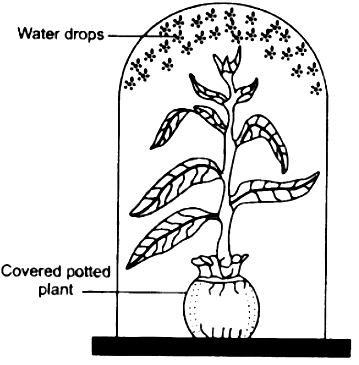
Given below is an experimental set up to study a particular process:

(i) Name the process being studied.
(ii) Explain the process named in (i) above.
(iii) Why is the pot covered with a plastic sheet?
(iv) Mention one way in which this process is beneficial to the plant.
(v) Suggest a suitable control for this experiment.
Answer
(i)
  1. Cuticle,
  2. Upper epidermis,
  3. Palisade tissue,
  4. Spongy parenchyma,
  5. Guard cell of a stoma.
    (ii) In the day time dotted arrow shows the path of $CO_2$​​​​​​​ while solid arrow shows the path of oxygen. A night dotted arrow shows the path of oxygen while the solid arrow shows the path of $CO_2:$
    (iii) Yes, we can add one more arrow in the figure to show the loss of water during transpiration.
    (iv) Only one leaf vein has been shown in this section.
View full question & answer
Question 183 Marks
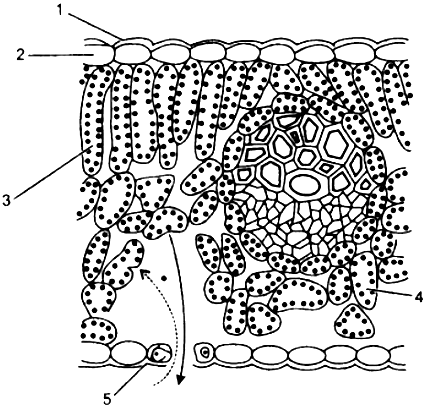
The figure below represents the vertical section of a leaf:

(i) Name the parts labeled 1 to 5.
(ii) What do the two arrows (dotted and solid) indicate in the day time and at night?
(iii) Could you add one more arrow in the figure? If yes, what for?
(iv) How many leaf veins have been shown in this section?
Answer
(i)
  1. Cuticle,
  2. Upper epidermis,
  3. Palisade tissue,
  4. Spongy parenchyma,
  5. Guard cell of a stoma.
(ii) In the day time dotted arrow shows the path of $CO_2$​​​​​​​ while solid arrow shows the path of oxygen. A night dotted arrow shows the path of oxygen while the solid arrow shows the path of $CO_2:$
(iii) Yes, we can add one more arrow in the figure to show the loss of water during transpiration.
(iv) Only one leaf vein has been shown in this section.
View full question & answer
Question 193 Marks
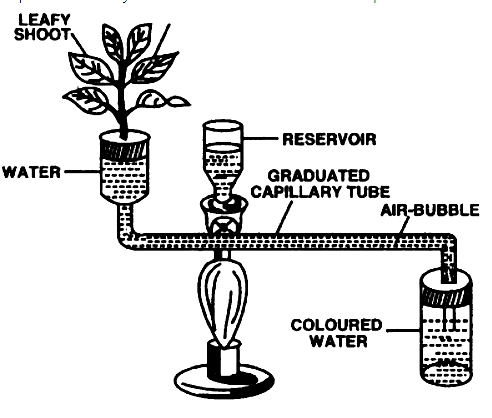
Given below is an apparatus used to study a particular process in plants. Study the same and answer the questions that follow :

(i) Name the apparatus.
(ii) Mention one limitation of this apparatus.
(iii) Which phenomenon is studied with the help of this apparatus?
(iv) What is the function of the part marked ‘reservoir’?
(v) What is the role of the air bubble in the experiment?
Answer
(i) Garreau’s Potometer.
(ii) The capillary tube should be properly dipped into the water.
(iii) Transpiration.
(iv) It is used to adjust the position of air bubble in graduated capillary tube.
(v) The movement of air bubble in graduated tube in a minute gives the rate of transpiration.
View full question & answer
Question 203 Marks
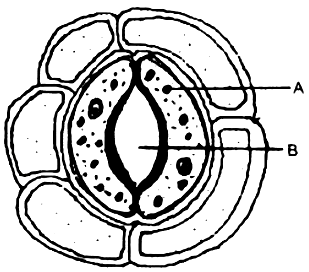
The diagram below represents a structure found in a leaf.

Study the same and answer the questions that follow:
(i) Name the pis labeled A and B.
(ii) What is the biological term for the above structure?
(iii) What is the function of the part labeled A?
(iv) Mention two structural features of A, which help in the function mentioned in (iii) above.
(v) Where is this structure likely to be found in a leaf?
(vi) The above structure helps in the process of transpiration. Explain the term transpiration.
(vii) How many other cells are found surrounding this structure as seen in the diagram?
Answer
(1) A—Guard cell B—Stoma.
(ii) Stomatal apparatus.
(iii) Regulates opening & dosing of Stomata.
(iv) It gives rigidity and protection to the cell.
(v) On the epidermis of the leaf.
(vi) Transpiration is the loss of water as water vapours from the aerial parts of the plant.
(vii) Five.
View full question & answer
Question 213 Marks
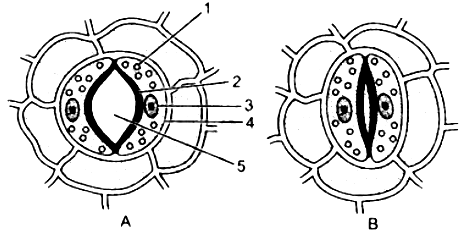
Given below are the diagrams of a certain structure in plants in two conditions.

(i) Name the structure shown.
(ii) Name the parts numbered 1-5.
(iii) What is the most apparent difference between A and B in the structure shown?
(iv) Describe the mechanism which brings about the change in the structure depicted in A and B.
Answer
(i) Stomata surrounded by epidermal cells.

(ii)

  1. Chloroplast,
  2. The inner wall of guard cells,
  3. Nucleus,
  4. Guard cells,
  5. Stoma.

(iii) The stoma is open in A and is almost closed in B.

(iv) The opening and dosing mechanism of stomata is regulated by the amount of water and solutes present in the guard cells. The guard cells have a thick inner wall facing the opening and a thin outer wall on the opposite side; their cytoplasm contains chloroplasts. During the day guard cells begin photosynthesis and the sugar produced during the process increases the osmotic pressure which draws in water from the adjoining cells. Hence, the guard cells become turgid and bulge outward due to their thin outer wall, thus widening the stomatal opening lying in between (A). As the stomata open, the diffusion of gases in and out begins to fulfilling the need for photosynthesis and for allowing transpiration. If for any reason the water content of the leaf is falling short, the guard cells fail to remain turgid, they turn flaccid or lose turgidity, thereby closing the stomatal opening (B) and the transpiration stops.

View full question & answer
[3 marks Question Answer] - Biology STD 10 Questions - Vidyadip