Question
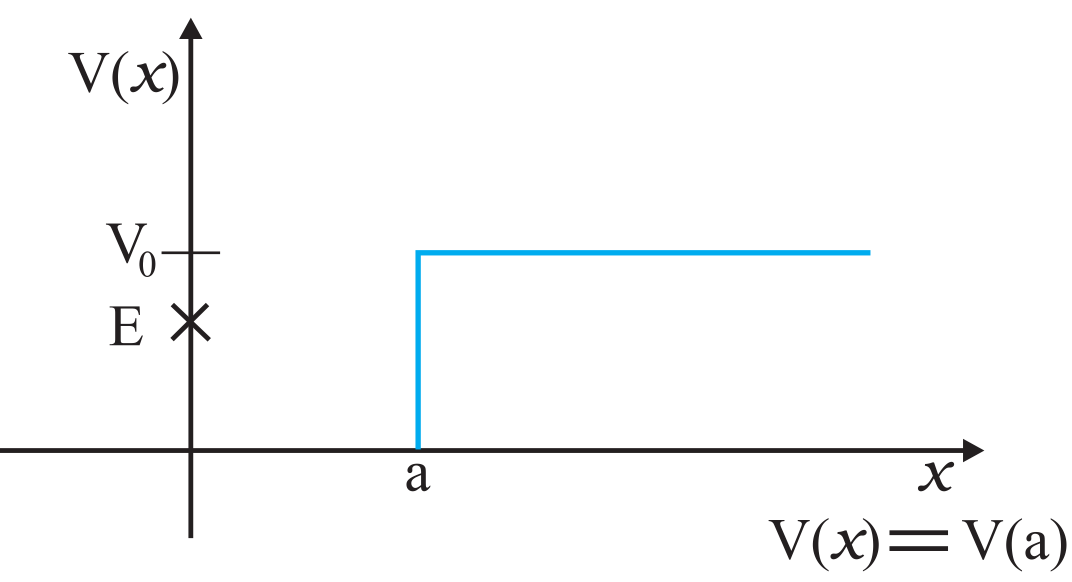
Given in are examples of some potential energy functions in one dimension. The total energy of the particle is indicated by a cross on the ordinate axis. In each case, specify the regions, if any, in which the particle cannot be found for the given energy. Also, indicate the minimum total energy the particle must have in each case. Think of simple physical contexts for which these potential energy shapes are relevan.
Answer

Total energy of a system is given by the relation, $E = P.E. + K. E$. $\therefore K.E. = E - P.E$. Kinetic energy of a body is a positive quantity. It cannot be negative. Therefore, the particle will not exist in a region where K.E. becomes negative. For $x > a, P.E. (V_0) > E$ $\therefore$ K.E. becomes negative. Hence the object cannot be present in the region $x < a$ and $x > b. x > a$ and $x < b; -V_1$ In the given case, the condition regarding the positivity of K.E. is satisfied only in the region between $x > a$ and $x < b$. The minimum potential energy in this case is -$V_1$. Therfore, $K.E. = E - (-V_1) = E + V_1$.
Therefore, for the positivity of the kinetic energy, the total energy of the particle must be greater than $-V_1$. So, the minimum total energy the particle must have is $–V_1$. $\frac{\text{b}}{2}<\text{x}<\frac{\text{a}}{2} ; \frac{\text{a}}{2}<\text{x}<\frac{\text{b}}{2} ; -\text{V}_1$ In the given case, the potential energy (V_0) of the particle becomes greater than the total energy (E) for $\frac{\text{b}}{2} < \text{x} < \frac{\text{b}}{2 }$ and $-\frac{\text{a}}{2}< \text{x} < \frac{\text{a}}{2}.$ Therefore, the particle will not exist in these regions. The minimum potential energy in this case is $-V_1$. Therfore, $K.E. = E - (-V_1) = E +_{V1}$. Therefore, for the positivity of the kinetic energy, the totaol energy of the particle must be greater than $-V_1$. So, the minimum total energy the particle must have is $-V_1$.

Need a full question paper?

Generate a complete, print-ready paper with questions like this in minutes — across 16+ boards, with answer keys.

Start Generating Free

Similar questions

Consider the situation of the previous problem. Consider the fastest electron emitted parallel to the large metal plate. Find the displacement of this electron parallel to its initial velocity before it strikes the large metal plate.
From a certain apparatus, the diffusion rate of hydrogen has an average value of $28.7 \mathrm{~cm}^3 \mathrm{~s}^{-1}$. The diffusion of another gas under the same conditions is measured to have an average rate of $7.2 \mathrm{~cm}^3 \mathrm{~s}^{-1}$. Identify the gas. [Hint: Use Graham's law of diffusion $\frac{\mathrm{R}_1}{\mathrm{R}_2}=\left(\frac{\mathrm{M}_2}{\mathrm{M}_1}\right)^{\frac{1}{2}}$, where $\mathrm{R}_1, \mathrm{R}_2$ are diffusion rates of gases 1 and 2 , and $\mathrm{M}_1$ and $\mathrm{M}_2$ their respective molecular masses. The law is a simple consequence of kinetic theory]
Two identical masses, one at rest and the other moving, undergo elastic oblique collision. Prove that they will move at right angles to each other after collision.
How many wavelengths are emitted by atomic hydrogen in visible range $(380nm-780nm)$? In the range $50nm$ to $100nm$?
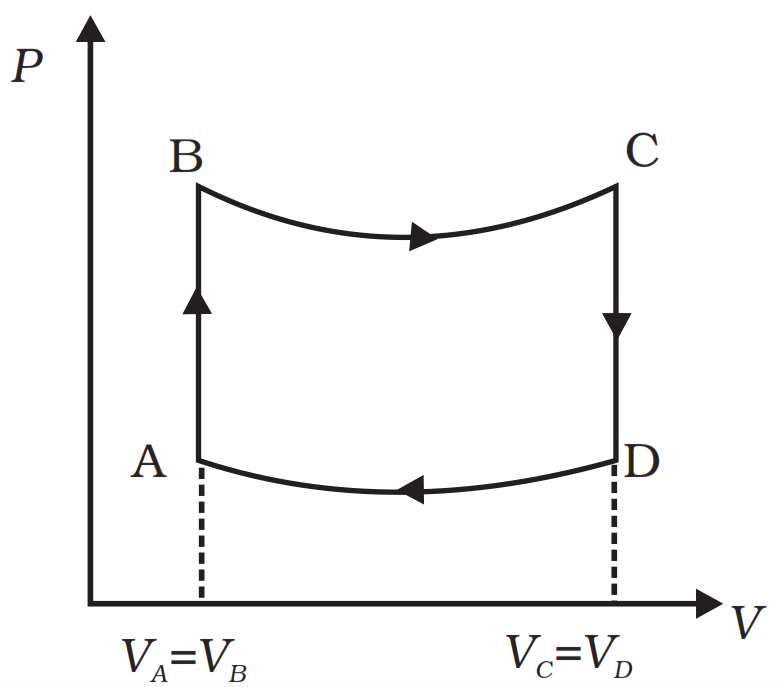
A cycle followed by an engine (made of one mole of perfect gas in a cylinder with a piston) is shown in Fig.
A to B : volume constant B to C : adiabatic C to D : volume constant D to A : adiabatic $V_C= V_D= 2V_A= 2V_B$
  1. In which part of the cycle heat is supplied to the engine from outside?
  2. In which part of the cycle heat is being given to the surrounding by the engine?
  3. What is the work done by the engine in one cycle? Write your answer in term of $P_A, P_B, V_A$.
  4. What is the efficiency of the engine?[$\gamma=\frac{5}{3}$ for the gas], $\big(\text{C}_\text{v}=\frac{3}{2}\text{R for one mole}\big)$
An object of mass $0.4kg$ moving with a velocity of $4ms^{-1}$ collides with another object of mass $0.6kg$ moving in same direction with a velocity of $2ms^{-1}$. If the collision is prefectly inelastic, what is the loss of K.E. due to impact?
Air is pumped into the tubes of a cycle rickshaw at a pressure of $2$ atm . The volume of each tube at this pressure is $0.002 \mathrm{~m}^3$. One of the tubes gets punctured and the volume of the tube reduces to $0.0005 \mathrm{~m}^3$. How many moles of air have leaked out? Assume that the temperature remains constant at $300 K$ and that the air behaves as an ideal gas.
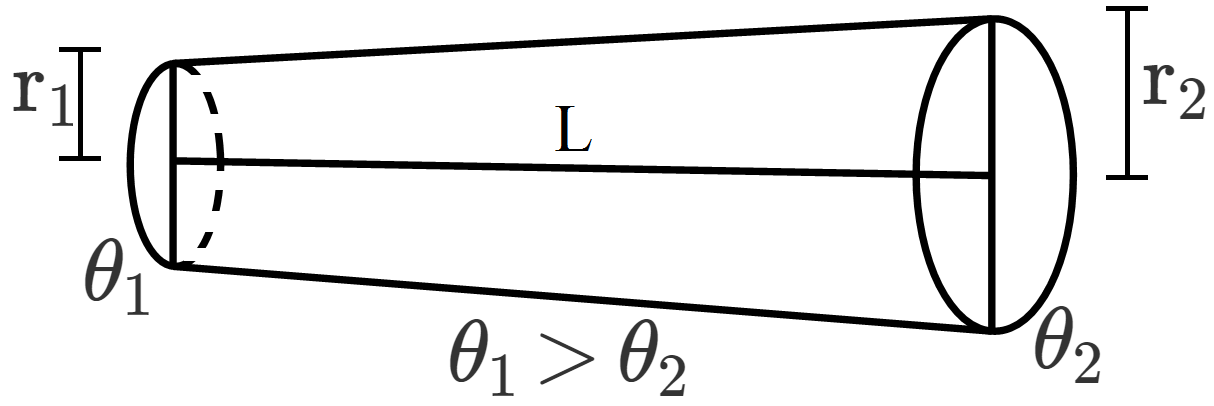
Find the rate of heat flow through a cross section of the rod shown in figure, $\big(\theta_2>\theta_1\big).$ Thermal conductivity of the material of the rod is K.
From a uniform circular disc of diameter d, a circular hole of diameter $\frac{\text{d}}{6}$ and having its centre at a distance of $\frac{\text{d}}{4}$ from the centre of the disc is scooped out. Find the centre of mass of the remaining portion.
Two bodies of masses $10kg$ and $20kg$ respectively kept on a smooth, horizontal surface are tied to the ends of a light string. A horizontal force $F = 600N$ is applied to (i) A, (ii) B along the direction of string. What is the tension in the string in each case?