MCQ
Given $\left| {{\vec A_1}} \right| = 2,\,\left| {{\vec A_2}} \right| = 3$ and $\left| {{{\vec A}_1} + {{\vec A}_2}} \right| = 3$.  Find the value or $\left| {\left( {{{\vec A}_1} + 2{{\vec A}_2}} \right) \times \left( {3{{\vec A}_1} - 4{{\vec A}_2}} \right)} \right|$
  • $64$
  • B
    $60$
  • C
    $62$
  • D
    $61$

Answer

Correct option: A.
$64$
a

Need a full question paper?

Generate a complete, print-ready paper with questions like this in minutes — across 16+ boards, with answer keys.

Start Generating Free

Similar questions

The total energy of particle performing $S.H.M.$ depend on
Assertion $(A):$ An astronaut in an orbiting space station above the earth experience weightlessness.
Reason $(R):$ An object moving around the earth under the influence of earth's gravitational force is in a state of 'free fall'.
A train is moving towards north. At one place it turns towards north-east, here we observe that
A force of $5\, N$, making an angle $\theta $ with the horizontal, acting on an object displaces it by $0.4\,m$ along the horizontal direction. If the object gains kinetic energy of $1\,J$, the horizontal component of the force is......$N$
A body of mass $0.5\, kg$ travels on straight line path with velocity $v =\left(3 x ^{2}+4\right) m / s$. The net workdone by the force during its displacement from $x =0$ to $x =2\, m$ is$.......J$
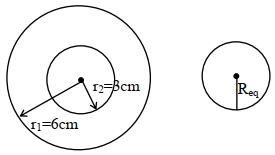
A soap bubble of radius $3\, {cm}$ is formed inside the another soap bubble of radius $6\, {cm}$. The radius of an equivalent soap bubble which has the same excess pressure as inside the smaller bubble with respect to the atmospheric pressure is .......... ${cm}$ 
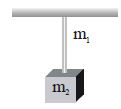
One end of a uniform rod of mass $m_1$ and crosssectional area $A$ is hung from a ceiling. The other end of the bar is supporting mass $m_2$. The stress at the midpoint is
A body of mass $6\,kg$ is under a force which causes displacement in it given by $S = \frac{{{t^2}}}{4}$ metres where $t$ is time. The work done by the force in $2 \,seconds$ is ............... $\mathrm{J}$
If the ratio of vapour density for hydrogen and oxygen is $\frac{1}{{16}}$, then under constant pressure the ratio of their rms velocities will be
The displacement of the interfering light waves are ${y_1} = 4\sin \omega \,t$ and ${y_2} = 3\sin \left( {\omega \,t + \frac{\pi }{2}} \right)$. What is the amplitude of the resultant wave