Question
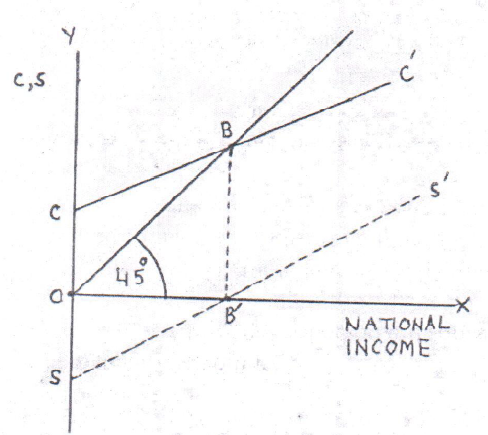
Given saving curve, derive consumption curve and state the steps in doing so. Use diagram.
Generate a complete, print-ready paper with questions like this in minutes — across 16+ boards, with answer keys.
| S.No. | Particulars | Amount (In ₹ crores) |
| (i) | National Income | 71,000 |
| (ii) | Gross Domestic Capital Formation | 10,000 |
| (iii) | Government Final Consumption Expenditure | ? |
| (iv) | Mixed Income of Self Employed | ? |
| (v) | Net Factor Income from Abroad | 1,000 |
| (vi) | Net Indirect Taxes | 2,000 |
| (vii) | Profits | 1,200 |
| (viii) | Wages & Salaries | 15,000 |
| (ix) | Net Exports | 5,000 |
| (x) | Private Final Consumption Expenditure | 40,000 |
| (xi) | Consumption of Fixed Capital | 3,000 |
| (xii) | Operating Surplus | 30,000 |
|
|
|
(₹ crores)
|
|
(i)
|
Net current transfers to abroad
|
$10$
|
|
(ii)
|
Private final consumption expenditure
|
$500$
|
|
(iii)
|
Current tansfers from government
|
$30$
|
|
(iv)
|
Net factor income to abroad
|
$20$
|
|
(v)
|
Net exports
|
$(-) 20$
|
|
(vi)
|
Net indirect tax
|
$120$
|
|
(vii)
|
National debt interest
|
$70$
|
|
(viii)
|
Net domestic capital formation
|
$80$
|
|
(ix)
|
Income accruing to government
|
$60$
|
|
(x)
|
Government final consumption expenditure
|
$100$
|
| (Rs. crore) | |
|
1000 |
|
100 |
|
1500 |
|
20 |
|
300 |
|
50 |
|
20 |
|
110 |
|
15 |
|
(–) 10 |
| ₹ in crores | ||
| (i) | Compensation of employees | 250 |
| (ii) | Mixed income of self-employed | 600 |
| (iii) | Profit | 80 |
| (iv) | Rent | 30 |
| (v) | Interest | 40 |
| (vi) | Net factor income to abroad | (–) 10 |
| (vii) | Net exports | 15 |
| (viii) | Consumption of fixed capital | 20 |
| (ix) | Net indirect taxes | 10 |
| (x) | Net current transfers to abroad | 8 |