Question
Given:$\sec A=\frac{29}{21}$, evaluate $: \sin A -\frac{1}{\tan A }$

Answer

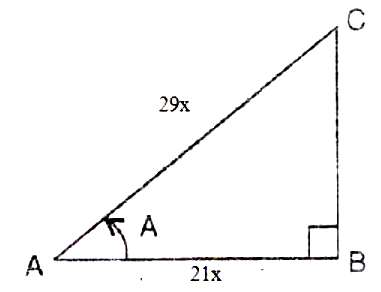
Consider the diagram below :


$\sec A=\frac{29}{21}$
i.e. $\frac{\text { hypotenuse }}{\text { base }}=\frac{29}{21}$
$\Rightarrow \frac{ AC }{ AB }=\frac{29}{21}$
Therefore if length of $AB = 21x$ , length of $AC = 29x$
Since
$AB^2 + BC^2 = AC^2\dots ...[$Using Pythagoras Theorem$]$
$(21x)^2 + BC^2 = ( 29x)^2$
$BC^2 = 841x^2 – 441x^2 =400x^2$
$BC = 20x \dots...($perpendicular$)$
Now
$\sin A =\frac{\text { perpendicular }}{\text { hypotenuse }}=\frac{20 x}{29 x}=\frac{20}{29}$
$\tan A =\frac{\text { perpendicular }}{\text { base }}=\frac{20 x}{21 x}=\frac{20}{21}$
Therefore
$\sin A -\frac{1}{\tan A }$
$=\frac{20}{29}-\frac{1}{\frac{20}{21}}$
$=\frac{20}{29}-\frac{21}{20}$
$=-\frac{209}{580}$

Need a full question paper?

Generate a complete, print-ready paper with questions like this in minutes — across 16+ boards, with answer keys.
Start Generating Free