Question
Given that; $A = B = C$. If $\vec A + \vec B = \vec C,$ then the angle between $\vec A$ and $\vec C$ is $\theta _1$. If $\vec A + \vec B+ \vec C = 0,$ then the angle between $\vec A$ and $\vec C$ is $\theta _2$. What is the relation between $\theta _1$ and $\theta _2$ ?
Answer

Get the step-by-step solution for this question inside the Vidyadip app.

Get the answer in the app

Need a full question paper?

Generate a complete, print-ready paper with questions like this in minutes — across 16+ boards, with answer keys.

Start Generating Free

Similar questions

In a radioactive reaction $_{92}{X^{232}}{ \to _{82}}{Y^{204}}$, the number of $\alpha - $ particles emitted is
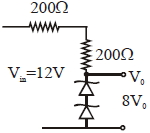
The circuit shown below is working as a $8\; \mathrm{V}\;dc$ regulated voltage source. When $12 \;\mathrm{V}$ is used as input, the power dissipated (in $\mathrm{mW}$ ) in each diode is

(considering both zener diodes are identical)

If particle is executing simple harmonic motion with time period $T$, then the time period of its total mechanical energy is ...........
A charged capacitor discharges through a resistance $R$ with time constant $\tau$. The two are now placed in series across an $AC$ source of angular frequeny $\omega = \frac{1}{\tau }$ The impedance of the circuit will be-
The refractive index of flint glass for blue line is $1.6333$ and red line is $1.6161$, then dispersive power of the Prism is
At $0°C $ the density of a fixed mass of a gas divided by pressure is $x.$ At $100°C,$ the ratio will be
The ratio of electric fields on the axis and at equator of an electric dipole will be
This is constant so option $(2)$ is correct.

The value of net resistance of the network as shown in the given figure is:

If the kinetic energy of a body is directly proportional to time $t,$ the magnitude of force acting on the body is

$(i)$ directly proportional to $\sqrt t$
$(ii)$  inversely proportional to  $\sqrt t$
$(iii)$ directly proportional to the speed of the body
$(iv)$ inversely proportional to the speed of body

If the direction of the initial velocity of the charged particle is perpendicular to the magnetic field, then the orbit will be   or  The path executed by a charged particle whose motion is perpendicular to magnetic field is