MCQ
Given that $u_x=$ horizontal component of initial velocity of a projectile, $u_y=$ vertical component of initial velocity, $R=$ horizontal range, $T=$ time of flight and $H=$ maximum height of projectile. Now match the following two columns.
Column $I$ Column $II$
$(A)$ $u_x$ is doubled, $u_y$ is halved $(p)$ $H$ will remain unchanged
$(B)$ $u_y$ is doubled $u_x$ is halved $(q)$ $R$ will remain unchanged
$(C)$ $u_x$ and $u_y$ both are doubled $(r)$ $R$ will become four times
$(D)$ Only $u_y$ is doubled $(s)$ $H$ will become four times
  • $( A \rightarrow q , B \rightarrow q , r , C \rightarrow r , s , D \rightarrow s )$
  • B
    $( A \rightarrow s , B \rightarrow q , r , C \rightarrow r , s , D \rightarrow p )$
  • C
    $( A \rightarrow p , B \rightarrow q , r , C \rightarrow r , s , D \rightarrow s )$
  • D
    $( A \rightarrow q , B \rightarrow q , p , C \rightarrow r , s , D \rightarrow s )$

Answer

Correct option: A.
$( A \rightarrow q , B \rightarrow q , r , C \rightarrow r , s , D \rightarrow s )$
a
(a)

Need a full question paper?

Generate a complete, print-ready paper with questions like this in minutes — across 16+ boards, with answer keys.

Start Generating Free

Similar questions

If the length of the simple pendulum is increased by $44\%$, then what is the change in time period of pendulum ..... $\%$
Which one has the dimensions different from the remaining three
What is the velocity of a metallic ball of radius r falling in a tank of liquid at the instant when its acceleration is one half that of a freely falling body? (The densities of metal and of liquid are $\rho$ and $\sigma$ respectively and of viscosity of liquid is $\eta$)
What is work done in holding a body of mass 20kg at a height of 2m above the ground? (g = 10m/ s2)
The dimensions of solar constant (energy falling on earth per second per unit area) are
The speed of light depends:
  1. On elasticity of the medium only.
  2. On inertia of the medium only.
  3. On elasticity as well as inertia.
  4. Neither on elasticity nor on inertia.
A glass capillary tube of inner diameter $0.28 \,mm$ is lowered vertically into water in a vessel. The pressure to be applied on the water in the capillary tube so that water level in the tube is same as that in the vessel is ............ $\times 10^3$ (surface tension of water $=0.07 \,N / m$ and atmospheric pressure $\left.=10^5 \,N / m ^2\right)$.
Two capillary tubes of same radius $r$ but of lengths $l_1$ and $l_2$ are fitted in parallel to the bottom of a vessel. The pressure head is $P$. What should be the length of a single tube that can replace the two tubes so that the rate of flow is same as before
Which is the point at which all three states of matter exist are in equilibrium are called :
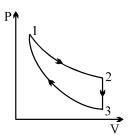
Three processes form a thermodynamic cycle as shown on $P-V$ diagram for an ideal gas. Process $1 \rightarrow 2$ takes place at constant temperature $(300K$). Process $2 \rightarrow 3$ takes place at constant volume. During this process $40J$ of heat leaves the system. Process $3 \rightarrow 1$ is adiabatic and temperature $T_3$ is $275K$. Work done by the gas during the process $3 \rightarrow 1$ is ..... $J$