MCQ
Given the correct order of initials $T$ or $F$ for following statements. Use $T$ if  statements is true and $F$ if it is false

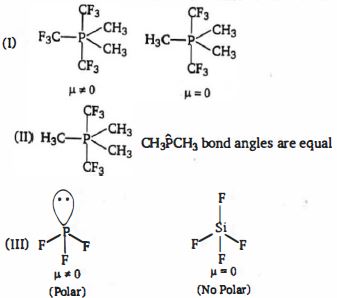
$(I)\, (CH_3)_2P(CF_3)_3$ is non-polar and $(CH_3)_3P(CF_3)_2$ is polar  molecule
$(II)\, CH_3 \widehat{P} CH_3$ bond angles are equal in $(CH_3)_3P(CF_3)_2$ molecule
$(III)\,PF_3$ will be more soluble in polar solvent than $SiF_4$

  • A
    $TTF$
  • B
    $FFT$
  • C
    $FFF$
  • $FTT$

Answer

Correct option: D.
$FTT$
d

Need a full question paper?

Generate a complete, print-ready paper with questions like this in minutes — across 16+ boards, with answer keys.

Start Generating Free

Similar questions

The uncertainties in the velocities of two particles, $A$ and $B$ are $0.05$ and $0.02\, ms^{-1}$ respectively. The mass of $B$ is five times to that of the mass of $A$. What is the ratio of uncertainties $\frac{{\Delta {x_A}}}{{\Delta {x_B}}}$ in their positions ?
Major development $(s)$ responsible for the formulation of Bohr's model of atom were :
Who is regarded as father of modern chemistry ?
Non-oxide ceramics can be
Based on the following thermochemical equations

${H_2}O\left( g \right) + C\left( s \right) \to CO\left( g \right) + {H_2}\left( g \right);\Delta H = 131\,kJ$

$CO\left( g \right) + \frac{1}{2}{O_2}\left( s \right) \to C{O_2}\left( g \right);\Delta H =  - 282\,kJ$

${H_2}\left( g \right) + \frac{1}{2}{O_2}\left( s \right) \to {H_2}O\left( g \right);\Delta H =  - 242\,kJ$

$C(s) + O_2(g) \to CO_2(g); \Delta H = X\,kJ$

The value of $X$ will be......$kJ$

Given the bond energies $N \equiv N,\,\,H - H$ and $N - H$ bonds are $945,\,436$ and $391\,kJ\,mol{e^{ - 1}}$ respectively, the enthalpy of the following reaction ${N_2}(g) + 3{H_2}(g) \to 2N{H_3}(g)$ is......$kJ$
For the process $\mathrm{H}_2 \mathrm{O}(1)(1$ bar, $373 \mathrm{~K}) \rightarrow \mathrm{H}_2 \mathrm{O}(\mathrm{g})(1$ bar, $373 \mathrm{~K})$, the correct set of thermodynamic parameters is
Select the hybrdisation which have non planar geometry when all are bond pair, but planar when there are $2$ lone pairs on central atom :
The pair likely to form the strongest hydrogen bonding  is 
The $pH$ of a $0.1$ molar solution of the acid $HQ$ is $3.$ The value of the ionization constant, $K_a$ of the acid is :