Question
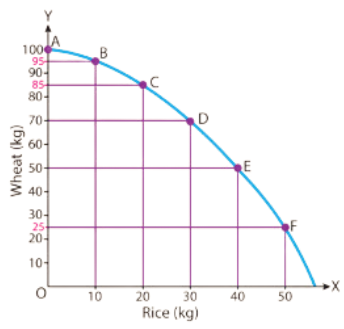
Given the following data, draw a production possibility curve. Also find marginal opportunity cost.
PossibilitiesABCDEF
Wheat (kg)1009585705025
Rice (kg)01020304050

Need a full question paper?

Generate a complete, print-ready paper with questions like this in minutes — across 16+ boards, with answer keys.

Start Generating Free

Similar questions

Direction Read the following case study and answer questions 1 to 5 on the basis of the same.
Collection of data is the first step in a statistical analysis. Data can be collected either from primary source or secondary source. Primary data is original as it is being collected for the first time. After collecting the data, next step is to organise the data as raw data cannot be used for further statistical analysis. There are various methods of classification of data based upon the nature of quantitative data.
  1. Time series graphs are presented on the basis of general characteristics of a data. Choose from the options below.
  1. True
  2. False
  3. Partially true
  4. Incomplete statement
  1. Classification of data based on time period is known as ......... classification.
  1. Chronological
  2. Temporal
  3. Spatial
  4. Both (a) and (b)
  1. Data are grouped with reference to the attributes is referred to as ... classification.
  1. Qualitative
  2. Quantitative
  3. Both (a) and (b)
  4. Neither (a) nor (b)
  1. In which of the following method of frequency distribution, the upper limit of each class is excluded from the series but equal to the lower limit of the succeeding series?
  1. Continuous exclusive frequency distribution.
  2. Continuous inclusive frequency distribution.
  3. Continuous cumulative frequency distribution.
  4. None of the above.
Find the Standard Deviation from the given data.
S. No. 1 2 3 4 5
X 10 20 30 40 50
Following table shows the marks obtained by a student. Draw a pie diagram to represent the data:
Subject:
English
Histoty
Economics
Maths
Geogtaphy
Marks:
60
75
80
95
80
Construct a pie diagram to represent the cost of construction of a house in Delhi.
Itens
Expenditure (in %)
Labour
25
Bricks
15
Cement
20
Steel
15
Timber
10
Supervision
15
Use the data in Table 3.2 that relate to monthly household expenditure (in ₹) on food of 50 households and:
  1. Obtain the range of monthly household expenditure on food.
  2. Divide the range into appropriate number of class intervals and obtain the frequency distribution of expenditure.
  3. Find the number of households whose monthly expenditure on food is:
  1. Less than ₹ 2000
  2. More than ₹ 3000
  3. Between ₹ 1500 and ₹ 2500
Calculate standard deviation and coefficient of variation from the following data.
Matks: Below 20 Below 40 Below 60 Below 80 Below 100
Number of Students: 8 20 50 70 80
Hint: Since, less than distribution is given, we first convert into an exclusive distribution.
What is a statistical series? Explain different types of statistical series on the basis of character.
Calculate Coefficient of correlation using step deviation method:
X $30$ $40$ $60$ $70$ $100$
Y $90$ $110$ $140$ $150$ $160$
Direction of export is shown in the following table. Prepare a pie diagram to show the percentage distribution of export.
Cuntry
Export (in %)
USA
25
Japan
15
UK
30
China
20
Others
10
A team comprising of three people is working on a big project, which involves data entry, with subsequent processing of this data and making a poster presentation.
Obviously each member of the team has different abilities in performing each task. Accordingly, Rhythm can make 1 poster or 400 data entries in a day. Hard-working Smith can make 2 posters or 1,200 data entries in a day. Stephen can make 3 posters or 900 data entries in a day.

(i) Initially if the entire team works on data entry, how many entries can be made in a day?
(ii) Eventually you wish to shift one member to the task of poster making whom would you shift and why?
(iii) Reassigning team members from data entry to making posters implies what about the shape of PPC?