MCQ
Given the function $f(x) = 2x \sqrt {{x^3}\, - \,\,1}    + 5 \sqrt x  \sqrt {1\,\, - \,\,{x^4}}  + 7x^2 \sqrt {x\,\, - \,\,1} + 3x + 2$ then :
  • A
    the function is continuous but not differentiable at $x = 1$
  • the function is discontinuous at $x = 1$
  • C
    the function is both cont. $\&$ differentiable at $x = 1$
  • D
    the range of $f(x)$ is $R^+.$

Answer

Correct option: B.
the function is discontinuous at $x = 1$
b

Need a full question paper?

Generate a complete, print-ready paper with questions like this in minutes — across 16+ boards, with answer keys.

Start Generating Free

Similar questions

If $f'(x) = \sin (\log x)$ and $y = f\left( {\frac{{2x + 3}}{{3 - 2x}}} \right)$, then $\frac{{dy}}{{dx}} = $
Two cards are drawn from a well shuffled deck of 52 playing cards with replacement. The probability that both cards are queen is
  1. $\frac{1}{13}\times\frac{1}{13}$
  2. $\frac{1}{13}+\frac{1}{13}$
  3. $\frac{1}{13}\times\frac{1}{17}$
  4. $\frac{1}{13}\times\frac{4}{5}$
$\mathop \smallint \limits_{ - \pi /2}^{\pi /2} \frac{{{{\sin }^2}x}}{{1 + {2^x}}}dx =$ . ..  . 
If the area above the $x -$ axis, bounded by the curves $y = {2^{kx}}$ and $x = 0$ and $x = 2$ is $\frac{3}{{\ln 2}},$ then the value of $k$ is
Let $P ( x )= x ^{2}+ bx + c$ be a quadratic polynomial with real coefficients such that $\int_{0}^{1} P ( x ) dx =1$ and $P ( x )$ leaves remainder $5$ when it is divided by $(x-2)$. Then the value of $9(b+c)$ is equal to:
 $(i)$  $f (x)$ is continuous and defined for all real numbers

$(ii)$ $f '(-5) = 0 \,; \,f '(2)$ is not defined and $f '(4)  = 0$

$(iii)$ $(-5, 12)$ is a point which lies on the graph of $f (x)$

$(iv)$ $f ''(2)$ is undefined, but $f ''(x)$ is negative everywhere else.

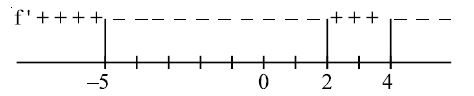
$(v)$ the signs of  $f '(x)$ is given below

Possible graph of $y = f (x)$ is

An unbiased coin is tossed $5$ times. Suppose that a variable $\mathrm{X}$ is assigned the value $\mathrm{k}$ when $\mathrm{k}$ consecutive heads are obtained for $\mathrm{k}=3,4,5$ otherwise $X$ takes the value $-1 .$ Then the expected value of $X,$ is
The system of equations $kx + 2y\,-z = 1$  ;  $(k\,-\,1)y\,-2z = 2$  ;  $(k + 2)z = 3$ has unique solution, if $k$ is equal to
Area of the region bounded by the curve $y=e^x$ and lines $x=0$ and $y=e$ is

$(A)$ $e-1$ $(B)$ $\int_1^e \ln (e+1-y) d y$ $(C)$ $e-\int_0^1 e^x d x$ $(D)$ $\int_1^r \ln y d y$

If a line makes angles $\alpha ,\beta ,\gamma ,\delta $ with the four diagonals of a cube, then the value of ${\cos ^2}\alpha + {\cos ^2}\beta + {\cos ^2}\gamma + {\cos ^2}\delta = $