Question
Given three equal resistors, how many different combination of all the three resistors can be made
|
(a) Six |
(b) Five |
(c) Four |
(d) Three |
Given three equal resistors, how many different combination of all the three resistors can be made
|
(a) Six |
(b) Five |
(c) Four |
(d) Three |
(c) Four
Generate a complete, print-ready paper with questions like this in minutes — across 16+ boards, with answer keys.
In Young’s double slit experiment, the central bright fringe can be identified
|
(a) By using white light instead of monochromatic light |
|
(b) As it is narrower than other bright fringes |
|
(c) As it is wider than other bright fringes |
|
(d) As it has a greater intensity than the other bright fringes |
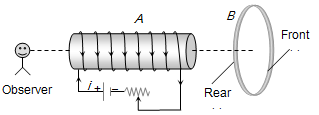
An aluminium ring B faces an electromagnet A. The current I through A can be altered
|
(a) Whether I increases or decreases, B will not experience any force |
|
(b) If I decrease, A will repel B |
|
(c) If I increases, A will attract B |
|
(d) If I increases, A will repel B |
The phenomenon utilised in an optical fibre is
|
(a) Refraction |
(b) Interference |
|
(c) Polarization |
(d) Total internal reflection |
When light is refracted from air into glass
|
(a) Its wavelength and frequency both increase |
|
(b) Its wavelength increases but frequency remains unchanged |
|
(c) Its wavelength decreases but frequency remains unchanged |
|
(d) Its wavelength and frequency both decrease |
A lens which has focal length of 4 cm and refractive index of 1.4 is immersed in a liquid of refractive index 1.6, then the focal length will be
|
(a) – 12.8 cm |
(b) 32 cm |
(c) 12.8 cm |
(d) – 32 cm |