MCQ
Given vector $\overrightarrow A = 2\hat i + 3\hat j, $ the angle between $\overrightarrow A $and $y-$axis is
  • A
    ${\tan ^{ - 1}}3/2$
  • ${\tan ^{ - 1}}2/3$
  • C
    ${\sin ^{ - 1}}2/3$
  • D
    ${\cos ^{ - 1}}2/3$

Answer

Correct option: B.
${\tan ^{ - 1}}2/3$
b
(b) $\vec{A}=2 \hat{i}+3 \hat{j}$

$A=|\vec{A}|=\sqrt{4+9}=\sqrt{13}$

$\cos \beta=\frac{y}{A}=\frac{3}{\sqrt{13}}$

$\cos \beta=\frac{3}{\sqrt{13}}$

$\sin \beta=\frac{x}{A}=\frac{2}{\sqrt{13}}$

$\operatorname{Tan} \beta =\frac{x}{y}=\frac{2}{3}$

$=\tan ^{-1}\left(\frac{2}{3}\right)$

Need a full question paper?

Generate a complete, print-ready paper with questions like this in minutes — across 16+ boards, with answer keys.
Start Generating Free

Similar questions

The correct value of ${0^o}C$ on the Kelvin scale is ........... $K$
The equation of a projectile is $y=\sqrt{3} x-\frac{ x^2}{2}$, the velocity of projection is
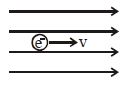
An electron is projected in the direction of electric field. Just after projection of electron
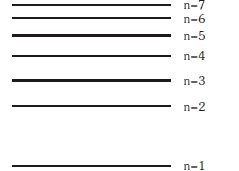
The maximum number of emission lines for atomic hydrogen that you would expect to see with naked eye if the only electronic levels involved are those shown in the figure, is
Given the masses of various atomic particles $m _{ p }=1.0072 u , m _{ n }=1.0087 u$ $m _{ e }=0.000548 u , m _{ v }=0, m _{ d }=2.0141 u$ where $p \equiv$ proton, $n \equiv$ neutron, $e \equiv$ electron, $\overline{ v } \equiv$ antineutrino and $d \equiv$ deuteron. Which of the following process is allowed by momentum and energy conservation $?$
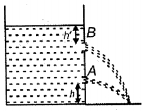
A tank is filled with water and two holes $A$ and $B$ are made in it. For getting same range, ratio of $h^{\prime} T h$ is ..........
Assertion : Binding energy (or mass defect) of hydrogen nucleus is zero.

Reason : Hydrogen nucleus contain only one nucleon.
Pauli suggested the emission of nutrino during $\beta^{+}$decay to explain
In the ideal double-slit experiment , when a glass-plate (refractive index $1.5$ ) of thickness $t$ is introduced in the path of one of the interfering beams (wave-length $\lambda$ ), the intensity at the position where the central maximum occurred previously remains unchanged. The minimum thickness of the glass-plate is
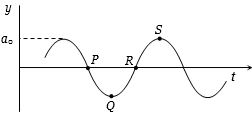
A wave motion has the function $y = {a_0}\sin (\omega \,t - kx)$. The graph in figure shows how the displacement $y$ at a fixed point varies with time $t$. Which one of the labelled points shows a displacement equal to that at the position $x = \frac{\pi }{{2k}}$ at time $t = 0$