Question
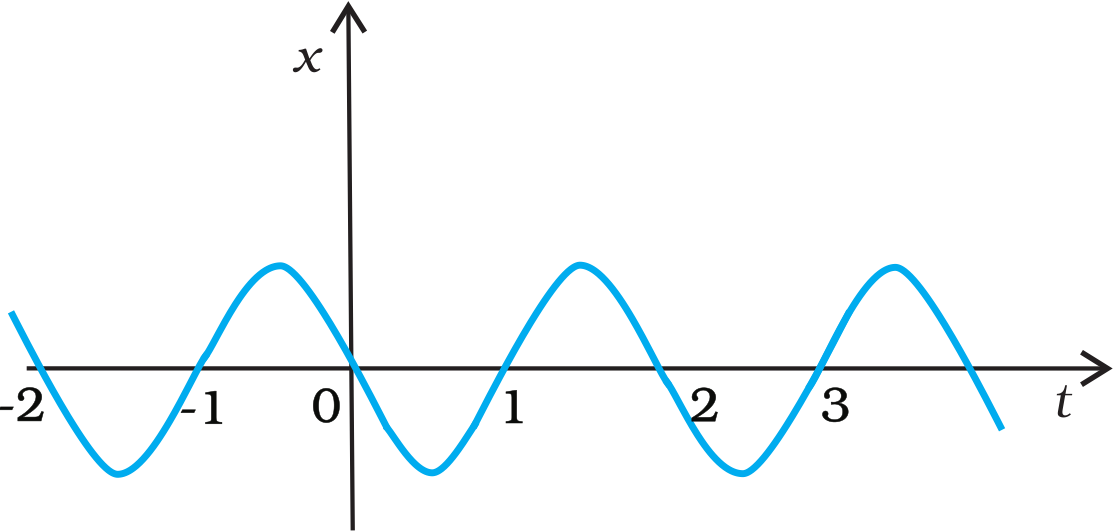
Gives the x-t plot of a particle executing one-dimensional simple harmonic motion. (You will learn about this motion in more detail in Chapter 14). Give the signs of position, velocity and acceleration variables of the particle at t = 0.3 s, 1.2 s, – 1.2 s.
Answer

For simple harmonic motion (SHM) of a particle, acceleration (a) is given by the relation:
$\text{a}=-\omega^2\text{x}$
Where $\omega$ = angular frequency
t = 0.3s
In this time interval, x is negative. Now the slope of the x-t plot is negative. Therefore, both position and velocity are negative. Acceleration of the particle using (i) will be positive.
t = 1.2s
In this time interval, x is positive. Now the slope of the x-t plot is positive. Therefore, both position and velocity are positive. Acceleration of the particle using (i) will be negative.
t = – 1.2s
In this time interval, x is negative. Now the slope of the x-t plot is positive. Therefore, position is negative and velocity is positive. Acceleration of the particle using (i) will be positive.

Need a full question paper?

Generate a complete, print-ready paper with questions like this in minutes — across 16+ boards, with answer keys.

Start Generating Free

Similar questions

A rigid bar of mass 15kg is supported symmetrically by three wires each 2.0m long. Those at each end are of copper and the middle one is of iron. Determine the ratios of their diameters if each is to have the same tension.
Two charges 2.0 × 10-6C and 1.0 × 10-6C are placed at a separation of 10cm. Where should a third charge be placed such that it experiences no net force due to these charges?
A famous relation in physics relates ‘moving mass’ m to the ‘rest mass’ mo of a particle in terms of its speed v and the speed of light, c. (This relation first arose as a consequence of special relativity due to Albert Einstein). A boy recalls the relation almost correctly but forgets where to put the constant c. He writes:

$\text{m}=\frac{\text{m}_0}{(1-\text{v}^2)^{1/2}}.$

Guess where to put the missing c.

The heat dissipated in a resistance can be obtained by the measurement of resistance, the current and time. If the maximum error in the measurement of these quantities is 1%, 2% and 1% respectively, what is the maximum error in determination of the dissipated heat?
A beam of uniform cross-section and uniform mass-density of mass 20kg is supported at ends. A mass of 5kg is placed at a distance of $\frac{\text{L}}{5\text{m}} $ from one of its end. If beam is L m long, what are reactions of supports?
In dealing with problems of equilibrium of a rigid body (like beam in this question). first of all draw a free body diagram of the system, indicating all of the forces acting on the system.
The position, velocity and acceleration of a particle executing simple harmonic motion are found to have magnitudes 2cm, 1m/s and 10m/s2 at a certain instant. Find the amplitude and the time period of the motion.
Giving the definition of rotational kinetic energy. Establish I = 2Er.
Derive a relation for work done in a gravitational field. Using it, (i) find potential difference between a pair of points. (ii) express whether gravitational force is conservative or non-conservative.
An adiabatic vessel of total volume V is divided into two equal parts by a conducting separator. The separator is fixed in this position. The part on the left contains one mole of an ideal gas (U = 1.5nRT) and the part on the right contains two moles of the same gas. Initially, the pressure on each side is p. The system is left for sufficient time so that a steady state is reached. Find,
  1. The work done by the gas in the left part during the process.
  2. The temperature on the two sides in the beginning.
  3. The final common temperature reached by the gases.
  4. The heat given to the gas in the right part.
  5. The increase in the internal energy of the gas in the left part.
Discuss how the principle of conservation of momentum is used in the launching of rockets. Deduce an expression for, (i) velocity at any instant and (ii) acceleration of the rocket and force experienced.