MCQ
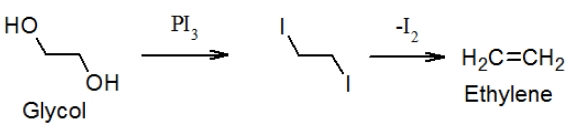
Glycol on treatment with $PI_3$ mainly gives -
- ✓Ethylene
- BEthylene iodide
- CEthyl iodide
- DEthane
Generate a complete, print-ready paper with questions like this in minutes — across 16+ boards, with answer keys.
Choose the correct answer from the options given below:
$M \mid M ^{2+}$ (saturated solution of a sparingly soluble salt, $\left.MX _2\right) \| M ^{2+}\left(0.001\right.$ mol dm $\left.d ^{-3}\right) \| M$ The emf of the cell depends on the difference in concetration of $M ^{2+}$ ions at the two electrodes. The emf of the cell at $298$ is $0.059 \ V$
$1.$ The solubility product $\left( K _{ sp } ; mol ^3 dm ^{-9}\right)$ of $MX _2$ at $298$ based on the information available the given concentration cell is (take $2.303 \times R \times 298 / F =0.059 \ V$ )
$(A)$ $1 \times 10^{-15}$ $(B)$ $4 \times 10^{-15}$
$(C)$ $1 \times 10^{-12}$ $(D)$ $4 \times 10^{-12}$
$2.$ The value of $\Delta G \left( kJ \ mol ^{-1}\right)$ for the given cell is (take $1 F =96500 \ C \ mol ^{-1}$ )
$(A)$ $-5.7$ $(B)$ $5.7$ $(C)$ $11.4$ $(D)$ $-11.4$
Give the answer question $1$ and $2.$
$F{e^{ + 2 }} + 2{e^ - }\, \to \,Fe\,;\,\,\,\,{E^o} = - 0.440\,V$
$F{e^{ + 3 }} + 3{e^ - }\, \to \,Fe\,;\,\,\,\,{E^o} = - 0.036\,V$The standard electrode potential $({E^o})$ for$F{e^{ + 3 }} + {e^ - } \to \,F{e^{ + 2 }}$ is .............. $\mathrm{V}$