MCQ
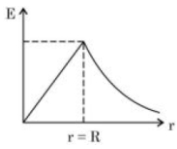
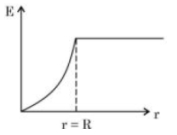
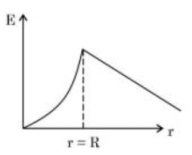
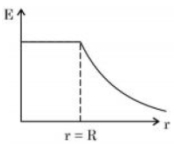
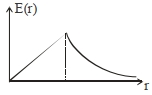
Graphical variation of electric field due to a uniformly charged insulating solid sphere of radius $R$, with distance $r$ from the centre $O$ is represented by:

  • B

  • C

  • D

Answer

Correct option: A.

a
Electric field of solid sphere (uniformly charged)

$E( r ) \begin{cases}\frac{ Q }{4 \pi \in_0 r ^2} & r \geq R \\ \frac{ Qr }{4 \pi \in_0 R ^3} & r \leq R \end{cases}$

Graphically

$E(r) \propto r$ for $r \leq R$

$\propto \frac{1}{r^2} \text { for } r \geq R$
Need a full question paper?

Generate a complete, print-ready paper with questions like this in minutes — across 16+ boards, with answer keys.

Start Generating Free

Similar questions

A rod of length $l$ having uniformly distributed charge $Q$ is rotated about one end with constant frequency $'f'.$ Its magnetic moment
At some location on earth the horizontal component of earth’s magnetic field is $18\times10^{-6}\,T$. At this location, magnetic needle of length $0.12\, m$ and pole strength $1.8\, A\,m$ is suspended from its mid-point using a thread, it makes $45^o$ angle with horizontal in equilibrium. To keep this needle horizontal, the vertical force that should be applied at one of its ends is
A small block of mass $m$ is kept on a rough inclined surface of inclination $\theta$ fixed in an elevator. The elevator goes up with a uniform velocity $v$ and the block does not slide on the wedge. The work done by the force of friction on the block in time $t$ as seen by the observer on the inclined plane will be
An astronomical telescope of ten-fold angular magnification has a length of $44\, cm$. The focal length of the objective is.......$cm$
Two particles move at right angle to each other. Their de Broglie wavelengths are ${\lambda _1}$ and ${\lambda _2}$ respectively. The particles suffere perfectly inelastic collision. The de Broglie wavelength $\lambda $ , of the final particle, is given by
An isolated rail car of mass $M$ is moving along a straight, frictionless track at an initial speed $v_0$. The car is passing under a bridge when $a$ crate filled with $N$ bowling balls, each of mass $m$, is dropped from the bridge into the bed of the rail car. The crate splits open and the bowling balls bounce around inside the rail car, but none of them fall out. Is the momentum of the rail car $+$ bowling balls system conserved in this collision?
The momentum of a photon with energy $20\, eV$ is
The work done in increasing the length of a metre long wire of cross-sectional area ........ $J.$ $1\,mm^2$ through $1\,mm$ will be $(Y = 2 \times 10^{11}\,Nm^{-2})$
In the reaction sequence $2C{H_3}CHO\xrightarrow{{O{H^ - }}}A\xrightarrow{\Delta }B$ ; the product $B$ is
If the position vector of a particle is

$\vec r =  - \cos \,t\hat i + \sin \,t\hat j - 18\,t\hat k$

then what is the magnitude of its acceleration ?