Question
Graphs of two function $\text{f}(\text{x})=\text{sin}\text{ x}$ and $\text{(g)}\text{x}=\text{cos}\text{ x}$ is given below:
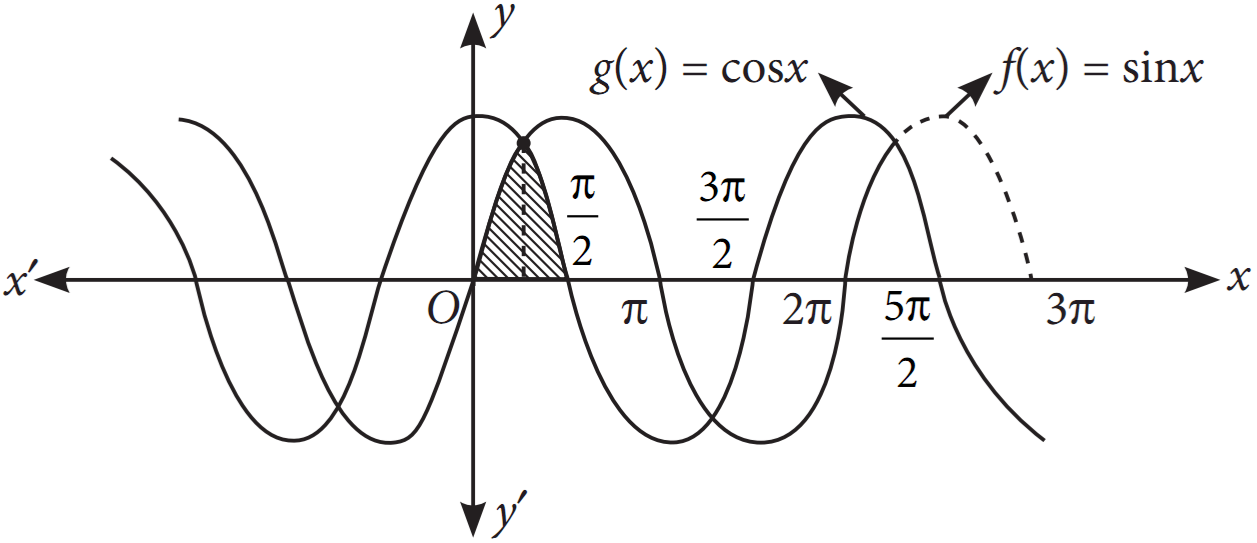
Based on the above information, answer the following questions.
  1. In $(0, \pi)$, the curves $\text{f}(\text{x})=\text{sin}\text{ x}$ and $\text{g}\text{ (x)}=\text{cos}\text{ x}$ at $\text{x}=$ 
    1. $\frac{\pi}{2}$
    2. $\frac{\pi}{3}$
    3. $\frac{\pi}{4}$
    4. ${\pi}$
  2. Value of $\int\limits_{0}^{\frac{\pi}{4}}\text{sin}\text{ x}\text{ dx}$ is.
    1. $1-\frac{1}{\sqrt{2}}$
    2. $1+\frac{1}{\sqrt{2}}$
    3. $2-\frac{1}{\sqrt{2}}$
    4. $2+\frac{1}{\sqrt{2}}$
  1. Value of $\int\limits_\frac{\pi}{4}^{\frac{\pi}{2}}\text{cos}\text{ x}\text{ dx}$ is.
    1. $1+\frac{1}{\sqrt{2}}$
    2. $1-\frac{1}{\sqrt{2}}$
    3. $2-\sqrt{2}$
    4. $2+\sqrt{2}$
  2. Value of $\int\limits_{0}^{\pi}\text{sin}\text{ x}\text{ dx}$ is.
  1. 0
  2. 1
  3. 2
  4. -2
  1. Value of $\int\limits_{0}^\frac{\pi}{2}\text{sin}\text{ x}\text{ dx}$ is.
  1. 0
  2. 1
  3. 3
  4. 4

Answer

  1. (c) $\frac{\pi}{4}$

Solution:

for point of intersection, we have

$\text{sin}\text{ x}=\text{cos}\text{ x}$

$\Rightarrow\frac{\text{sin}\text{ x}}{\text{cos}\text{ x}}=1$

$\Rightarrow\text{tan}\text{ x}=1$

$\Rightarrow\text{x}=\frac{\pi}{4}$

  1. (a) $1-\frac{1}{\sqrt{2}}$

Solution:

$\int\limits_{0}^{\frac{\pi}{4}}\text{sin}\text{ x}\text{ dx}=\big[-\text{cos x}\big]^\frac{\pi}{4}_0=-\text{cos}\frac{\pi}{4}+\text{cos}0$

$=1-\frac{1}{\sqrt{2}}$

  1. (b) $1-\frac{1}{\sqrt{2}}$

Solution:

$\int\limits_{\frac{\pi}{2}}^{\frac{\pi}{4}}\text{cos}\text{ x}\text{ dx}=\big[\text{sin x}\big]^\frac{\pi}{2}_\frac{\pi}{4}=\text{sin}\frac{\pi}{2}-\text{sin}\frac{\pi}{4}$

$=1-\frac{1}{\sqrt{2}}$

  1. (c) 2

Solution:

$\int\limits_{0}^{\pi}\text{sin}\text{ x}\text{ dx}=\big[-\text{cos x}\big]^{\pi}_0=\big[-\text{cos}{\pi}+\text{cos}0\big]=2$

  1. (b) 1

Solution:

$\int\limits_{0}^\frac{\pi}{2}\text{sin}\text{ x}\text{ dx}=\big[-\text{cos x}\big]^\frac{\pi}{2}_0=\Big[-\text{cos}\frac{\pi}{2}+\text{cos}0\Big]$

$=0+1+1$

Need a full question paper?

Generate a complete, print-ready paper with questions like this in minutes — across 16+ boards, with answer keys.

Start Generating Free

Similar questions

Ajay enrolled himself in an online practice test portal provided by his school for better practice. Out of 5 questions in a set-I, he was able to solve 4 of them and got stuck in the one which is as shown below.

If A and Bare independent events, P(A) = 0.6 and P(B) = 0.8, then answer the following questions.

  1. $\text{P}(\text{A}\cap\text{B})=$
  1. 0.2
  2. 0.9
  3. 0.48
  4. 0.6
  1. $\text{P}(\text{A}\cup\text{B})=$
  1. 0.92
  2. 0.08
  3. 0.48
  4. 0.64
  1. $\text{P}(\text{B}|\text{A})=$
  1. 0.14
  2. 0.2
  3. 0.6
  4. 0.8
  1. $\text{P}(\text{A}|\text{B})=$
  1. 0.6
  2. 0.9
  3. 0.19
  4. 0.11
  1. P (not A and not B)
  1. 0.01
  2. 0.48
  3. 0.08
  4. 0.91 
Three car dealers, say A, B and C, deals in three types of cars, namely Hatchback cars, Sedan cars, SUV cars. The sales figure of 2019 and 2020 showed that dealer A sold 120 Hatchback, 50 Sedan, 10 SUV cars in 2019 and 300 Hatchback, 150 Sedan, 20 SUV cars in 2020; dealer B sold 100 Hatchback, 30 Sedan, 5 SUV cars in 2019 and 200 Hatchback, 50 Sedan, 6 SUV cars in 2020; dealer C sold 90 Hatchback, 40 Sedan, 2 SUV cars in 2019 and 100 Hatchback, 60 Sedan, 5 SUV cars in 2020.

Image

(i) Write the matrix summarizing sales data of 2019 and 2020.

(ii) Find the matrix summarizing sales data of 2020.

(iii) Find the total number of cars sold in two given years, by each dealer?

OR

If each dealer receives a profit of ₹ 50000 on sale of a Hatchback, ₹100000 on sale of a Sedan and ₹200000 on sale of an SUV, then find the amount of profit received in the year 2020 by each dealer.

If two vectors are represented by the two sides of a triangle taken in order, then their sum is represented by the third side of the triangle taken in opposite order and this is known as triangle law of vector addition. Based on the above information, answer the following questions.

  1. If $\vec{\text{p}},\vec{\text{q}},\vec{\text{r}}$ are the vectors represented by the sides of a triangle taken in order, then $\vec{\text{q}},+\vec{\text{r}}=$
  1. $\vec{\text{p}}$

  2. $2\vec{\text{p}}$

  3. $-\vec{\text{p}}$

  4. None of these
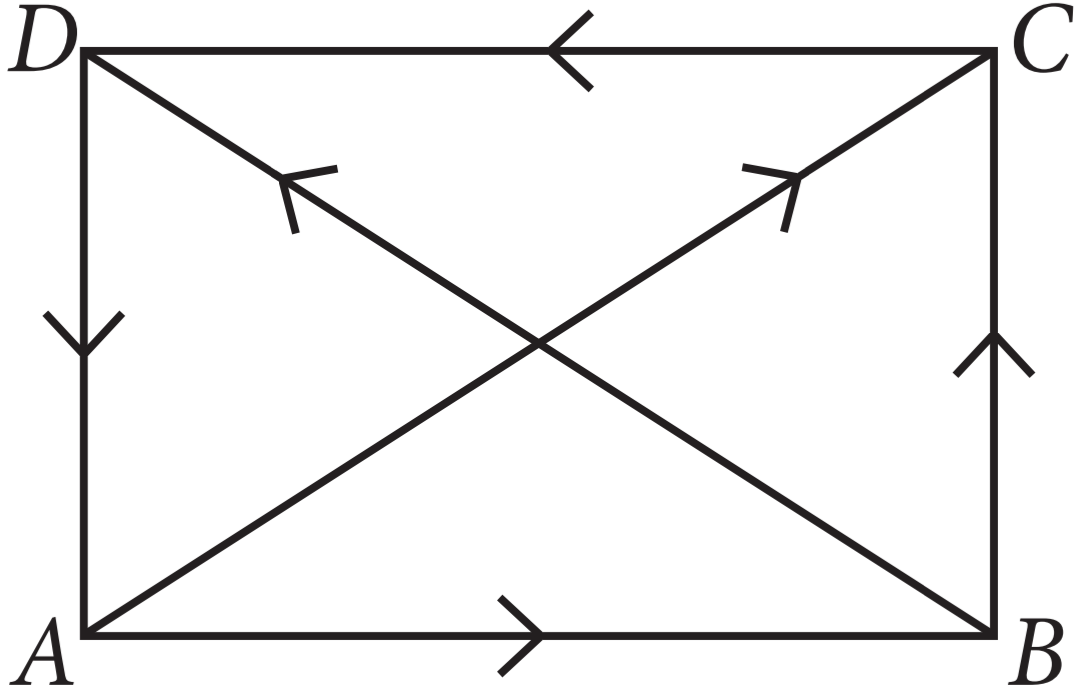
  1. If ABCD is a parallelogram and AC and BD are its diagonals, then $\overline{\text{AC}}+\overline{\text{BD}}=$
  1. $2\overline{\text{DA}}$

  2. $2\overline{\text{AB}}$

  3. $2\overline{\text{BC}}$

  4. $2\overline{\text{BD}}$

  1. If ABCD is a parallelogram, where $\overline{\text{AB}}=2\vec{\text{a}}$ and $\overline{\text{BC}}=2\vec{\text{b}},$ then $\overline{\text{AC}}-\overline{\text{BD}}=$
  1. $3\vec{\text{a}}$

  2. $4\vec{\text{a}}$

  3. $2\vec{\text{b}}$

  4. $4\vec{\text{b}}$

  1. If ABCD is a quadrilateral whose diagonals are $\overline{\text{AC}}$ and $\overline{\text{BD}},$ then $\overline{\text{BA}}+\overline{\text{DC}}=$

  1. $\overline{\text{AC}}+\overline{\text{DB}}$

  2.  $\overline{\text{AC}}+\overline{\text{BD}}$

  3. $\overline{\text{BC}}+\overline{\text{AD}}$

  4. $\overline{\text{BD}}+\overline{\text{CA}}$

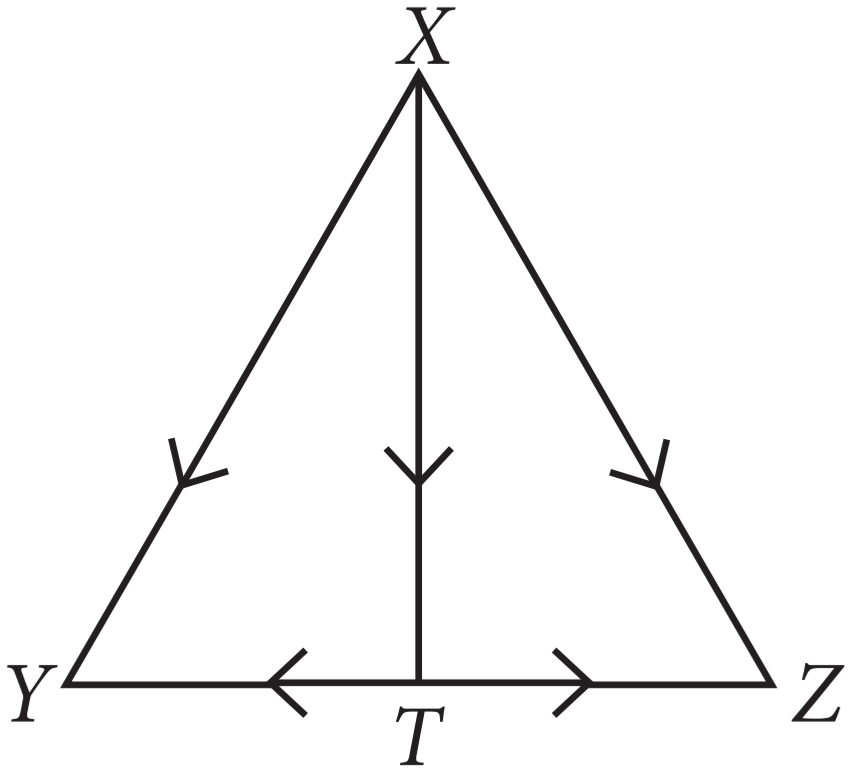
  1. If T is the mid point of side YZ of $\triangle\text{XYZ},$ then $\overline{\text{XY}}+\overline{\text{XZ}}=$

  1. $2\overline{\text{YT}}$

  2. $2\overline{\text{XT}}$

  3. $2\overline{\text{TZ}}$

  4. None of these
Western music concert is organised every year in the stadium that can hold 36000 spectators. With ticket price of ₹ 10, the average attendance has been 24000. Some financial expert estimated that price of a ticket should be determined by the function.
$\text{p}(\text{x})=15-\frac{\text{x}}{3000}$ where x is the number of tickets sold.

Based on the above information, answer the following questions.
  1. The revenue, R as a function of x can be represented as.
  1. $15\text{x}-\frac{\text{x}^2}{3000}$
  2. $15-\frac{\text{x}^2}{3000}$
  3. $15\text{x}-\frac{1}{3000}$
  4. $15\text{x}-\frac{\text{x}}{3000}$
  1. The range of x is.
  1. [24000, 36000]
  2. [0, 24000]
  3. [0, 36000]
  4. None of these
  1. The value of x for which revenue is maximum, is.
  1. 20000
  2. 21000
  3. 22500
  4. 25000
  1. When the revenue is maximum, the price of the ticket is.
  1. ₹ 5
  2. ₹ 5.5
  3. ₹ 7
  4. ₹ 7.5
  1. How many spectators should be present to maximize the revenue?
  1. 21500
  2. 21000
  3. 22000
  4. 22500
A spherical ball of salt is dissolving in water in such a manner that the rate of decrease of the volume at any instant is propotional to the surface. Prove that the radius is decreasing at a constant rate.
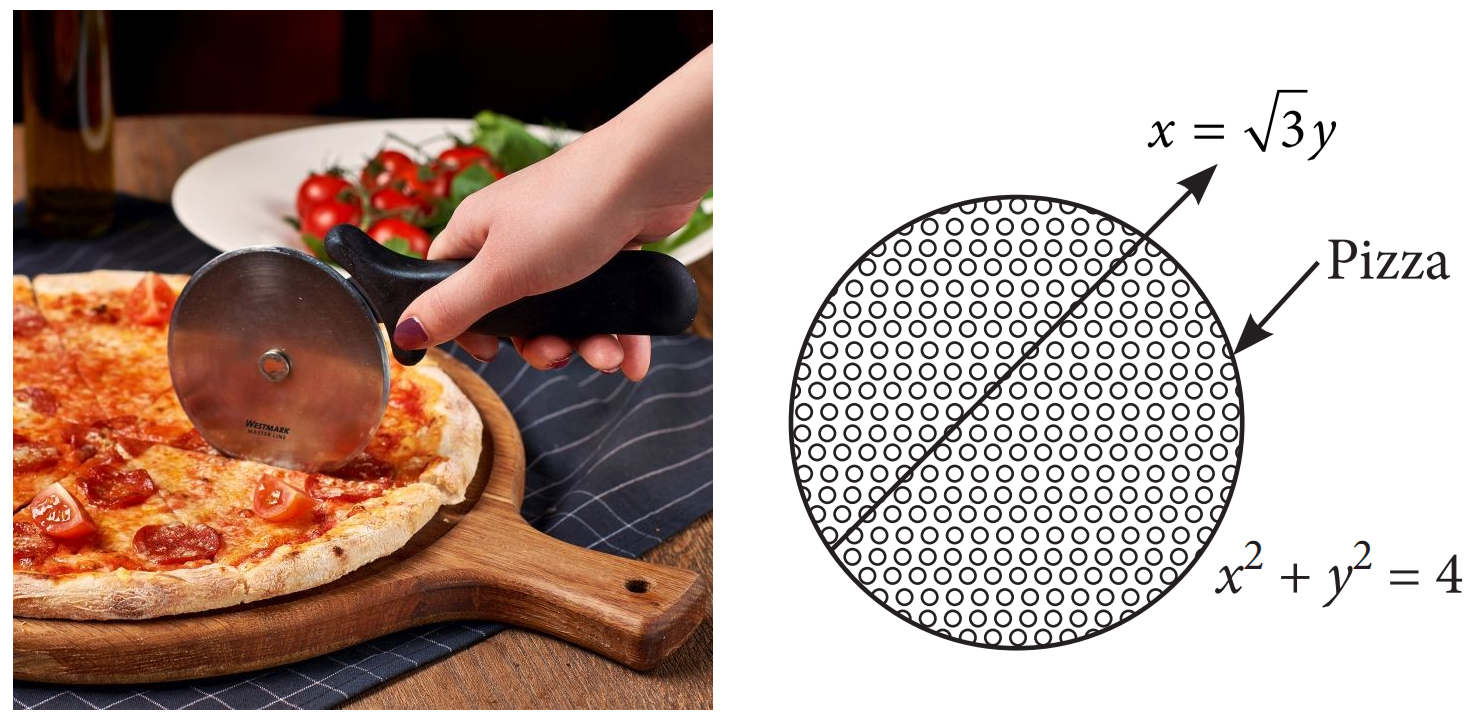
A child cut a pizza with a knife. Pizza is circular in shape which is represented by x2 + y2 = 4 and sharp edge of knife represents a straight line given by $\text{x}=\sqrt{3\text{y}}$

Based on the above information, answer the following questions.

  1. The point(s) of intersection of the edge of knife (line) and pizza shown in the figure is (are).
  1. $(1, \sqrt{3}),(-1,-\sqrt{3})$

  2. $(\sqrt{3},1),(-\sqrt{3,}-1)$

  3. $(\sqrt{2,}0),(0,\sqrt{3})$

  4. $(-\sqrt{3,}),(1,-\sqrt{3})$

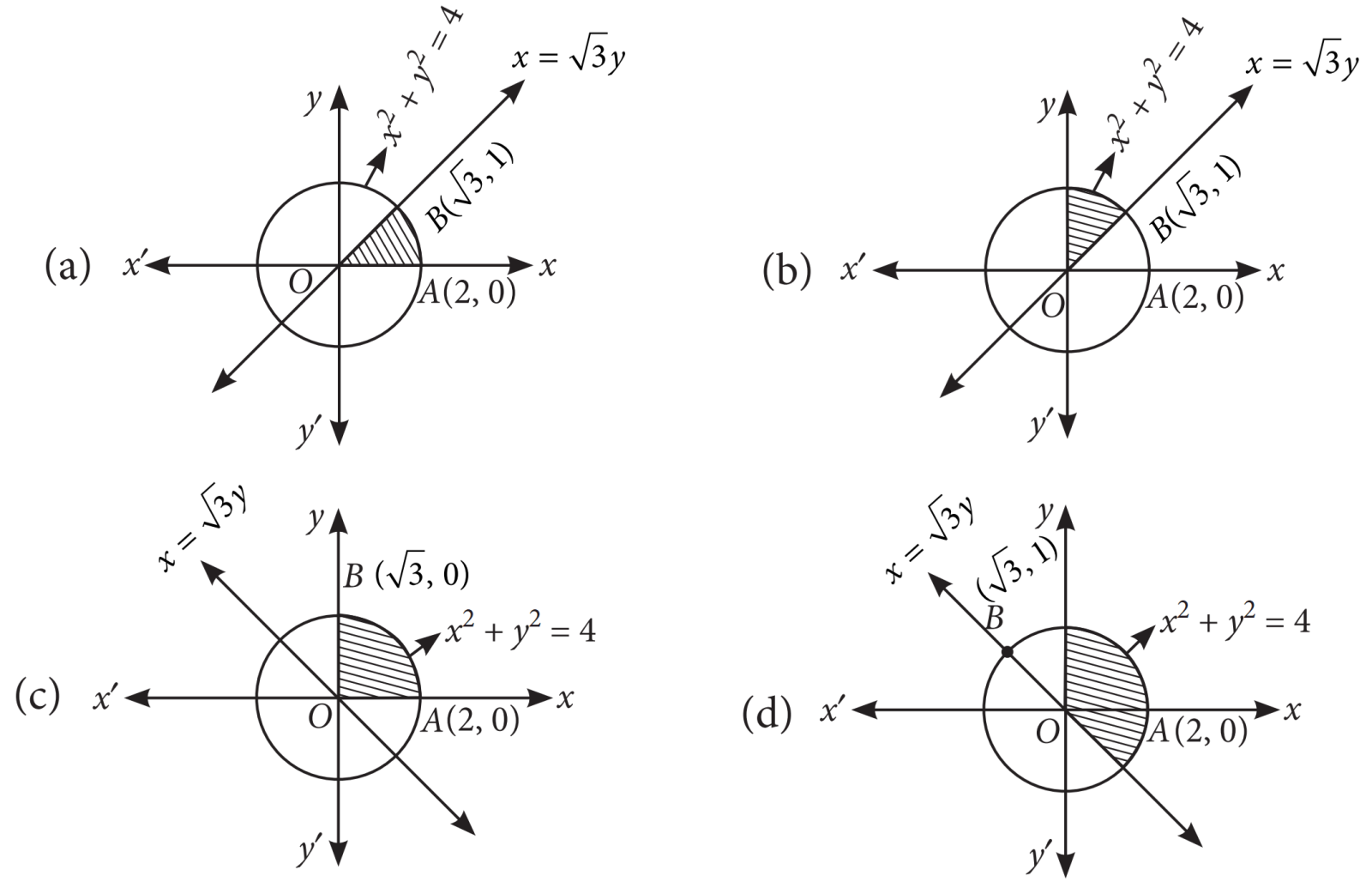
  1. Which of the following shaded portion represent the smaller area bounded by pizza and edge of knife in first quadrant?

  1. Value of area of the region bounded by circular pizza and edge of knife in first quadrant is.
  1. $\frac{\pi}{2}\text{ sq.units}$

  2. $\frac{\pi}{3}\text{ sq.units}$

  3. $\frac{\pi}{5}\text{ sq.units}$

  4. $\pi\text{ sq.units}$

  1. Area of each slice of pizza when child cut the pizza into 4 equal pieces is.
  1. $\pi\text{ sq.units}$

  2. $\frac{\pi}{2}\text{ sq.units}$

  3. $3\pi\text{ sq.units}$

  4. $2\pi\text{ sq.units}$

  1. Area of whole pizza is.
  1. $3\pi\text{ sq.units}$

  2. $2\pi\text{ sq.units}$

  3. $5\pi\text{ sq.units}$

  4. $4\pi\text{ sq.units}$

Show that $\text{f(x)}=\tan^{-1}(\sin\text{x}+\cos\text{x})$ is an increasing function in $\Big(0,\frac{\pi}{4}\Big).$
Akash and Prakash appeared for first round of an interview for two vacancies. The probability of Nisha's selection is $\frac{1}{3}$ and that of Ayushi's selection is $\frac{1}{2}$.

Image

(i) Find the probability that both of them are selected.

(ii) The probability that none of them is selected.

To hire a marketing manager, it's important to find a way to properly assess candidates who can bring radical changes and has leadership experience. Ajay, Ramesh and Ravi attend the interview for the post of a marketing manager.
Ajay, Ramesh and Ravi chances of being selected as the manager of a firm are in the ratio $4: 1: 2$ respectively. The respective probabilities for them to introduce a radical change in marketing strategy are $0.3,0.8$, and 0.5 . If the change does take place.

Image

(i) Find the probability that it is due to the appointment of Ajay (A).

(ii) Find the probability that it is due to the appointment of Ramesh (B).

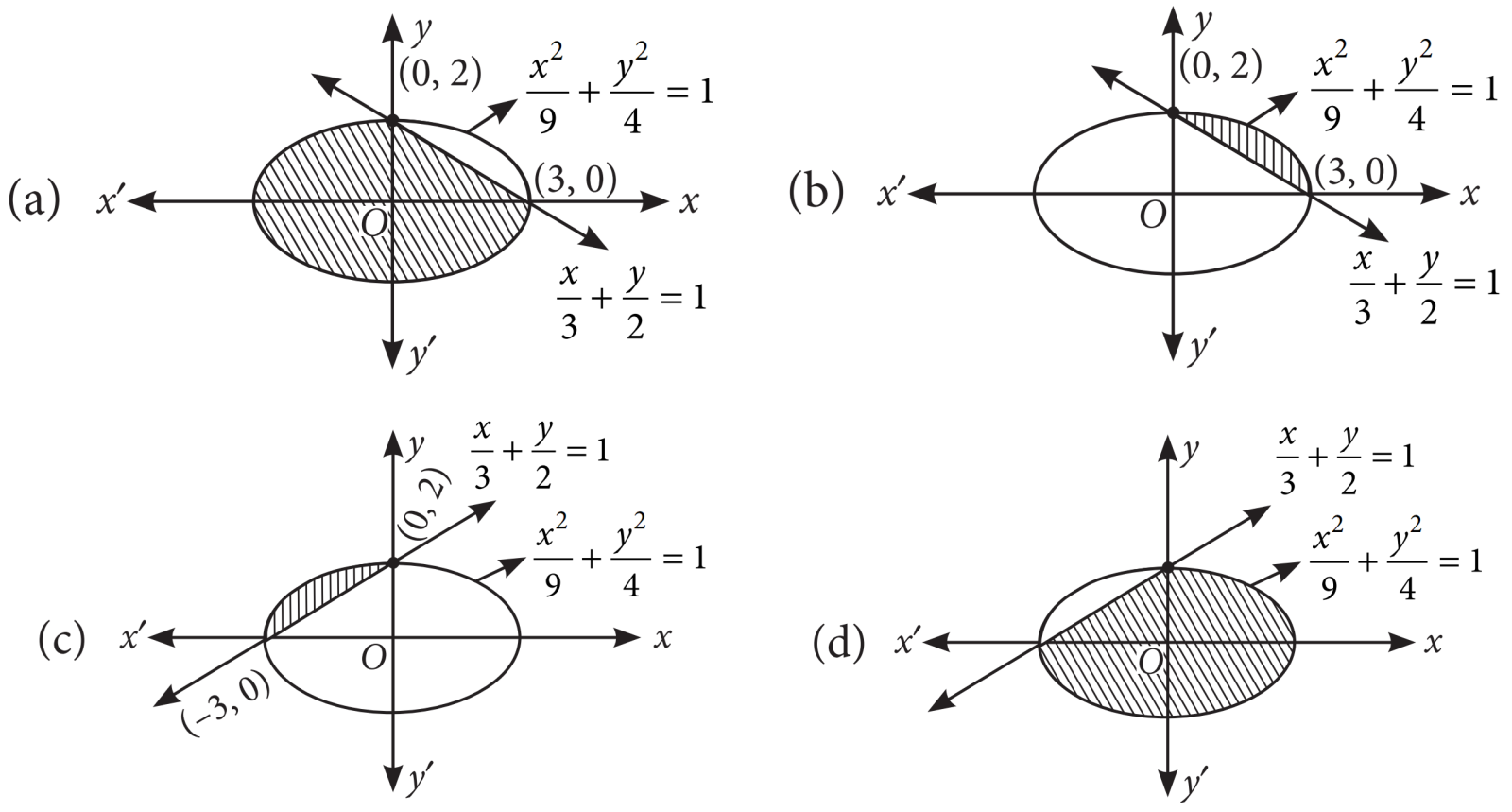
A mirror in the shape of an ellipse represented by $\frac{\text{x}^2}{9}+-\frac{\text{y}^2}{4}=1$ was hanging on the wall. Arun and his sister were playing with ball inside the house, even their mother refused to do so. All of sudden, ball hit the mirror and got a scratch in the shape of line represented by $\frac{\text{x}}{3}+\frac{\text{y}}{2}=1$

Based on the above information, answer the following questions.

  1. Point(s) of intersection of ellipse and scratch (straight line) is (are).
  1. (0, 2), (3, 0)
  2. (2, 0), (3, 0)
  3. (2, 3), (0, 0)
  4. (0, 3), (3, 0)
  1. Area of smaller region bounded by the ellipse and line is represented by.

  1. The value of $\frac{2}{3}\int\limits_{0}^{3}\sqrt{9-\text{x}^2}\text{dx}$ is.
    1. $\frac{\pi}{2}$

    2. $\pi$

    3. $\frac{3\pi}{2}$

    4. $\frac{\pi}{4}$

  1. The value of  $2\int\limits_{0}^{3}\bigg(1-\frac{\text{x}}{3}\bigg)\text{dx}$ is.
    1. 0
    2. 1
    3. 2
    4. 3
  1. Area of the smaller region bounded by the mirror and scratch is.
  1. $3\Big(\frac{\pi}{2}+1\Big)\text{ sq.units}$

  2. $\Big(\frac{\pi}{2}+1\Big)\text{ sq.units}$

  3. $\Big(\frac{\pi}{2}-1\Big)\text{ sq.units}$

  4. $3\Big(\frac{\pi}{2}-1\Big)\text{ sq.units}$