MCQ
Gravitational force has only on sign but coulomb force has:
- APositive sign.
- BNegative sign.
- CBoth a and b.
- DNone.
Generate a complete, print-ready paper with questions like this in minutes — across 16+ boards, with answer keys.
A achromatic combination is made with a lens of focal length f and dispersive power ω with a lens having dispersive power of 2ω. The focal length of second will be
|
(a) 2f |
(b) f/2 |
(c) -f/2 |
(d) – 2 f |
An amplitude modulated wave is modulated to 50%. What is the saving in power if carrier as well as one of the side bands are suppressed
|
(a) 70% |
(b) 65.4% |
(c) 94.4% |
(d) 25.5% |
Two capacitors of capacities  and
and  are charged to voltages
  and
and  respectively. There will be no exchange of energy in connecting them in parallel, if
|
(a) |
(b) |
(c) |
(d) |
The number of neutrons released when  undergoes fission by absorbing
  and (
and (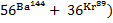 are formed, is
|
(a) 0 |
(b) 1 |
(c) 2 |
(d) 3 |
A transistor is used as an amplifier in CB mode with a load resistance of 5 k W the current gain of amplifier is 0.98 and the input resistance is 70 W, the voltage gain and power gain respectively are
|
(a) 70, 68.6 |
(b) 80, 75.6 |
(c) 60, 66.6 |
(d) 90, 96.6 |
A diminished image of an object is to be obtained on a screen 1.0 m from it. This can be achieved by appropriately placing
|
(a) A convex mirror of suitable focal length |
|
(b) A concave mirror of suitable focal length |
|
(c) A concave lens of suitable focal length |
|
(d) A convex lens of suitable focal length less than 0.25 m |
Assertion : Charge is invariant.
Reason : Charge does not depends on speed of frame of reference.
|
(a) If both assertion and reason are true and the reason is the correct explanation of the assertion. |
|
(b) If both assertion and reason are true but reason is not the correct explanation of the assertion. |
|
(c) If assertion is true but reason is false. |
|
(d) If the assertion and reason both are false. |


