Question
| Group ‘A’ | Group ‘B’ |
| (1)Macro | (a) Slicing method |
| (2) Micro | (b) Classical economist |
| (3) Adam Smith | (c) Neo-classical economist |
| (4) Prof. Marshall | (d) Inflation |
| (e)Lumping method |
| Group ‘A’ | Group ‘B’ |
| (1)Macro | (a) Slicing method |
| (2) Micro | (b) Classical economist |
| (3) Adam Smith | (c) Neo-classical economist |
| (4) Prof. Marshall | (d) Inflation |
| (e)Lumping method |
Generate a complete, print-ready paper with questions like this in minutes — across 16+ boards, with answer keys.
| Group ‘A’ | Group ‘B’ |
| (1) Demand | (a) Exceptional demand |
| (2) Prestige goods | (b) Prof. Marshall |
| (3) Joint demand | (c) Demand curve shift to right |
| (4) Demand increases | (d) Complementary demand |
| (e) A higher price |
| Group ‘A’ | Group ‘B’ | |
| 1. Increase in supply | Technology up gradation | |
| 2. Exception to law of supply | More supply at higher price | |
| 3. Determination of law of supply | Perishable Goods | |
| Group ‘A’ | Group ‘B’ |
| Demat Account | (a) Commercial Bank |
| Overdraft | (b)Ancillary function |
| Credit creation | (c) 1949 |
| Banking Regulation Act | (d) 1935 |
| (e) Amount withdrawn above the actual balance |
| Group ‘A’ | Group ‘B’ |
| (1) Joint Demand | (a) Luxury car |
| (2) Demand and price | (b) Exception to the law of demand |
| (3) Giffen’s goods | (c) Inverse relationship |
| (4) Prestige goods | (d) Several commodities |
| (e) Vegetables |
| Group ‘A’ | Group ‘B’ |
| (1) Factor of Production | (a) Other things being equal |
| (2) Ceteris Paribus | (b) Land |
| (3) Price theory | (c) Micro economics |
| (4) Lumping method | (d) Profit |
| (e)Whole economy |
| Group ‘A’ | Group ‘B’ |
| 1. Ordinal measurement | (a)Maximum TU |
| 2. Principles of Economics | (b) $M U_X>P_X$ |
| 3. Point of satiety | (c) Prof. Alfred Marshall |
| 4. Consumer’s equilibrium | (d) Grading of utility |
| (e) $M U_X>P_X$ |
| Group ‘A’ | Group ‘B’ |
| Expenditure Method | Inventory method |
| GDP | C + I + G + (X-M) + (R-P) |
| National income | Micro economic concept |
| Unpaid services | Services of housewife |
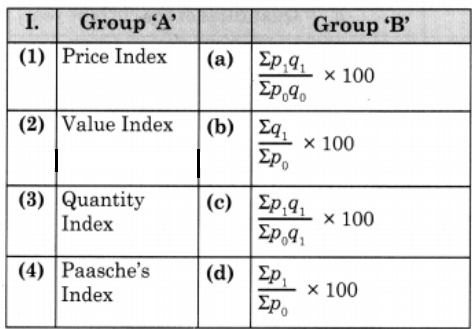
| Group ‘A’ | Group ‘B’ |
| (1) Micro economics | (a) Theory of investment |
| (2) Macro economics | (b) Key tool of micro economics |
| (3) Marginalism | (c) Price theory |
| (4) Aggregate study | (d) Forest |
| Income and employment theory |
| Group ‘A’ | Group ‘B’ |
| 1. Total utility | (a) Point of Satiety |
| 2. Zero MU | (b) Furniture from wood |
| 3. Time utility | (c) Aggregate of utilities |
| 4. Form utility | (d) Apples for Kashmir |
| (e) Organ donation |