MCQ
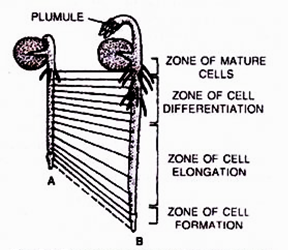
Growth is maximum in the zone of:
- ACell division
- BCell elongation
- CCell maturation
- DAll of the above
Explanation:
Growth is estimated by an increase in cell number, area, volume, and length.Cell growth undergoes three major phases.They are as followed:
a) During cell division, the meristematic cells divide rapidly to increase the number of cells.This increases the number of cells.
b) During the cell elongation phase, the newly formed cells elongate and increase in length and volume.It also shows increased vacuole formation and new cell wall deposition. Amount of protoplasm increases.
c) During cell differentiation, the cell has achieved maximum growth and proceeds towards maturation to attain specific function.
As, maximum increase in length and volume takes place in the cell elongation phase. It is considered as zone of maximum growth.
Generate a complete, print-ready paper with questions like this in minutes — across 16+ boards, with answer keys.
Statement $I$: A protein is imagined as a line, the left end represented by first amino acid (C-terminal) and the right end represented by last amino acid ( $N$-terminal).
Statement $II$: Adult human haemoglobin, consists of $4$ subunits (two subunits of $\alpha$ type and two subunits of $\beta$ type.)
In the light of the above statements, choose the correct answer from the options given below: