MCQ 11 Mark
Which one is a long day plant?
- ASpinach.
- BMirabilis jalapa.
- CTobacco.
- DGlycine max.
Answer
View full question & answer→- Spinach.
155 questions · self-marked practice — reveal the answer and mark yourself.
Explanation:
Cytokinins are a type of plant growth substances or plant growth regulators that are involved primarily in cell growth and differentiation. But can also affect or interfere with exility growth apical growth sector.The compounds that have a kind of resembling structure to the nucleic acid adenine that promotes cell division and has other similar functions to Kinetin.Cytokinins are formed from the nucleic acid metabolism
Explanation:
Phytocytomine is a plant growth regulator. It is a kind of kinetin.It is synthesized from Licheniformis bacillus.
Explanation:
Aerobic respiration will hasten rotting of apple.
Explanation:
Ethylene is a fruit ripening hormone. It stimulates all the biochemical changes which take place upon fruit ripening.
Explanation:
Cytokinins induce the formation of new leaves and chloroplast in leaves.
Ethylene promotes abscission in plants.Auxins help in water movement and promote protoplasmic streaming in plants.
Explanation:
Auxin is a plant hormone.
It is produced at the tip of stem.
Apical dominance is a phenomenon in which central stem is dominant and lateral stems are suppressed.
It promotes stem elongation and inhibits growth of lateral buds.
Hence, low concentration of auxin inhibits growth in stem.
Explanation:
Parthenocarpy is the natural or artificially induced production of fruit without fertilization of ovules, which makes the fruit seedless.Cytokinin is more effective in inducing parthenocarpy because cytokinin induced fruit showed enhanced accumulation of gibberellins and auxins which are also responsible for inducing parthenocarpy.
Explanation:
The phenomenon of generation of whole plant by single cell is totipotency.This is the characteristic of plants mostly.When a plant of differentiated tissue is cultured in a nutrient medium it gain the property of division get specialized and form and organ.
Explanation:
Auxins promote stem elongation.a
Explanation:
Vascular plants are the plants which have fully developed vascular tissues which help in the conduction of water, minerals and food throughout the plant.Light increases the metabolic functions of plant-like photosynthesis, seed germination, transportation, transpiration etc. which further promotes the process like growth, development and differentiation.
Explanation:
Growth is an irreversible increase in the size.There are three developmental stages of growth of all plant parts including shoot and root.These are cell division, cell enlargement and cell differentiation.Cell division is the first phase that results in increase in the number of cells. In plants, karyokinesis, division of nucleus is followed by cytokinesis, the division of the cytoplasm.Cell enlargement gives the proper size to the organ and tissue.During this, protoplasm, vacuole, etc are formed.Cell differentiation is seen at cell level, tissue level, organ level and at the level of an organism.The cells differentiate to form different types of tissues that later perform different but specific functions.
Explanation:
Gibberellin is a plant hormone which is responsible for stem elongation by promoting cell division and elongation.
They are responsible for increased internodal length in a plant.
Auxins cause cell elongation and cell differentiation while cytokinins promote only cell division.
Phycobilins are pigments found in cyanobacteria which capture the light energy for photosynthesis in them.
Explanation:
Ethylene is a gaseous plant hormone.It is also called as ripening hormone as it increases ripening of fruits.Fruit ripening is accompanied by increase rate of respiration.Due to increased respiration, complex carbohydrates are broken down into simpler sugars and cell wall becomes soft.It inhibits cell division. It is also involved in abscission of leaves, fruits and flowers.
Explanation:
r is the relative growth rate and also measures the ability of the plant to produce new plant material (efficiency index).
Explanation:
Coconut milk is the liquid endosperm in unripened fruit and is rich in plant hormone cytokinin.The other hormones are absent in coconut milk.
Explanation:
Gibberellin is a plant hormone which is involved in various physiological processes of plants.It is a plant growth regulator.It is promotes stem elongation, seed germination, leaf and fruit senescence, etc.It breaks the seed dormancy that require cold or light to germinate.
Explanation:
Ethylene is a gaseous hormone which has many functions such as fruit ripening, flower wilting, and leaf fall. It is unusual because of its gaseous nature.Ethylene brings about change in colour, texture and softens the ripening fruits.Some fruits release ethylene as the ripening begins.
Explanation:
Gibberellic acid induce male flowers on female plants of Cannabis sativa. When exogenous gibberellin was induced in genetically female plants of Cannabis, there was marked stem elongation and production of male (staminate) flowers in gibberellin treated female plants of Cannabis.Hence, exogenous GA induces the formation of male flowers on genetically female plants of Cannabis.
Explanation:
Leaves are the main recipients of light energy and thus are the main player in photo period.
Explanation:
Abscisic acid is the plant hormone, which is responsible for dormancy of seeds and inhibition of seeds.
It stimulates the closure of stomata, inhibit shoot growth, stimulate the storage of proteins in seeds, and so on.
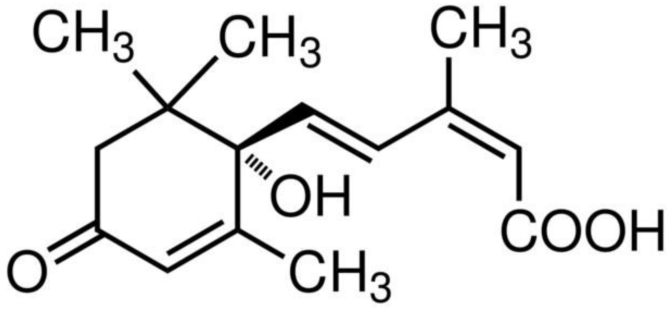
Explanation:
Abscisic acid are the derivatives of carotenoids.
Explanation:
Cytokinin is a naturally occurring plant growth hormone (PGR) extracted from coconut milk.
Cytokinins are synthesized in root apex, endosperm of seeds, and young fruits where cell division takes place continuously.
They stimulate cell division, cell enlargement and cell differentiation and also prevent ageing of plant parts.
Hence, natural cytokinins are synthesized in tissues for dividing.
Explanation:
Auxin promotes rooting for the cuttings.NAA is a prominent auxin which is used to promote rooting in stem cuttings.NAA is known as naphthalene acetic acid.It is a synthetic auxin which promotes rooting in dwarf plants or stem.It also decreases the rate of senescence and abscission.It promotes respiration and increases the rate of metabolism.It increases the sweetening in certain fruits.
Explanation:
Abscisic acid is a plant hormone. It is also called as stress hormone.
During unfavourable environmental conditions like drought, it induces seed dormancy.
When there is favaourable condition, seed dormancy is broken and germination takes place.
Explanation:
ABA inhibits seed germination.ABA stimulates the closure of stomata in the epidermis and increases the tolerance of plants to various kinds of stresses.
Explanation:
Photoperiodism is the phenomenon in which various physiological reactions like flowering response to the relative length of dark or light periods.
Gibberellin is a plant hormone which brings about the rapid flowering in plants. It replaces the long day required for bolting in plants.
Explanation:
Gibberellin is a plant hormone.It acts as plant growth promoter.It is involved various physiological processes of plants.It is acidic in nature. Chemically, it is pentacyclic diterpene acid. It stimulates flowering, germination and stem elongation.
Explanation:
Typical plant growth represents sigmoid curve.
Explanation:
Ethylene is a plant growth regulator. It is also called as ripening hormone as it is responsible for speeding up ripening of fruits.
Fruit ripening is accompanied by increase rate of respiration.
Due to increased respiration, complex carbohydrates are broken down into simpler sugars and cell wall becomes soft.
Explanation:
Abscisic acid is an antagonist to gibberellins as shown in the table given.
| Abscisic Acid | Gibberellic acid |
| It inhibits Growth. | It promotes growth. |
| It promotes the dormancy of seeds, buds and tubers. | It overcomes the natural dormacy of seeds, tubers, etc. |
| It inhibits the synthesis of RNA and proteins. | IT promotes the synthesis of RNA and Proteins. |
| causes abscission of flowers and fruits. | Promotes development of fruits. |
| Promotes leaf senescence. | Prevents leaf Senescence. |
| Promotes stomatal closure. | Promotes stomatal opening. |
| Prevents anylase Activity. | Promotes anylase activity during seed Germination. |
Explanation:
Gibberellins especially GA3 is used to speed up the malting process in brewing industry.
Explanation:
Auxin is the phytohormone that handles apical dominance and positive phototropism.
It can cause the cells to elongate on the shaded side, so this side grows more.
This unequal growth of the two sides results in the stem's growth towards the light.
Explanation:
Plants growth throughout their life due to the presence of meristems at certain locations in their body.
Explanation:
Auxin is a plant hormone. It is produced in high concentration at the shoot apex.Apical dominance is a phenomenon in which central stem is dominant and lateral stems are suppressed.It promotes stem elongation and inhibits growth of lateral buds.Hence, low concentration of auxin inhibits growth in shoot.
Explanation:
Gibberellic acid enhances the synthesis of α-amylase in isolated aleurone layers of seeds.
Explanation:
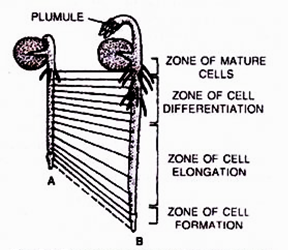
Growth is estimated by an increase in cell number, area, volume, and length.Cell growth undergoes three major phases.They are as followed:
a) During cell division, the meristematic cells divide rapidly to increase the number of cells.This increases the number of cells.
b) During the cell elongation phase, the newly formed cells elongate and increase in length and volume.It also shows increased vacuole formation and new cell wall deposition. Amount of protoplasm increases.
c) During cell differentiation, the cell has achieved maximum growth and proceeds towards maturation to attain specific function.
As, maximum increase in length and volume takes place in the cell elongation phase. It is considered as zone of maximum growth.
| A. | IAA | i. | Herring sperm DNA |
| B. | ABA | ii. | Bolting |
| C. | Ethylene | iii. | Stomatal closure |
| D. | GA | iv. | Weed-free lawns |
| E. | Cytokinins | v. | Ripening of fruits |
Explanation:
Growth, at a cellular level, is princi-pally a consequence of increase in the amount of protoplasm. Growth is, measured by a variety of parameters such as:
One single maize root apical meristem can give rise to more than 17,500 new cells per hour, whereas cells in a watermelon may increase in size by up to 3,50,000 times. In the formed, growth is expressed as increase in cell number; the latter expresses growth as increase in size of the cell.
Explanation:
Gibberellin is a plant hormone.It was first identified as a product of metabolism obtained from fungus Gibberella fujikuroi.This fungus causes Bakanae disease in rice.
Explanation:
Gibberellin increases the length of stem and thus increases the amount of sugar in sugarcane.
Explanation:
Rhizocaline is a hormone or hormone-like factor distinct from auxin that is held to play a role in the formation of plant roots.
It is also called as root forming hormone and it is produced by the leaves.
Explanation:
Growth, differentiation and development processes of plants are found to be regulated by two or more phytohormones acting synergistically or antagonistically, e.g., cell division is promoted by both auxins and cytokinins acting synergetically. Cell growth is controlled by auxins, gibberellins and cytokinins. Morphogenesis is interplay of auxins and cytokinins, where both must be present in some minimum concentration.
Explanation:
Presence of cytokinin in an area causes preferential movement of nutrients towards it. When applied to lateral buds, they help in their growth despite the presence of apical bud. Thus, they act antagonistically to auxin.
Explanation:
Ethylene is a plant hormone.It is also called as ripening hormone.It is responsible for ripening of fruits.Fruit ripening is accompanied by increased rate of respiration.Ethylene rich atmosphere is used to accelerate the process of ripening of fruits like banana.
Explanation:
Cocis nucifera is the scientific name for coconut.Coconut water is mainly used as culture media.However, in an emergency, it can be even used as a substitute for human blood plasma.
Explanation:
The cytokinins are plant growth substances that act primarily on cell division and little or no effect on extension growth.
The most important function of cytokinins is the promotion of cell division.
It is now well established that these are true cell division factors.
The varying amount of cytokinins, along with sufficient auxin is required for the growth of callus in the tissue culture experiments.
Explanation:
Ethylene is the gaseous hormone that stimulates growth and development of floral organs and promotes fruit ripening. It does so by causing softening of fruit due to enzymatic breakdown of cell walls, starch hydrolysis, sugar accumulation and disappearance of organic acids and phenolic compounds.
Explanation:
Auxin is the hormone that stimulates cell elongation and growth. In the shoot when light falls on it the hormone gets activated and also promote the movement of shoot towards the light.
Explanation:
The growth-promoting hormone in the plants are Auxins, Gibberellins, Cytokinesis, etc.
It improves the growth and development of plants.
Auxin is synthesized at the tip of the shoot of plants.
When the tendril came in contact with a support, auxin stimulates faster growth of a cell on the opposite side that's why the tendril forms a coil around the support.
Explanation:
Zinc is a necessary element required for the synthesis of IAA ( Indole-3- acetic acid), a type of auxin. So, deficiency of Zn will reduce its production.
Explanation:
Increase in surface area denotes the growth in a dorsiventral leaf.
Explanation:
Plasticity in plant growth means that plant development is dependent on the environment.
Explanation:
Monocarpic plants are those plants that flower once during their life time, set seeds and then die, e.g., bamboos.
Explanation:
The auxins are the plant growth hormones which are released by the plant cells.These hormones are also called as the growth regulators which are involved in various processes in the plant body.It promotes the growth by the elongation of cells in the apical meristem and the cambium in the culture cells.The most commonly known auxin is the IAA (Indole acetic acid)
Explanation:
Indole-3-acetic acid (IAA) is the most common, naturally occurring, plant hormone of the AUXIN class.It is the best known of the auxins,and has been the subject of extensive studies by plant physiologists.IAA is a derivative of indole, containing a carboxymethyl substituent.
Explanation:
Auxin is a plant hormone that is involved in various physiological processes.It promotes cell elongation.
Hence, it is mostly produced in the meristematic region of stem.It is also present on the tip of roots and buds.