MCQ
Half-life is measured by
  • Geiger-Muller counter
  • B
    Carbon dating
  • C
    Spectroscopic method
  • D
    Wilson-Cloud chamber

Answer

Correct option: A.
Geiger-Muller counter
a
(a)

Need a full question paper?

Generate a complete, print-ready paper with questions like this in minutes — across 16+ boards, with answer keys.
Start Generating Free

Similar questions

A conducting rod of length $L$ is falling with velocity $V$ in a uniform horizontal magnetic field $B$ normal to the rod. The induced emf between the ends the rod will be:
The Lenz's law is based on which of the following physical quantity?
An electron and proton have the same de-Broglie wavelength. Then the kinetic energy of the electron is
A capacitor is charged with a battery and energy stored is $U$. After disconnecting battery another capacitor of same capacity is connected in parallel to the first capacitor. Then energy stored in each capacitor is
Two long wires are hanging freely. They are joined first in parallel and then in series and then are connected with a battery. In both cases, which type of force acts between the two wires
In a car, a rear view mirror having a radius of curvature $1.50\, m$ forms a virtual image of a bus located $10.0 \,m$ from the mirror. The factor by which the mirror magnifies the size of the bus is close to
When the distance between the charged particles is halved, the force between them becomes
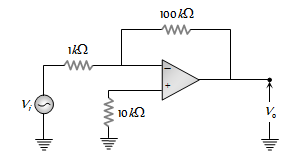
The voltage gain of the following amplifier is
Electrons in the atom are held to the nucleus by:
In an $X$-ray tube, electrons emitted from a filament (cathode) carrying current I hit a target (anode) at a distance $d$ from the cathode. The target is kept at a potential $V$ higher than the cathode resulting in emission of continuous and characteristic $X$-rays. If the filament current $I$ is decreased to $\frac{ I }{2}$, the potential difference $V$ is increased to $2 V$, and the separation distance $d$ is reduced to $\frac{ d }{2}$, then

$(A)$ the cut-off wavelength will reduce to half, and the wavelengths of the characteristic $X$-rays will remain the same

$(B)$ the cut-off wavelength as well as the wavelengths of the characteristic $X$-rays will remain the same

$(C)$ the cut-off wavelength will reduce to half, and the intensities of all the $X$-rays will decrease

$(D)$ the cut-off wavelength will become two times larger, and the intensity of all the $X$-rays will decrease