Question
$\mathrm{He}_2{ }^3$ and $\mathrm{He}_1{ }^3$ nuclei have the same mass number. Do they have the same binding energy?

Answer

The nuclei $\mathrm{{He}_2 }^3$ and $\mathrm{He}_1{ }^3$ have the same mass number. $\mathrm{He}_2{ }^3$ has two protons and one neutron. $\mathrm{He}_2{ }^3$ has one proton and two neutrons. As He 3 has only one proton hence the repulsive force between protons is missing in ${ }_1 \mathrm{He}^3$, so the binding energy of ${ }_1 \mathrm{He}^3$ is greater than that of ${ }_2 \mathrm{He}^3$.

Need a full question paper?

Generate a complete, print-ready paper with questions like this in minutes — across 16+ boards, with answer keys.
Start Generating Free

Similar questions

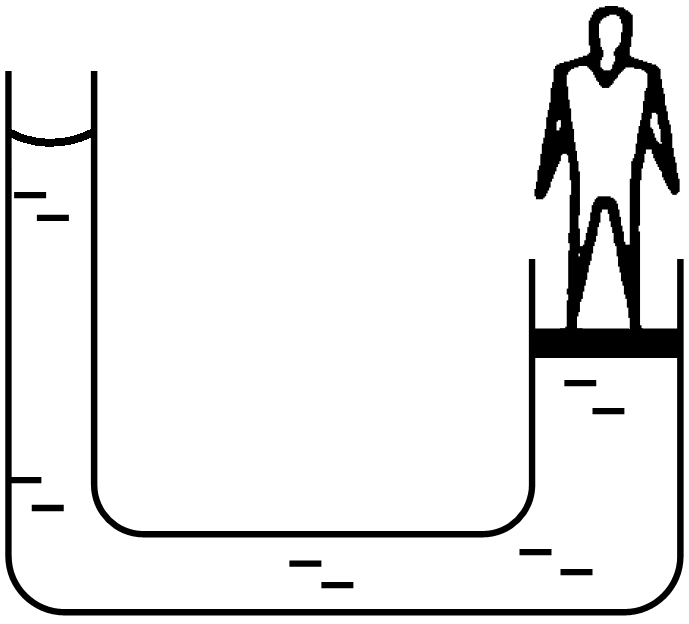
The area of cross-section of the wider tube shown in is $900cm^2$. If the boy standing on the. Piston weighs 45kg, find the difference in the levels of water in the two tubes.
An ordinary electric fan does not cool the air, still it gives comfort in summer. Explain.
The peak power consumed by a resistive coil, when connected to an AC source, is 80W. Find the energy consumed by the coil in 100 seconds, which is many times larger than the time period of the source.
Define the term resistivity and write the SI unit.
The current in a discharging LR circuit is given by $\text{i}=\text{i}_0\text{e}^{\frac{-\text{t}}{\tau}}$ where $\tau$ is the time constant of the circuit. Calculate the rms current for the period $\text{t}=0$ to $\text{t}=\tau.$
Write a short note on $X-$ rays.
Write the function of a (i) Transducer and (ii) Repeater in a communication system.
What should be the radius ‘r’ of nearest possible orbits of satellite of mass ‘m’ revolving around the planet of mass ‘M’ as per Bohr Postulates in terms of m, M, G, h where G is Gravitational constant and h is plank’s constant.
Two identical coils, radius of each is 8 cm and number of turns is 100 are coaxial and their centers are 12 cm apart. If current of 1 A flows in each coil in the same direction, then calculate the magnetic field at the midpoint on the axial line.
Two concentric spherical shells have masses $M_1, M_2$ and radii $R_1, R_2\left(R_1,<R_2\right)$. What is the force exerted by this system on a particle of mass $m_1$ if it is placed at a distance $\frac{\mathbf{R}_1+\mathrm{R}_2}{2}$ from the centre?