MCQ
Heat and work are equivalent. This means,
  • A
    The temperature of a body can be increased by doing work on it.
  • B
    A body kept at rest may be set into motion along a line by supplying heat to it.
  • C
    When we do work on a body, we supply heat to it.
  • D
    When we supply heat to a body, we do work on it.
Answer

  1. The temperature of a body can be increased by doing work on it.

Explanation:

As heat and work are equivalent, temperature of a body can be increased by doing work on it.

Need a full question paper?

Generate a complete, print-ready paper with questions like this in minutes — across 16+ boards, with answer keys.

Start Generating Free

Similar questions

The total kinetic energy of a body of mass $10\ kg$ and radius $0.5\ m$ moving with a velocity of $2\ m/s$ without slipping is $32.8\ joule$.  The radius of gyration of the body is  .......... $m$
Measure of two quantities along with the precision of respective measuring instrument is:

$\text{A} = 2.5\text{ms}^{-1} \pm 0.5\text{ms}^{-1}$

$\text{B} = 0.10\text{s} \pm 0.01\text{s}$

The value of A B will be,

  1. $(0.25 \pm 0.08)\text{m}.$

  2. $(0.25 \pm 0.5)\text{m}.$

  3. $(0.25 \pm 0.05)\text{m}.$

  4. $(0.25 \pm 0.135)\text{m}$

If the surface tension of a liquid is $T$, the gain in surface energy for an increase in liquid surface by $A$ is
Two vectors $\dot{A}$ and $\dot{B}$ are defined as $\dot{A}=a \hat{i}$ and $\overrightarrow{\mathrm{B}}=\mathrm{a}(\cos \omega t \hat{\mathrm{i}}+\sin \omega t \hat{j}$ ), where a is a constant and $\omega=\pi / 6 \mathrm{rad} \mathrm{s}^{-1}$. If $|\overrightarrow{\mathrm{A}}+\overrightarrow{\mathrm{B}}|=\sqrt{3}|\overrightarrow{\mathrm{A}}-\overrightarrow{\mathrm{B}}|$ at time $t=\tau$ for the first time, the value of $\tau$, in, seconds, is. . . . . .
A ball kept in a closed box moves in the box making collisions with the walls. The box is kept on a smooth surface. The velocity of the centre of mass.
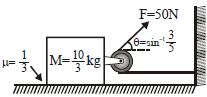
In the given figure the acceleration of $M$ is $(g = 10 \,ms^{-2})$
A body of mass $2\,kg$ slides down with an acceleration of $3\,m/s^2$ on a rough inclined plane having a slope of $30^o$ . The external force required to take the same body up the plane with the same acceleration will be  ........ $N$ $(g\, = 10\, m/s^2)$
It is found that if a neutron suffers an elastic collinear collision with deuterium at rest, fractional loss of its energy is $p_d $ ; while for its similar collision with carbon nucleus at rest, fractional loss of energy is $P_c$. The values of $P_d$ and $P_c$ are respectively
Surface tension is due to:
A body falling on the ground from $a$ height of $10\, m$, rebounds to a height $2.5\, m,$ then the ratio of the velocities of the body just before and after the collision will be