Heat current is maximum in which of the following (rods are of identical dimension)
- A

- B

- C

- D

Easy


Download our appand get started for free
Experience the future of education. Simply download our apps or reach out to us for more information. Let's shape the future of learning together!No signup needed.*
Similar Questions
- 1View SolutionIn which of the following process, convection does not take place primarily
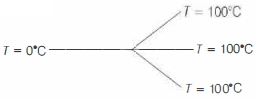
- 2A metallic prong consists of $4$ rods made of the same material, cross-sections and same lengths as shown below. The three forked ends are kept at $100^{\circ} C$ and the handle end is at $0^{\circ} C$. The temperature of the junction is ............. $^{\circ} C$View Solution
- 3The initial temperature of a body is $80°C$ . If its temperature falls to $64°C$ in $5$ minutes and in $10$ minutes to $52°C$ then the temperature of surrounding will be ...... $^oC$View Solution
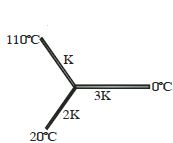
- 4Three rods of equal length and cross sectional area and coefficient of thermal conductivities $K, 2K$ and $3K$ are joined as shown in figure temperature of their ends are $110\ ^oC, 20\ ^oC$ and $0\ ^oC$ respectively then temperature of junction will be ......... $^oC$View Solution
- 5Four rods of identical cross-sectional area and made from the same metal form the sides of square. The temperature of two diagonally opposite points and $T$ and $\sqrt 2 $ $T$ respective in the steady state. Assuming that only heat conduction takes place, what will be the temperature difference between other two pointsView Solution
- 6Instantaneous temperature difference between cooling body and the surroundings obeying Newton's law of cooling is $\theta$. Which of the following represents the variation of $\ln \theta$ with time $t$ ?View Solution
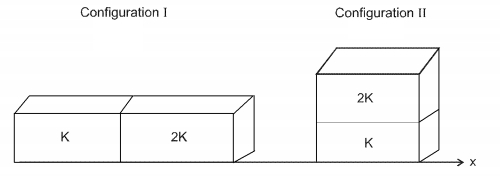
- 7Two rectangular blocks, having indentical dimensions, can be arranged either in configuration $I$ or in configuration $II$ as shown in the figure, On of the blocks has thermal conductivity $k$ and the other $2 \ k$. The temperature difference between the ends along the $x$-axis is the same in both the configurations. It takes $9\ s$ to transport a certain amount of heat from the hot end to the cold end in the configuration $I$. The time to transport the same amount of heat in the configuration $II$ is :View Solution
- 8A body cools from ${60^o}C$ to ${50^o}C$ in $10$ minutes. If the room temperature is ${25^o}C$ and assuming Newton's law of cooling to hold good, the temperature of the body at the end of the next $10$ minutes will be ......... $^oC$View Solution
- 9It takes $10$ minutes to cool a liquid from $61^oC$ to $59^oC$. If room temperature is $30^oC$ then time taken in cooling from $51^oC$ to $49^oC$ is ....... $\min$View Solution
- 10As per the given figure, two plates $A$ and $B$ of thermal conductivity $K$ and $2 K$ are joined together to form a compound plate. The thickness of plates are $4.0 \,cm$ and $2.5 \,cm$ respectively and the area of cross-section is $120 \,cm ^{2}$ for each plate. The equivalent thermal conductivity of the compound plate is $\left(1+\frac{5}{\alpha}\right) K$, then the value of $\alpha$ will be_______View Solution
