A body cools from ${60^o}C$ to ${50^o}C$ in $10$ minutes. If the room temperature is ${25^o}C$ and assuming Newton's law of cooling to hold good, the temperature of the body at the end of the next $10$ minutes will be ......... $^oC$
Diffcult
Download our app for free and get started
(c) $\frac{{60 - 50}}{{10}} = K\left( {\frac{{60 + 50}}{2} - 25} \right)$….$.(i)$
$\frac{{50 - \theta }}{{10}} = K\left[ {\frac{{50 + \theta }}{2} - 25} \right]$…..$(ii)$
On dividing, we get $\frac{{10}}{{50 - \theta }} = \frac{{60}}{\theta } $
$\Rightarrow \theta = {42.85^o}C$

Download our appand get started for free
Experience the future of education. Simply download our apps or reach out to us for more information. Let's shape the future of learning together!No signup needed.*
Similar Questions
- 1View SolutionIf black wire of platinum is heated, then its colour first appear red, then yellow and finally white. It can be understood on the basis of
- 2The rate of loss of heat from a body cooling under conditions of forced convection is proportional to its $(A)$ heat capacity $(B)$ surface area $(C)$ absolute temperature $(D)$ excess of temperature over that of surrounding : state ifView Solution
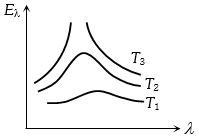
- 3View SolutionVariation of radiant energy emitted by sun, filament of tungsten lamp and welding arc as a function of its wavelength is shown in figure. Which of the following option is the correct match
- 4Two metallic spheres ${S_1}$ and ${S_2}$are made of the same material and have identical surface finish. The mass of ${S_1}$ is three times that of ${S_2}$. Both the spheres are heated to the same high temperature and placed in the same room having lower temperature but are thermally insulated from each other. The ratio of the initial rate of cooling of ${S_1}$ to that of ${S_2}$ isView Solution
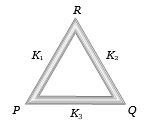
- 5hree rods of same dimensions are arranged as shown in figure they have thermal conductivities ${K_1},{K_2}$ and${K_3}$ The points $P$ and $Q$ are maintained at different temperatures for the heat to flow at the same rate along $PRQ$ and $PQ$ then which of the following option is correctView Solution
- 6View SolutionIce is used in a cooler in order to cool its contents. Which of the following will speed up the cooling process?
- 7The sun radiates electromagnetic energy at the rate of $3.9 \times 10^{26}\,W$. It's radius is $6.96 \times 10^8\,m$. The intensity of sun light at the solar surface will be (in $W/m^2$)View Solution
- 8View SolutionWhich of the following law states that “good absorbers of heat are good emitters”
- 9A spherical black body with a radius of $24\;cm$ radiates $440\;W$ power at $500\;K$. If the radius were halved and the temperature doubled, the power radiated in watt would beView Solution
- 10Which of the following circular rods. (given radius $ r$ and length $l$ ) each made of the same material as whose ends are maintained at the same temperature will conduct most heatView Solution