MCQ
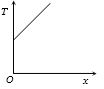
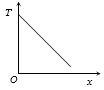
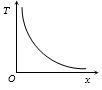
Heat is flowing through a conductor of length l from $x = 0$ to $x = l$ . If its thermal resistance per unit length is uniform, which of the following graphs is correct
  • A

  • B


  • D

Answer

Correct option: C.

c
(c) $\frac{{dQ}}{{dt}} = - KA\frac{{d\theta }}{{dx}}$
( $\frac{{dQ}}{{dt}},$ $K$ and $A$ are constants for all points
$ \Rightarrow \,\,d\theta \propto - dx$; i.e. temperature will decrease linearly with $x$ .

Need a full question paper?

Generate a complete, print-ready paper with questions like this in minutes — across 16+ boards, with answer keys.

Start Generating Free

Similar questions

Two bodies $A$ & $B$ rotate about an axis, such that angle $\theta_A$ (in radians) covered by first body is proportional to square of time, & $\theta_B$ (in radians) covered by second body varies linearly. At $t = 0, \theta \,A = \theta \,B = 0$. If $A$ completes its first revolution in $\sqrt \pi$ sec. & $B$ needs $4\pi \,sec$. to complete half revolution then; angular velocity $\omega_A : \omega_B$ at $t = 5\, sec$. are in the ratio
If heat is supplied to an ideal gas in an isothermal process:
An ideal gas initially at pressure $1$ bar is being compressed from $30 \,m ^{3}$ to $10\, m ^{3}$ volume and its temperature decreases from $320\, K$ to $280\, K$. then find final pressure of gas (in bar)
Among the four graphs Fig. there is only one graph for which average velocity over the time intervel $(0, T )$ can vanish for a suitably chosen $T.$ Which one is it?
A block of mass $10\, kg$ is placed on an inclined plane. When the angle of inclination is $30°$, the block just begins to slide down the plane. The force of static friction is ....... $kg\, wt$
Select the correct choice(s) :
If $t =\sqrt{ x }+4$, then $\left(\frac{ dx }{ dt }\right)_{ t =4}$ is.
As a body performs $S.H.M.$, its potential energy $U.$ varies with time as indicated in
A juggler tosses a ball up in the air with initial speed $u$. At the instant, it reaches its maximum height $H$, he tosses up a second ball with the same initial speed. The two balls will collide at a height
A spherical marble of radius $1\, cm$ is stuck in a circular hole of radius slightly smaller than its own radius (for calculation purpose, both can be taken same) at the bottom of a bucket of height $40 \,cm$ and filled with water up to $10 \,cm$. If the mass of the marble is $20 \,g$, then the net force on the marble due to water is close to