MCQ
Heating an aqueous solution of aluminium chloride to dryness will give:
- A$AlCl_3$
- B$Al_2Cl_6$
- ✓$Al_2O_3$
- D$Al(OH)Cl_2$
$\mathrm{AlCl}_{3}+3 \mathrm{H}_{2} \mathrm{O} \rightarrow \mathrm{Al}(\mathrm{OH})_{3}+\mathrm{HCl}$
On strongly heating $\mathrm{Al}(\mathrm{OH})_{3}$ is converted into $\mathrm{Al}_{2} \mathrm{O}_{3}$
$\mathrm{Al}(\mathrm{OH})_{3} \rightarrow \mathrm{Al}_{2} \mathrm{O}_{3}+3 \mathrm{H}_{2} \mathrm{O}$
$\mathrm{AlCl}_{3}$ on heating gives $\mathrm{Al}_{2} \mathrm{O}_{3}$
Generate a complete, print-ready paper with questions like this in minutes — across 16+ boards, with answer keys.
Which one of the following options represents identical molecules?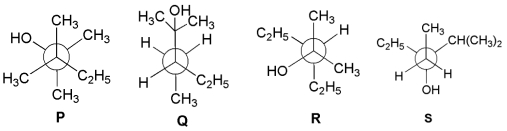
$(a)$ $Be _{2} C$
$(b)$ $CaC _{2}$
$(c)$ $Mg _{2} C _{3}$
$(d)$ $Al _{4} C _{3}$