Question
Heavy water is

Answer

Heavy water is water that contains heavy hydrogen or deuterium. Deuterium differs from the hydrogen usually found in water, protium, in that each atom of deuterium contains a proton and a neutron. Heavy water may be deuterium oxide, $D _2 O$ or it may be deuterium protium oxide,$DHO$. Heavy water occurs naturally, although it is much less common than regular water.

Need a full question paper?

Generate a complete, print-ready paper with questions like this in minutes — across 16+ boards, with answer keys.
Start Generating Free

Similar questions

The mean electric energy density between the plates of a charged capacitor is (here $q$= charge on the capacitor and $A$= area of the capacitor plate)
The forbidden energy gap is maximum in:
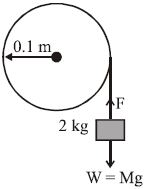
The moment of inertia of a solid flywheel about its axis is $0.1\,kg-m^2$. A tangential force of $2\,kg\,wt$. is applied round the circumference of the flyweel with the help of a string and mass arrangement as shown in the figure. If the radius of the wheel is $0.1\,m,$ find the angular acceleration of the solid fly wheel (in $rad/sec^2$)
Which of the following products is obtained by the oxidation of propionaldehyde
A tuning fork makes $256$ vibrations per second in air. When the velocity of sound is $330\, m/s$, then wavelength of the tone emitted is  ... $m$
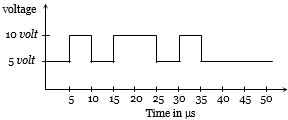
In a negative logic the following wave form corresponds to the
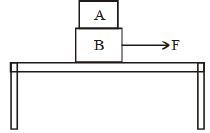
Two blocks $A$ and $B$ of masses $m_A = 1\,kg$ and $m_B = 3\,kg$ are kept on the table as shown in figure. The coefficient of friction between $A$ and $B$ is $0.2$ and between $B$ and the surface of the table is also $0.2.$ The maximum force $F$ that can be applied on $B$ horizontal, so that the block $A$ does not slide over the block $B$ is ........ $N$. [Take $g = 10\,m/s^2$ ]
A beam of light strikes a glass plate at an angle of incident $60^o $ and reflected light is completely polarised than the refractive index of the plate is
The rate of disintegration of fixed quantity of a radioactive element can be increased by
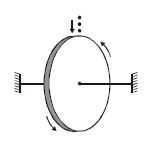
A uniform disc of mass $m_0$ rotates freely about a fixed horizontal axis passing through its centre. A thin cotton pad is fixed to its rim, which can absorb water. The mass of water dripping onto the pad per unit time is $\mu.$ After what time will the angular velocity of the disc get reduced to half its initial value ?