MCQ
Henry is the unit of :
- ASelf inductance
- BMutual inductance
- ✓Both self and mutual inductance
- DNone of these
Generate a complete, print-ready paper with questions like this in minutes — across 16+ boards, with answer keys.
 nucleus after absorbing energy decays into two α - particles and an unknown nucleus. The unknown nucleus is
|
(a) Nitrogen |
(b) Carbon |
(c) Boron |
(d) Oxygen |
A heater coil is cut into two equal parts and only one part is now used in the heater. The heat generated will now be
|
(a) One fourth |
(b) Halved |
(c) Doubled |
(d) Four times |
A person can see clearly only upto a distance of 25 cm. He wants to read a book placed at a distance of 50 cm. What kind of lens does he require for his spectacles and what must be its power
|
(a) Concave, – 1.0 D |
(b) Convex, + 1.5 D |
(c) Concave, – 2.0 D |
(d) Convex, + 2.0 D |
The ratio of speed of an electron in ground state in Bohrs first orbit of hydrogen atom to velocity of light in air is
|
(a) |
(b) |
(c) |
(d) |
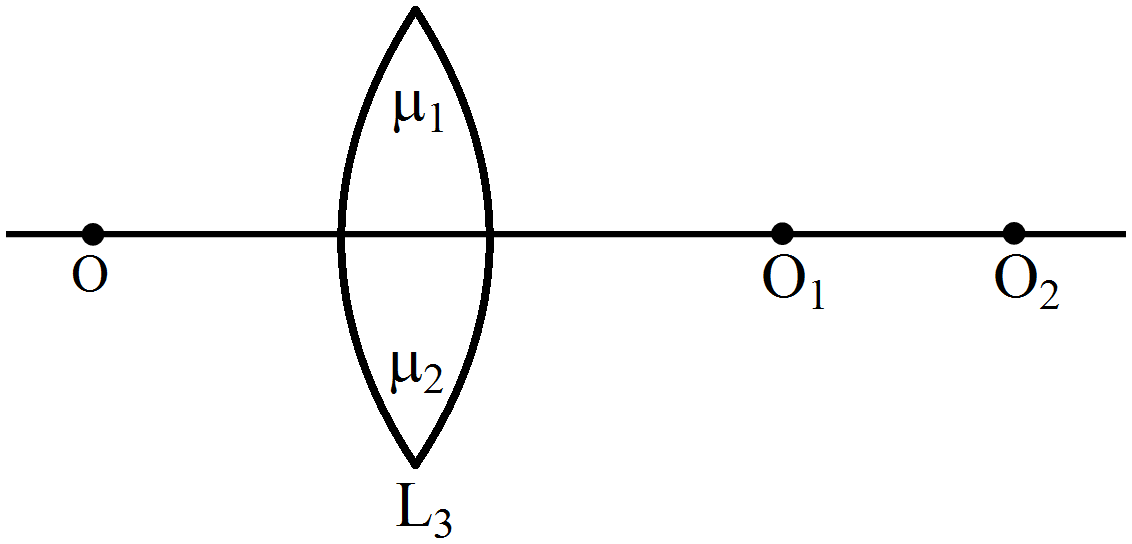
Consider three converging lenses L1, L2 and L3 having identical geometrical construction. The index of refraction of L1 and L2 are $\mu_1$ and $\mu_2$ respectively. The upper half of the lens L3 has a refractive index $\mu_1$ and the lower half has $\mu_2$. A point object O is imaged at O1 by the lens L1 and at O2 by the lens L2 placed in same position. If L3 is placed at the same place:
A proton and an alpha particle are separately projected in a region where a uniform magnetic field exists. Their initial velocities are perpendicular to direction of magnetic field. If both the particles move around magnetic field in circles of equal radii, the ratio of momentum of proton to alpha particle  is
is
|
(a) 1 |
(b) |
(c) 2 |
(d) |
For a transistor the parameter b = 99. The value of the parameter a is
|
(a) 0.9 |
(b) 0.99 |
(c) 1 |
(d) 9 |


