MCQ
$Henry/ohm$ can be expressed in
  • Second
  • B
    Coulomb
  • C
    Mho
  • D
    Metre

Answer

Correct option: A.
Second
a
(a) $\frac{L}{R}$ is a time constant of $L-R$ circuit so Henry/ohm can be expressed as second.

Need a full question paper?

Generate a complete, print-ready paper with questions like this in minutes — across 16+ boards, with answer keys.

Start Generating Free

Similar questions

The kinetic energy force on the particle continuously increases with time.
  1. The resultant force on the particle must be parallel to the velocity at all instants.
  2. The resultant force on the particle must be at an angle less than 90° all the time.
  3. Its height above the ground level must continuously decrease.
  4. The magnitude of its linear momentum is increasing continuously.
The order of the magnitude of speed of light in $SI$ unit is ........ 
The excess pressure inside a soap bubble is twice the excess pressure inside a second soap bubble. The volume of the first bubble is n times the volume of the second where n is:
  1. 4
  2. 2
  3. 1
  4. 0.125.
The value of escape velocity on a certain planet is $2 \,km/s$. Then the value of orbital speed for a satellite orbiting close to its surface is
A spherical drop of liquid splits into $1000$ identical spherical drops. If $u _{ i }$ is the surface energy of the original drop and $u_f$ is the total surface energy of the resulting drops, the (ignoring evaporation). $\frac{u_f}{u_i}=\left(\frac{10}{x}\right)$. Then value of $x$ is $......$
Two particles $A$ and $B$ start from rest and move for equal time on a straight line. Particle $A$ has an acceleration of $2\,m / s ^2$ for the first half of the total time and $4\,m / s ^2$ for the second half. The particle $B$ has acceleration $4\,m / s ^2$ for the first half and $2\,m / s ^2$ for the second half. Which particle has covered larger distance?
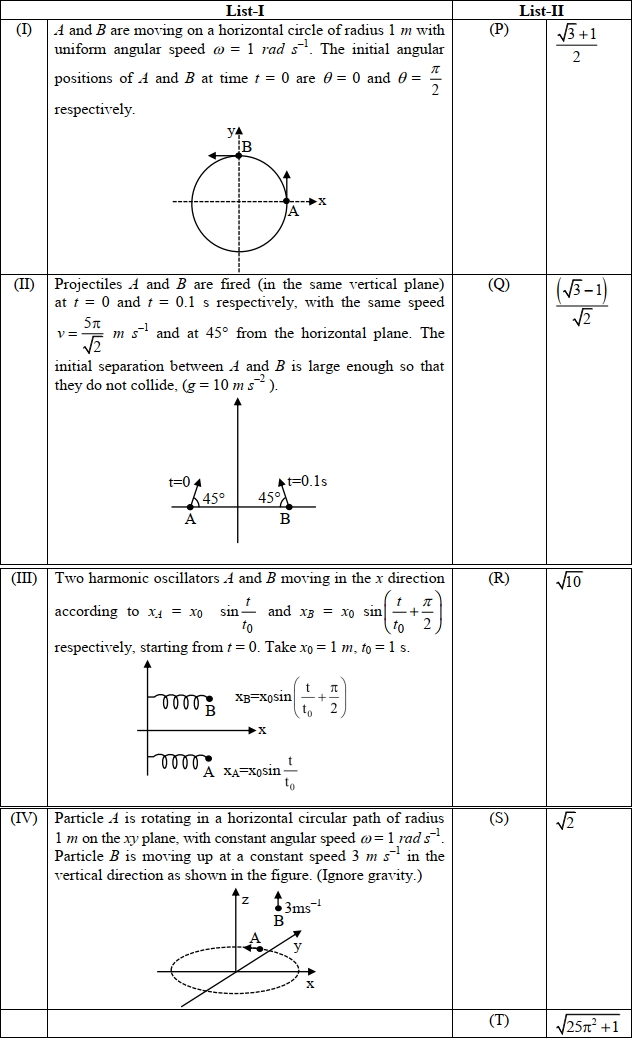
$List I$ describes four systems, each with two particles $A$ and $B$ in relative motion as shown in figure. $List II$ gives possible magnitudes of then relative velocities (in $ms ^{-1}$ ) at time $t=\frac{\pi}{3} s$.

Which one of the following options is correct?
A sound source is moving towards a stationary observer with $(1/10)$ of the speed of sound. The ratio of apparent to real frequency is .........
The translatory kinetic energy of a gas per $gm$ is
A steel wire $1.5\,m$ long and of radius $1\,mm$ is attached with a load $3\,kg$ at one end the other end of the wire is fixed it is whirled in a vertical circle with a frequency $2\,Hz$ . Find the elongation of the wire when the weight is at the lowest position $(Y = 2 \times 10^{11}\,N/m^2$ and $g = 10\,m/s^2)$